Home
Home

Before we begin, give yourself a pat on the back for owning an iPad. Feels good, amirite? Our day of reckoning has come. Sword and Sworcery EP is great, but I hesitate to call it a great “game”. It’s swo much more than that and deserves a better classification. Allow me to get academic with you a moment. It’s a great “art-thing”, yeah, let’s go with that. I feel much better now. Problem solved.
Sword and Sorcery EP is a handsome art-thing with pretty pictures and pretty sound/music. It is a wholly new experience I am a better man for having experienced. It taught me so much about life and the cosmos. I frequently boot out of the game to go on Swafari (I like to have fun with letters, too) and look up things like ‘metaphysics’, ‘cosmic design’, and ‘lunar calendar’. It makes you want to use phrases like "hauntingly beautiful".
It’s that killer platform-defining app you’re going to show off to your unconverted friends, family, and acquaintances. I frequently haunt Starbucks and Barnes and Noble for hours, crank the brightness and sound up, and play the art-thing in a spot where the screen is most visible and wait for people to ask what it is and compliment me on how cool it is. It makes me feel good when they say they don’t own an iPad.
Now, for the hard-hitting teleological and ontological questions Sword and Sworcery posits:
- If this “art-thing” is indeed an “art”, is Twitter now officially a literary art form?
- Is the App Store now a platform to be taken seriously as a serious digital purveyor of quality art-thing content for serious and discerning gamers?
- Does this mean The Angry Birds will be labeled as an “art-thing” as a result of Sword and Sorcery’s art-thing status and academic and critical/financial success?
- Will we start seeing a ripple effect where fart app and iOS beer pong game developers release updates that add culture, class, sophistication, super handsome pixel art, and “art themes” to their games, and branding models?
- Will “amirite” become a meme?
I urge you, yes you, dear reader, to send a new iPad 2© to Mr. Ebert with Sword and Sorcery installed on it. I’m totally serious. The more iPad 2s we send to Mr. Ebert, the more likely he is to play it, or rather, “experience” it. Please include a helpful walkthrough of the art-thing (We don’t want him to get stuck. He needs to beat it and absolutely not get stuck or frustrated). He must not get distracted/frightened from the art-thing narrative and experimental graphics and gameplay.
If the honorable Mr. Ebert plays this game, I’m sure he will rule in our favor. He will then eat his own words from the can of worms he opened on Twitter. That will show him to mess with us gamers! Eat those word-worms! Suck it, we’ve got art now, for real this time!
The honorable Dear Leader of art judgment.
Mr. Ebert will then tweet an apology, something like, “ I’m very sincerely sick over the stink I made about games. Bad call, y’all. This is a fine day to be alive. S:S&S EP’s art and narrative changed how I look at things!” Or, maybe one of Mr. Ebert’s Twitter friends will tweet a sorcery hashtag, and Mr. Ebert will read the wry one-liner and retweet it with a preface of “Brilliant, wild, genius! I knew I was on this Twitter thing for a reason!”
Now, for some serious and unpleasant questions pertaining to Sword and Sorcery’s artistic legitimacy:
- Does it hurt the art-thing’s chances of being art and a thematic and important serious work that you need to hold your iPad in portrait style for fights? It kind of hurts my wrists.
- If the forthcoming iPhone version is 1/5th of the iPad’s screen size, does that make the art-thing 1/5th the amount of art?
- Is it not art if you don’t own a pair of expensive headphones?
- If a known felon or sex predator tweets some dialogue from the art-thing, does that make it dark or unsavory art?
I am tormented by these questions. I feel … tired …
zZzZzZzZzZzZzZzZzZzZzZzZzZzZzZzZzZzZzZzZzZzZzZzZzZzZzZzZzZzZzZzZzZzZzZzZzZzZzZzZzZzZzZ
*****
Whoa, that was weird. I guess that was a B-Side I was experiencing. Oh well.
Let’s be clear, yes, Sword and Sworcery EP shares App Store real estate with noveltyware neighbors like Fart Generator Premium and single-mechanic, 99 cent bulk gumball games. But, for the love of god, put the platform partisanship aside and out of mind. Sword and Sorcery EP’s residence does not affect the game qualitatively whatsoever, and neither does its touch-based input, really. Moving on …
Part point-and-click and part Zelda, S: S&S EP puts the player into the role of an adventurer in a side-scrolling fantasy world with an idiosyncratic pixel aesthetic. There are puzzles, items to fetch, sonorous jams and excellent art to imbibe, the odd spot of narrow swordplay, somewhat hidden gameplay events, a small character population that supplies useful and useless dialogue, and lots of fevered poking and prodding to discover natural instruments in the arrangement of quasi-musical puzzles. And there’s a mechanic where moon phases change aspects of the game’s world, but we’ll get to that later.
When the game is at its best, it’s an infrequently meditative jaunt through a beautiful and bizarre nature preserve. It’s like examining a series of gallery paintings at a quick pace, with a lovely in-house ambient DJ. There’s some nice garnish, charming events, and the wonderful investigative gameplay of determining the order or action of integrated musical responses by fingering scenery, like playing linear waterfall streams as strings on a harp.
The latter is the game’s “song of sorcery” component, in which the player awakens forest spirits whose locations are designated by a bubble plume signpost. Once found, the player must activate a gameplay mode where touch input changes to become a mostly trial and error, fingertapping survey of the screen to find flora and fauna that emit a musical note, and oftentimes must be used with other such objects to compose a rough melody, completing the puzzle.
Acting as a wandering wizard detective, who examines the environment and plays its hidden, and not so hidden, instruments, even if clumsily, is the best gameplay boon Sword and Sorcery has to offer.
The sword combat seems like an unnecessary afterthought, with a limited purpose and frequency that could have been replaced by the wonderful sorcery mechanic, tweaked to meet the sporadic conflict. The game is much more sworcery than it is sword.
It’s a shame then that the overall game is terribly confused.
Consider yourself warned, there be spoilers ahead, but I’ll keep them a little vague and concerned mostly with the game’s dialogue and the mechanics of its moon phase gameplay system -- the two constituents of the game I feel really get in its own way. And yet, the game takes it upon itself to spoil its lunar puzzles for you anyway, so whatever.
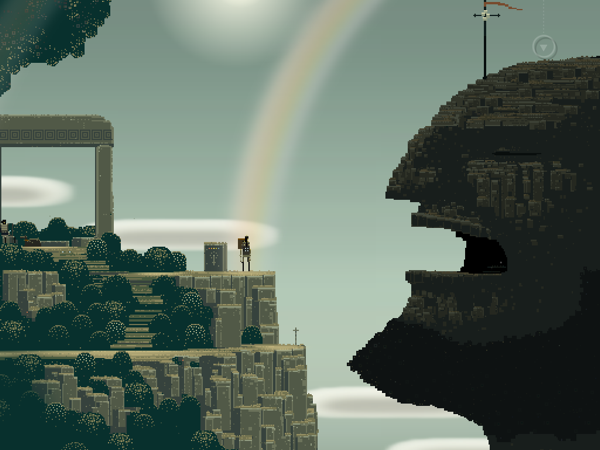
SHUT UP AND LET ME PLAY #sorcery
When not telegraphing useful information to the player, the game’s character dialogue is a distracting encumbrance that revels in its own flat and awkward meta-humor. And there’s a lot of it.
Every line of dialogue -- from NPCs to your own character’s observations after poking things -- can be tweeted. I completely ignored this functionality, so it didn’t bother me or infringe upon my experience, though I don’t think it justifies itself as a fresh, kinda sorta purposeful relay system for useful information between players.
What did infringe upon my experience was the dialogue itself. Text dialogue is necessary for providing hints, riddles, or rules concerning the song of sorcery gameplay, and the abstract and extraneous lunar puzzle mechanics. But, you need to wade through a sea of bad, jarring jokes to get there.
For example (a relatively small sampling):
You'll find this first S:S&S EP session to be fairly straightforward. It typically only requires 15 - 30 minutes to complete. #sworcery
We had bridged the chasm & we felt super smart. #sworcery
We got The Megatome & we are the smartest. #gotmegatome#sworcery
We got The Gold Trigon. We are so awesome. #sworcery
We have re-assembled The Trigon Trifecta & we are heroes. #sworcery
We spied a curious-looking nestbox with an inscription that read "Tweet & ye shall be re-tweeted". #sworcery
We got the peculiar feeling that it was maybe a time of miracles - where my miracles at? #miracles #sworcery
We were like groan, not another fetch quest, amirite? #sworcery
You woke the deathless spectre who still lurks in the darkness beneath Mingi Taw. What a creep, amirite? #sworcery
Astride a logbridge on the old road stood a grim flagpole adorned with blocky-looking skulls. #sworcery
And yet Logfella offered zero help about what to do next, which kinda rubbed us the wrong way if we're being totally honest. #sworcery
Our research data shows a high correlation between a participant's progress in S:S&S EP & their aptitude for being awesome. #sworcery
The Grizzled Boor was included in S:S&S EP to allow participants to self-identify as compassionate, reasonable people. #sworcery
Perhaps you have already heard about an impossible island under a looming Bright Moon, maybe you read about it on the internet? #sworcery
Be advised that henceforth we will be monitoring your inputs in relative silence. #sworcery
I wish the last line were true. The characters never shut the fuck up and let the game speak for itself. It’s not cute, it’s not clever, and it doesn’t feel natural given the game’s underlying tone. It’s an irritating and abrasive spew of snarky, biting, and apathetic quips from some hipster’s Twitter feed.
The majority of the game’s humor relies on how these characters are transparently tearing down the 4th wall with a sledgehammer. The joke is that these “miracles” are worthless illusions. The joke is that you’re playing a game.
These intentionally patronizing characters sound as if they were GLaDOS’s consciousness after being uploaded to Twitter, dumbed down and remade in its image. It’s not as if any attempt at humor would be unbefitting for the game, but between the settled upon writing style, manner of speech, and meandering self-aware humor, it all sounds so out of place. Every character’s a comedian, and pretty bored and stoic ones at that. Except for the dog, he’s cool.
These insipid and irreverent advisors, who poke fun at the game’s own clichés and player conditioning, only know a blunt force approach to 4th wall comedy. GLaDOS performs it in a subtle and smart way. The Companion Cube is a symbol or euphemism for ordinary and lifeless objects the player is routinely told are characters they should empathize with and care for. The baleful, macabre, and matter-of-fact testimony GLaDOS gives about the perils of test subjects past is an amusing allegory for game testing, designer scare tactics, prohibitions on unwanted player behavior, and other dimensions of behavioral psychology in game design. S:S&SEP is wincingly direct.
The Superbros. show no restraint in presenting their 4th wall peepholes. Just as you run the risk in film of alienating or distracting your audience with an actor looking directly into the barrel of a lens, acknowledging the audience and the artifice, S:S&SEP routinely chides the player and unimaginatively points at the props and facades that surround them. They’re trying too hard and too little to be funny.
Its heritage of medieval heroic folklore is at once a genre it honors and supplements through gameplay, and some throwback, thrift store vintage it wears “ironically” (nice ogre and wolf-moon profile tee, man).
The pretentiously unpretentious, painfully self-aware shtick is more damaging than simply being a hodgepodge of dead jokes, it’s a cacophony of empty intrusions that cheapen and undermine what is a good experience underneath.
These are not characters, they are out-of-game visitors, they are its writers. I felt naked, made to feel like a fool for taking the game seriously, mocked and derided for buying into its own lovingly crafted illusions and landscape. The world feels invaded and unreal, because writers taken with their own lifeless material are lurking behind almost every screen edge, far more sinister and unwelcome than a Grizzled Boor, three-eyed wolves, and the Gogolithic Mass all sewn into one.
LinkLinkage: I was all like groan, not this angry ginger again, amirite? #buzzkill #boredom
It really reads as if the game is making fun of itself and only half-heartedly believes in its own interactive vision. There are two halves that comprise this bipolar design philosophy. There’s the half I like, the game itself, the sweet one, the one that’s easy on the eyes and charming, the one that makes good conversation, and sure it makes some missteps, but I forgive it. Then there’s the dark half, the dialogue, the one who speaks loudly saying nothing when it feels insecure, the one who talks during movies and spoils every beat, the one who likes the sound of its own voice.
Many times it felt like I was on an ill-fated camping trip with some blabbering douche who provided commentary on how post-modern toasting marshmallows is, and how subsistence hunting is played out.
Even if the game’s dialogue can be so construed as a high concept commentary on the modern gaming populace, it was a thorny, omnipresent obstacle standing in the way of my appreciating the interactive rewards.
Also, for a game that’s selling itself as some ruminative journey of discovery and experiential exploration, the dialogue leaves little room for the imagination, which leads me to the virtually non-existent moon phase gameplay.