Home
Home

Editor's note: Many things make Demon's Souls special. I'm a big fan of its oppressive mood -- I feel the world's weight on my shoulders as I play. Rob points out how your actions, not a bunch of cheesy cut-scenes or hackneyed dialogue, tell the story. Do you appreciate this approach to storytelling? -Jason
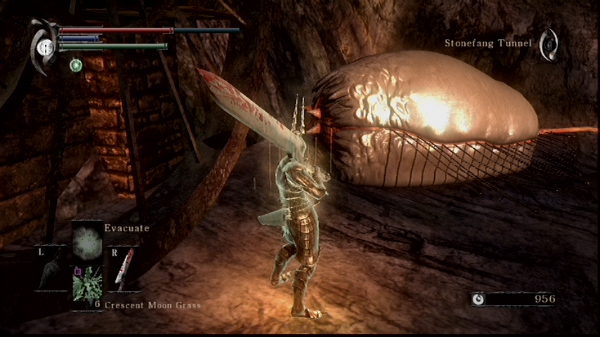
The land's shrouded in blackness. Enemies are more resilient than ever, and new, more powerful foes lurk in dark corners. After much patience and caution, I'm set to meet my prize -- a primeval demon.
I've been searching for colorless demon's souls. Each playthrough has only 10 such souls. These souls are unique as they are the only upgrades available for rare items. You may apply up to five colorless souls to each item, which means that you may fully upgrade only two items per playthrough.
The game has just a few ways to obtain these elusive souls, and my journey to obtain all 10 in one playthrough has revealed another unique aspect of Demon's Souls -- it uses gameplay to tell a specific story.
In the beginning of the game, I talked to the Crestfallen Warrior, a blue soul trapped in the Nexus. He's trapped because he lost his will to collect more souls. His predicament is meant to impart knowledge of one key component of survival in Boletaria -- I need to travel outside of the Nexus and collect souls, least my own soul slowly fade away.
As I journey onward, the Crestfallen Warrior's dialogue foreshadows my coming accomplishments -- he begins to comment on my regained body and on the demon's souls that I've acquired. He warns that my collecting of these souls will cause me to fall into the same trap as Allant.
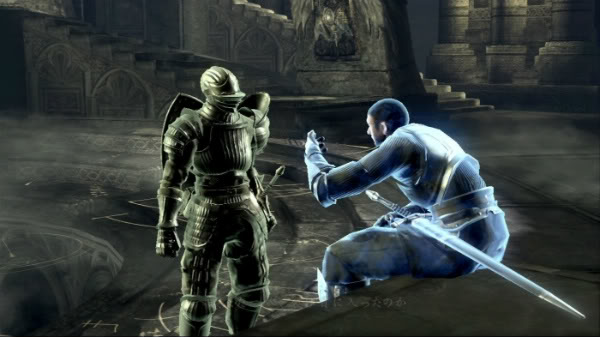
The Crestfallen Warrior.
The Crestfallen Warrior is, of course, referring to King Allant of Boletaria. In an effort to bring untold prosperity to his kingdom, Allant dabbled in the soul arts. His meddling awakened the Old One, an irrevocable poison strewn across the land with intentions to devour the souls of humankind.
In essence, Demon's Souls sets up a reward system that specifically encourages the player to mold his character to reflect the plot developing behind the scenes. This became most evident to me through the hunt for colorless souls.
As I said, only a few ways to find these souls exist. The first one is easy and in plain sight, provided that you can bring the world's tendency to either pure white or pure black. The next two are even easier than the first -- all the player needs to do is trade the right items for the souls.
The bulk of these souls are held by primeval demons; one is located in each of the five worlds connected to the Nexus. In order to bring the primeval demons out of hiding, I must descend each world's tendency into pure blackness.
These account for eight of the 10 -- the final two souls require the player to shift further toward blackness. They can be obtained through assassination quests, and the only way to be offered the quests is to shift your character's tendency to pure black. How does one do so? By murdering characters in the game.
The game doesn't just encourage players to shift black through colorless souls but also through world tendency events. Some pathways or characters are only ever available when a particular world is pure white or pure black. The game has a limited number of ways to shift a world pure white -- but limitless methods to shift worlds black.
Worlds shift white when the player scourges the land of demons, specifically the major and chief demons of each realm. Once these demons are slain, there are few other noticeably effective ways to shift a world white. NPC black phantoms and primeval demons are the other major ways to shift a world white, but those methods are only available once a world is pure black, and their effect can only be felt once.
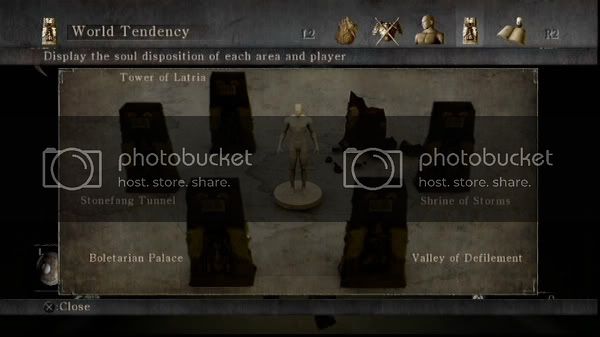
Pure black world tendency.
Shifting black, on the other hand, is really easy. All the player needs to do is perish while in body form. Any death -- suicide, death from the environment, death from an invading black phantom -- is enough to shift a world toward black. This method is effectively without limit, because a player always has the option to die.
To get the most out of Demon's Souls in one run -- to get all the items, as many upgrades as possible, experience all tendency events -- players must work toward making Boletaria a harsher place. In doing so, the player has fallen into the same trap as Allant by furthering the goals of the Old One.
At the end of the game, the Old One opens an invitation to his realm. He has chosen you to become his next demon. Everything you have achieved in the game, from killing demons to murdering fellow characters, has brought you to this point. He even offers the player one final chance to join him in his quest to consume the Earth in the deep, colorless fog.
The narrative is the story of your descent into darkness. You fall for the allure of power by killing demons to increase your soul level. By the end, you're murdering friendly humans who are unlucky enough to still be alive.
I should mention that players do have the option to lull the Old One back to sleep, saving Boletaria from darkness. But such action immediately returns the player to the Nexus for the next playthrough.
At the end of the second run, players are again encouraged to join the Old One rather than return him to eternal slumber -- the reward for joining is more than threefold the reward for setting the world straight.
Demon's Souls does not impart this narrative through cut-scenes or dialogue choices. It doesn't have a morality or karma system. To completely experience the game, players are encouraged to become demons themselves. By taking advantage of specific game mechanics encouraged by the game itself, player actions further the story of Demon's Souls.