L.A. Noire's attachment to game tropes sabotages its innovation

Christian_profile_pic
Friday, June 03, 2011
EDITOR'S NOTEfrom Rob Savillo

I haven't played L.A. Noire, but Rockstar's insistance on structuring their releases in particularly artificial ways has burned me before (see: Red Dead Redemption). I'm disappointed, then, that Christian's assessment highlights similar faults in the latest from the company.

This article contains minor plot spoilers for L.A. Noire.


L.A. Noire is bullshit.

OK, I’m being a bit hyperbolic -- let me back that up: L.A. Noire is an incredible story/feeling/theme/experience/thing designed around the tropes of the “video game” as a medium. And that's a bad thing.
LA Noire Notebook

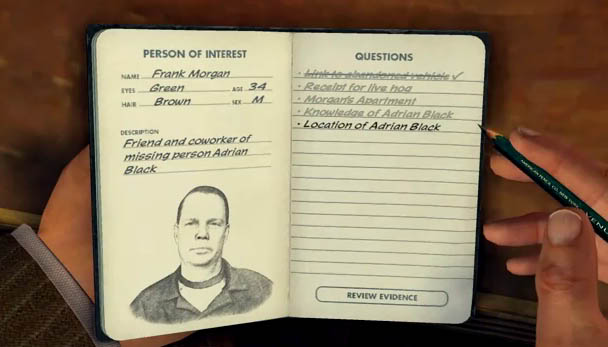
I’m wrapping up the second homicide case. My excruciating attention to detail has paid off, and I have a stack of evidence a mile high. There’s only one problem: All of this evidence points equally at two different suspects. Neither suspect has an alibi, both have histories of violence, and both are liars...despite impeccable police work, I’m stuck.

There’s one more piece of evidence I’m waiting on: a blood test. But the results never come.

I should investigate the work places of both suspects to match their respective uniforms to one found at the crime scene. But I can’t do that, either. I have the captain breathing down my neck, and I need to charge one of them. Being the good detective that I am, I go with the one for whom I have the most concrete evidence against.


And I’m wrong. My captain puts me in my place, and I miss out on that coveted five-star rating for solving the case.

So after all of that extensive police work, doing everything the game told me to do...the case comes down to a wild guess. That’s it. And even though I made the guess that anyone would make -- the one with the most evidence -- I’m wrong?

Bullshit.

Investigating the apartment of a couple of overdosed junkies, I find something curious: a numbered slip, like a betting stub or a lottery ticket or something. At a nearby restaurant frequented by the victims, I find a stack of the things. Now, I’m no expert on gambling in 1947, but I’ve watched enough T.V. to know a gambling racket when I see one.

“Tell us about the numbers,” I...er...“politely” inquire.

“Man, the numbers are the white man’s tax on poor folk!”

...What the hell does that mean?! How do my options of “Truth," "Doubt," or "Lie” apply to that response at all? How does that response apply to my question? Where is my, “You didn’t answer the question, like, at all” button?

Bullshit.
LA Noire Interview

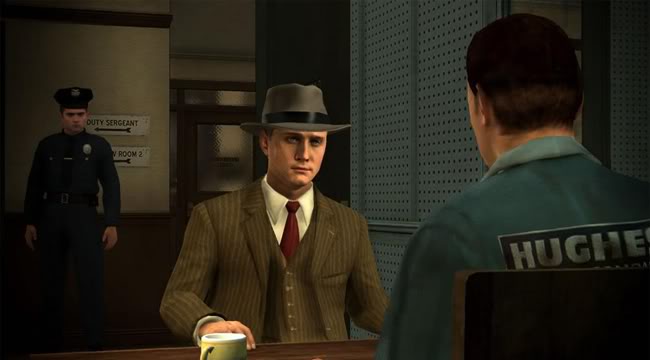
I’m questioning a real-estate tycoon about his company’s promotional flyers found, coincidentally, near the site of every crime scene in a string of arsons.

“My company runs many promotions. I’m not familiar with that one.”

OK. I know he’s lying, but I can’t prove anything. I don’t have any evidence that he has personal knowledge in this specific promotional run by his huge company. I choose “Doubt,” since my gut tells me he’s lying, but I can’t prove it

Nope. Wrong. The correct choice was “Lie” and the so-called “evidence” was a flyer with his picture on it -- the exact same picture that’s plastered on all of this company’s promotions from billboards and posters to, apparently, contest flyers. Now can you say, “circumstantial"?

Bullshit.

Now in L.A. Noire’s final few missions, rarely does a moment pass that doesn’t go like one of the above. In the first example, I see the game punishing me for playing it well -- for playing as an investigator -- instead of playing it the way they wrote it. Awesome.

The second example is just a case of bad dialogue; the words are fine, but the line doesn’t play to the mechanic. The questioning/decision-making mechanic of the game is built around information, so they give me a line that contains no information at all. Great.

The final example gets under my skin more than anything. An ambiguous line of dialogue, bad detective work as the “right” answer, a lack of adequate information to make an informed call (choosing “Lie” as the correct answer leads the man to provide information that -- while vital -- does not pertain to the question) -- this one just has it all.

I couldn’t dismiss any of this as “bad design” without digging deeper. Ultimately, after a lot of beard-stroking and head-scratching, I found a place to squarely lay all of the blame: the game’s feedback.

I’m talking about the special, crime-scene music that only stops once you’ve found every clue; the chime that occurs when you sniff out an object (pixel hunting, anyone?); the constant tutorial reminders; the right/wrong checklist for interview questions; the experience points; and the rating at the end of each case.

Played well, with all of its handicaps, L.A. Noire isn’t a difficult game. Be thorough, pay attention -- you’ll do fine. The way I see it, backed into this corner as an effort to make their game more “accessible,” Team Bondi had only one way to ratchet up the difficulty: ambiguity.

So dialogue becomes intentionally misleading, “evidence” becomes more circumstantial, patterns that the game taught you to recognize get cast aside, and the story takes more and more of the spotlight away from gameplay. Increasingly, the player is shown more about what’s going on than Cole ever is. In order to play the game “right,” I have to deliberately dumb myself down to remember what Cole knows versus what I know.

Team Bondi and Rockstar went so far to make this new, innovative thing, and then backed off in the most rudimentary places and fell back on the most unnecessary qualities of the “video game” in order to...do what, exactly? Without ratings, without experience, without “gamey” feedback, I’d be allowed to just play and enjoy. I can’t figure out what place all of the stat tracking, feedback, and role-playing game elements have in L.A. Noire other than as “video-game stuff.”

And the game is worse for it.

 
Problem? Report this post
BITMOB'S SPONSOR
Adsense-placeholder
Comments (28)
Default_picture
June 02, 2011

SPOILER ALERT.

Regarding the second case, the evidence doesn't implicate either suspect--the real killer is still at large. As a player and detective, you sense the case hasn't been closed properly. The game conveys this "gut feeling" perfectly.

L.A. Confidential has a similar plot thread, where the lead protagonist, Ed Exley, endeavors to solve the Night Owl case after it's been closed.

Christian_profile_pic
June 02, 2011

Well, yes, but in the vacuum of that scenario, the evidence points to both men. Not knowing that there's a killer still at large, the bulk of your evidence implicates Hugo Moller -- the "wrong" choice.

But my point was simply that there is no "right" answer, hence the arbitrarity of the rating system.

Default_picture
June 02, 2011

Evidence points at both men, more so at Moller, but something doesn't feel right. There's not sufficient evidence to indict either one of them. And that's my point. You don't know the identity of the real killer, but your gut tells you that something is amiss. In the vacuum of that scenario, the "guilty" party is who the Captain decides it is. And it's made clear that he's wrong.

If each case was an end unto itself, and didn't connect to an overarching plot, I'd agree with you.

Christian_profile_pic
June 02, 2011

You do everything that the game demands of you, then your decision comes down to a blind guess. When you make the proper one -- the one with more evidence to support it -- you're punished. You're not punished by the story -- the captain yelling at you -- you're punished by the rating you get. You're punished by the fact that the game considers one option "right" when neither is. You're rewarded for playing the game wrong, because you're playing the story right.

As a detective, you're supposed to make a case and support it with evidence. When you do that, you're punished. The game says, "Fuck you and play it the way we wrote it!" Your agency is made irrelevent, and any choice or interactivity is secondary to the plot.

What I'm saying is: fine, that's fine, but don't implement a reward/punishment, choice/consequence feedback loop if you're taking my decision-making away.

EDIT: I think you're missing the point of this article, latching onto one small premise. This isn't about the story; it's about the rudimentary mechanics woven into it -- the right/wrong checklist during interviews, the star rating, the reward structure, the escalation of difficulty....

EDIT: Although in that example, the case is also just not complete. There's a lot more work to do and those guy's have only been locked up for a couple of hours. A game built entirely around information-gathering forces you into a guess.

Christian_profile_pic
June 02, 2011

The story is great but the game sucks.

Default_picture
June 02, 2011

I would argue that it pulls a narrative trick that few games have attempted. Your CO brings his own preconceptions and biases to the case (like his assumption that communists and "fifth columnists" are innately culpable), and he's the one who really decides the guilty party. You're subsequently awarded for agreeing with your boss. Is not real life similar?

When you realize that "failing" a case is nearly impossible, you come to the conclusion that points and ratings mean little. But the game tricks you into believing they're significant (like the false sense of accomplishment for "solving" each case).

I'd equate this plot device with an unreliable narrator. In this case, you've got unreliable colleagues and an imperfect boss.

Christian_profile_pic
June 02, 2011

"But the game tricks you into believing they're significant"

Exactly. That's the whole point of this article. It seems we agree. :P

Default_picture
June 02, 2011

Well, I suppose we're skirting closer to what David Cage described as "interactive entertainment." It's nearly impossible to "lose" at L.A. Noire unless you give up. The shooting sequences aren't too difficult and you always catch a fleeing suspect if you keep running. So the fact that I allegedly "failed" didn't bother me, irrespective of ratings, points, or trophies, because the story justified it. Heavy Rain is very similar.

If Heavy Rain and L.A. Noire were proper "games", there'd be more opportunities to "lose."
I'll say this, though--despite the murkiness of suspects' eventual guilt, the interrogations seemed fair to me. Often, their facial expressions give them away. In most cases, if they stare straight at you, without shifting their glance, it indicates "truth". If they seem shifty-eyed or overly-nervous, they're probably hiding something or outright lying. Naturally, you use accumulated evidence to contradict a lie. I didn’t feel this game mechanic was unfair or manipulative in any way.

Christian_profile_pic
June 02, 2011

The main distinction that I would make with Heavy Rain is that HR game never tells you that you're "wrong." This issue with LANoire It isn't about losing; it's about being "wrong." Heavy Rain has no reward structure, no feedback loop; it just drops all of its mechanical video game tropes in favor of telling a story. L.A. Noire sort of does the same thing, except it tells you otherwise, as bluntly as it can, as often as it can. The game doesn't want you to accurately piece puzzles together, to gather concrete evidence, to support your argument logically...it wants you to be Cole Phelps. Again, which would be admirably if the game wasn't constantly pulling you in two different directions regarding how you're "supposed" to play it.

Interrogations seemed fair to me in the early game, when evidence was evidence and dialogue contained actual information. Then they perverted those core mechanics in an effort to raise the stakes, and in doing so they undermined their own game. Cole's responses begin to have less and less to do with the actual question, as do the responses of those being interrogated. More and more, calling someone out on a lie has less to do with actually accusing them of lying -- and being able to prove it -- and more to do with getting them to reveal a new piece of information that is, again, unrelated to the original question. "Evidence" becomes more and more ambiguous, but the game doesn't adapt for this -- you're still expected to treat the slightest little superficial glimmers of "proof" as being concrete, something to build a case on. If this is an example of Cole's police work becoming sloppier, then fine, but don't tie a reward-based consequence structure to it if I don't really have any agency. 

Follow Heavy Rain's lead. If you're not interested in making gameplay, then don't make gameplay. Let me do my pixel-hunting and my dialogue trees and let it be; don't tell me that I'm "wrong" or "right" or "good" or "bad."

The game doesn't present you with scenarios of success or failure. The game gives you multiple ways to fail, and you choose the "right" one. It's not about solving a case, it's about figuring out the "right" way for Cole to fuck things up. I feel like I'm filling in a Mad Libs, trying to puzzle out the "canon" version of story, rather than problem-solving.

Default_picture
June 02, 2011

Heavy Rain isn't a police procedural, nor does it aspire to be. In L.A. Noire, Cole works with the available evidence (which happens to be misleading). The game rewards you based on your ability to work within that controlled structure (not solve the case, which happens regardless).  I don't remember many instances where the game was unfair and arbitrarily assigned guilt (in that controlled environment).

It’s also a good idea to pay attention to the Captain, and note his prejudices. In an existential sort of way, the rewards structure is administered by your superiors. It’s clear that Captain Donnelly hates communists, so if you accuse a “red” or “fifth columnist”, you’ll usually reap the dividends.  At one point, I recall the Captain congratulating you for putting away “Another Red.” The game awards you for paying attention.

Yes, Heavy Rain excises all traditional gaming mechanics, but based on your definition, it's possible to "fail" or "succeed" numerous times--trophies, plot threads, whether a character lives or dies. How many people earned the "pride saved" trophy, and how many allowed Madison to strip down? :)

Late in the game, I found myself screaming "bullshit" at suspects' lies, because I was keenly aware that a particular piece of evidence contradicted them. I'm not sure which cases you're referring to, but the evidence didn't seem very ambiguous to me. Even if a suspect is innocent, there's normally rock-solid evidence to contradict his lies. If anything, Team Bondi was overly-generous with how blatant they made some of the contradictions.

The QTE nature of Heavy Rain makes it possible to cleanly sever all gaming tropes (including traditional "success" and "failure" award structures). This wouldn't have worked with L.A. Noire, because you're in control most of the time. If there was no feedback whatsoever, it'd get boring, and quickly.

If "rewards based consequence structures" are to be tied solely to player agency, should we not also remove trophies and scoring systems from all linear titles where the only possible "failure" is death? That’s not really “failure”, is it? That’s more like going off-script (and being dragged back in). True “failure” is permanent. If an action game dictates that the hero proceeds through the level unmolested, why do we reward success? It's literally impossible to fail if "failure" is met with a game-over screen and a do-over. If the only permanent outcome is success, why should we reward it? Based on this logic, the only game that should reward "success" is Heavy Rain.

Christian_profile_pic
June 02, 2011

"...but based on your definition, it's possible to "fail" or "succeed" numerous times--trophies, plot threads, whether a character lives or dies. How many people earned the "pride saved" trophy, and how many allowed Madison to strip down?"

I don't see how that's based on "my" definition -- trophies are superfluous, not a part of the actual game; whether a character lives or dies is simply a part of the story, the game doesn't give you clothes or intuition points for "not dying"; you don't recieve a rating for making the choices that you made.

"I'm not sure which cases you're referring to, but the evidence didn't seem very ambiguous to me."

Off the top of my head... SPOILERS

-The aforementioned example of flyer. Hell, even when you select it, Monroe says, "That doesn't prove anything." Yeah, no shit, that's why I didn't see it as evidence of anything. Again, finding the "right" way for Cole to screw up.

-One of Sheldon's/Cole's friends' line: "Tell Sheldon...it was a good try..." being "evidence" that Sheldon stole the morphine.

-I forget his name, but when you're questioning your (former) boss as Kelso, using his shares in the Redevelopment Fund as evidence of fraud -- in fact, they aren't, as when you select them, the subject of the dialogue changes to a new topic.

-One of the arson suspects -- Ryan, i think -- the the anarchist flyers as "evidence" that he burned down a house, even though you know at this point that someone working for the Redevelopment fund burned down the house... why would an anarchist be working for a giant corporation?

"It’s also a good idea to pay attention to the Captain, and note his prejudices."

Again, fine, awesome -- I think it's great that they're weaving subtleties like that into the story. But again, it's an example of the game rewarding you not for playing well -- for finding evidence and building a case -- but for playing to the story. Yet again, let the captain dress me down or praise me for my decision -- don't break the fourth wall to tell me I was "wrong" when I clearly wasn't.

" This wouldn't have worked with L.A. Noire, because you're in control most of the time. If there was no feedback whatsoever, it'd get boring, and quickly."

I disagree; LA Noire is a standard adventure game. There's nothing incredible happening, here, outside of the tech; it's pixel hunting and dialogue trees. In most adventure games, your reward for solving something is progress. If LA Noire is going to tell its story regardless of your successes, then that's fine -- it doesn't need the reward structure. The game understands this in its early levels, when missing a piece of evidence or conducting a poor interview  leads to the case becoming harder, more convoluted.

I'll articulate my point better (and this addresses your last point, too): the feedback loop should develop through the gameplay, through the narrative, not through breaking the fourth wall to plainly tell you when you picked the wrong binary choice. See: The Witcher -- actions have consequences, story progresses regardless, but there is no "good," no "right" -- just actions and consequences, communicated through the plot. Any material rewards (XP, loot, whathaveyou) are tangential, and the ones that you don't get are invisible; the game doesn't pop up a dialogue box to tell you, "if you had picked this other choice, you would have gotten a better thing." The game trusts you to make choices, accept the consequences, and enjoy the ride; LA Noire doesn't.

I agree with your point about fail states. I don't see how L.A. Noire addresses that as an issue. So you can fail and the story keeps going... so what? There are no consequences for failure other than that rating at the end, that suit you just *almost* unlocked -- none of that matters, and yet the game insists otherwise.

Christian_profile_pic
June 02, 2011

Also, this is minor, but it goes back to my point about L.A. Noire contradicting its sense of agency, wanting the player to play it the way they wrote it: at least half the time, I found that I worked a case "out of order." I'd have Cole and other characters referencing events, people, or things that hadn't appeared yet. The game would give me a choice of left or right, but when I chose the "wrong" one, it broke. Again, I have to ask: why not just send me to the place I was supposed to go? Clearly, they wanted me to go right, not left, and yet because of (what I percieve to be) a beholden sense to what makes the "video game," they felt the need to give me that choice in their barren open world. And because of this archaic sense of what makes a game a game, L.A. Noire is lesser for it.

Christian_profile_pic
June 02, 2011

Although I did just beat it and -- hot damn! -- maybe we can agree that that was one of best, most exciting, most resonating final acts in gaming?

Default_picture
June 03, 2011

I'll agree to that.

Robsavillo
June 03, 2011

Tom Chick has a very similar opinion of L.A. Noire, too. I'm just about ready to write off Rockstar completely.

Christian_profile_pic
June 03, 2011

Out of curiosity, Rob, what were your issues with Red Dead?

Robsavillo
June 03, 2011

Red Dead is a boring collection of minigames loosely strung together by a linear narrative tied to Rockstar's unimaginative mission structure. I'm tired of seeing a "game over" screen with failure, which requires me to jump through the same hoops again and again. Why can't I just continue playing if I fail a mission? Oh yeah, because of Rockstar's ahderence to the same type of game tropes you criticize in L.A. Noire.

Further, everything interesting about Red Dead (fame, honor, treasure hunting, clearing out gangs, etc.) is undermined by the game world's ambivalence toward your actions. I'm at a point where I can murder people in broad daylight and suffer no lasting consequences (not even an honor hit!).

It's just no longer interesting to play, and the narrative meanders about without direction.

Default_picture
June 03, 2011

I found the landscape of Red Dead boring as shit, and the character of John Marsden uninteresting. The central premise seemed like a cop-out—government forces Marsden to come out of “retirement,” giving Rockstar a convenient excuse to include senseless mayhem. The narrative never hooked me.

I've made the same observations about "game over" screens, interactivity, and fail states. There're few instances in L.A. Noire where "failure" portends a do-over--gunfights (which are seldom), chases, and doing wacky things like mucking up a crime scene. Usually, the game will adapt to your input, be it “success” or “failure”. It's not as highly-evolved as Heavy Rain, where there's literally no game-over, but its close.

Default_picture
June 03, 2011

I'll say this, Rob. As Rus points out, if you play L.A. Noire with the same mentality that you'd approach GTA or Red Dead, you'll be disappointed. It's a radically different experience. I don't think Rockstar has ever done a game like this (even if they were only the publisher). Equating a police procedural (Noire) with an open-world Western (Red Dead) is comparing apples to oranges. I think you'd be pleasantly surprised with Noire.

Even Christian seems to have belatedly come around :-) Btw, congrats on the promotion, Christian!

Christian_profile_pic
June 03, 2011

That's true, but that's also the problem: Rockstar/Bondi still shoehorn that stuff into the game, unnecessarily. Yes, you can ignore it, but that you have to ignore a big chunk of the game in order to enjoy it properly is a problem. That said, the story is fantastic, and worth cutting through all of that fat.

Thank you! :)

Mikeminotti-biopic
June 03, 2011

That second homicide case also bugged me a whole ton.

02-the-arcade-fire-rebellion-lies1
June 04, 2011

I think I see your point. I'd be quite curious to see this game operating without any of its game mechanics. I personally don't have a problem with the curve balls that this game seems to throw your way at times (such as accusing the wrong person). This only adds to the real-world notion that shit doesn't always work out how it should. Cole shouldn't be seen as some hero that cleans up Hollywoodland (even if the game tries to do otherwise). Sure, I feel like an ass when I "fail" a case, but I learned to embrace that feeling pretty quickly and improve on the next case. Having my boss make me feel like an idiot is a pretty thrilling experience!

Thoughtful piece of work here, sir. 

Default_picture
June 04, 2011

You get a bad score for charging Hugo Moller because the captain is the one dolling out the stars.  He wanted you to charge the pervert, not Moller.  The game wasn't punishing you, because the stars aren't objective scores bestowed upon you by the Gaming Gods, but your (Cole Phelps') in-game superior.  It was the captain.  He was punishing you.

Also, when you talk about the flyer during the arson case with Walter Bishop, in real life he better know about the promotion his face is involved with.  He would have had to sign off on the company using his likeness in the first place, so it's perfectly reasonable for a detective to assume Walter Bishop would at least be aware of the flyer.

Christian_profile_pic
June 04, 2011

"so it's perfectly reasonable for a detective to assume Walter Bishop would at least be aware of the flyer."

The fact that you had to use the word "assume" at all contradicts your point: evidence is supposed to be proof, something you don't have to "assume" or infer a connection to (this is what makes the so-called evidence circumstantial). Again, the game tells you this when Monroe replies, "That doesn't prove anything" and shuts you down. The only reason "Lie" is correct is because he then goes on a tangent about the chief of police and mayor being involved with the Suburban Redevelopment Fund.

"He would have had to sign off on the company using his likeness in the first place..."

Assuming this is even true, then that signed document is the evidence that you would need for "Lie" to be the proper answer. That's proof. Anything short of that is, as you put it, an assumption on Cole's part -- "Doubt."

Default_picture
June 04, 2011

This was my point. The points are closely aligned with the storyline. The Captain is the ultimate arbiter. Thus, the highly-subjective scoring system was part of the experience, inasmuch as it reflected the judgment of your CO.

Christian_profile_pic
June 04, 2011

So how do experience points, direct binary feedback, unlockables, and comprehensive stats reflect the judgement of your CO? Assuming the case ratings are subjective and tory-related, they're contradicted by the other rating/feedback systems that contribute to the case ratings, but are just arbitrary. My CO isn't there to tell me that I got a question wrong, that I haven't found every clue, that one clue is more important than another, but all of that contrbutes to the case rating objectively. All of my proper police work building a case AGAINST Hugo Moller contributes directly and objectively to my rating until I actually charge him. Then, and only then, does the story take over to penalize me.

SPOILER

And that's to say nothing of the fact that you still recieve ratings as Kelso, despite having no CO or superior of any kind to pass judgement on your work.

Default_picture
June 04, 2011

Again, it all goes back to the Captain, who is the one doling out the stars and citations. He's obviously a very religious man (not to mention someone with high morals), so naturally he'd despise a child molester. The evidence could implicate either suspect, but based on the Captain's preconceptions, it's clear you ought to charge Rooney.

Since it and L.A. Noire have so much in common, consider L.A. Confidential: Ed Exley gets the Medal of Valor for killing what turn out to be the wrong culprits, and subsequently closing the Night Owl case. He gets awards and adulation for killing the wrong guys. It's the same with Phelps.

SPOILER
With Kelso, I suppose Team Bondi simply didn't want to change it up near the end. And Kelso most certainly does have a superior until he turns against him.

Default_picture
June 04, 2011

Were I a detective in that time period, I would have said "Lie" and shown the flyer with his face on it.  Saying it's circumstantial is the rebuttal of a suave man good at worming out of questioning, and wanting to shut you down.  You forget that everything you say as Phelps is an attempt to coax the witness/suspect into giving you more information, or confessing.

If your choices are "I think you knew," (doubt), and "You had to know, since your face is all over the marketing campaign!" (lie), I'd go with lie every time.

Also, does Phelps have the documentation on him?  No.  But he has the flyer.  And no, he wouldn't go looking for the documentation stating Walter Bishop knew about the flyers, for many reasons.  The captain said no, and it would only prove knowledge of the contest, not who was being called and given the prize.

I don't think L.A. Noire is perfect in any way (besides capturing the feel of being a detective), but neither do I think these gripes are worth fussing over.

I played without any of the musical clues, btw.  It feels less gamey that way.

You must log in to post a comment. Please register if you do not have an account yet.