Majora's Mask: Personalities at the end of the world

Default_picture
Monday, January 30, 2012
EDITOR'S NOTEfrom Layton Shumway

I'm ashamed to say I still haven't played Majora's Mask. Matt's description of the game's surprisingly deep narrative has convinced me to change that.
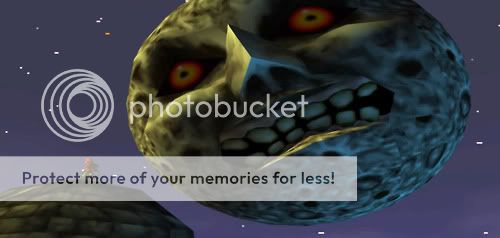
The Legend of Zelda: Majora's Mask

This article contains spoilers for The Legend of Zelda: Majora’s Mask.

As Link, you’ve helped Romani Ranch owner Cremia and her energetic little sister Romani through some tough times in the last three days. Looking up in the sky, though, it’s clear to Cremia that she has bigger issues to worry about.

On the eve of the Carnival of Time, the two are milking the cows when Romani informs Link that she finally gets to enjoy the ranch’s signature drink, Chateau Romani.

“Until now, my sister always said, ‘Wait until you're an adult.’ But why now?” Romani asks.

“You've become an adult now, Romani,” Cremia says. “I see it in you. I'm acknowledging it.”

As they finish their work, the siblings head outside, Cremia bidding farewell to Link: “Good night...see you...tomorrow...OK?”

Cremia knows she won’t see you tomorrow, but she stays strong in order to comfort her little sister as the only world they know heads for oblivion overnight.

These little moments define the dark, underrated narrative of 2000’s The Legend of Zelda: Majora’s Mask.


The people you meet during the last three days of their lives bring an incredible normality to what’s usually characterized as an odd entry in the Zelda franchise. Majora’s Mask surrounds itself with some especially alien material (literally), but at its heart, it depicts a very human story and convincing world.

Modern game developers should take note of what Majora’s Mask achieves with its setting and three-day cycle. Post-apocalyptic adventures litter store shelves (Fallout 3, Borderlands, Left 4 Dead), and if a character such as Commander Shepard in Mass Effect is trying to prevent the end of days, they’re pegged as kooky conspiracy theorists.

In Majora’s Mask, the end of the world is a visual entity that hangs in the sky, looming larger and larger every second. People are obviously skeptical of the ominous moon, but by the end of the third day, Clock Town is nearly abandoned. The surreal atmosphere during the final night is something I personally haven’t experienced in any other game. The land of Termina reflects the strange aura felt during events such as the Cuban Missile Crisis and the Y2K scare.

During that final night, curious stories abound: the Postman who is torn between leaving and sticking to his precise daily schedule; the angry, non-believing foreman who defiantly begs for the moon to drop; the guards who want to flee but have been ordered to stay and police the town; the kids who run around blissfully unaware that their lives are about to be cut short; and the egotistical Sword Master who, in the span of two hours, stops boasting about cutting the moon in half and starts cowering in the back room of his dojo, screaming, “I don’t want to die!”

These encounters drastically alter and shape Link’s values throughout his quest in Termina. As you enter Clock Town with the form of a Deku Scrub, your ultimate desire is revenge against Skull Kid. Not only did the little punk steal your horse, your Ocarina of Time, and curse you to the body of a Deku Scrub, he also taunts you at every turn.

When Deku Link confronts Skull Kid, he realizes the gravity of the situation as the moon hovers closely above the masked child. Fortunately, Link has the power of time by his side, and he prevents mass destruction by mere seconds. With great power comes great responsibility (yawn), so with the future of Termina in his hands, Link’s new driving force is to stop Majora’s Mask from pulling down the moon.

However, the only way to achieve that goal is with the help of the citizens of Termina. With a notebook in hand, you involve yourself in their lives, and, with good intentions, use them to progress your adventure. You learn their schedules, their personalities, and their aspirations.

Changing how a character spends their final moments is gratifying. Reuniting troubled couple Anju and Kafei and watching them spend their last minute of life together is a wonderful ending to the game’s most extensive sidequest. Erasing the moment seconds later is heartbreaking.

By the end of your journey, your final goal is far more dynamic than simply saving Termina; it’s about giving these people the chance to actually live out the events you helped make happen in three days.

At the conclusion of your quest, though, the most important life you change is that of the Skull Kid. During the Dawn of a New Day, you give Skull Kid the one thing he’s been seeking well before his corruption by Majora’s Mask: friendship.

That's something you've shared with the rest of Termina, whether they know it or not.

 
Problem? Report this post
MATT PEREZ'S SPONSOR
Comments (11)
Default_picture
January 29, 2012

Great read Matt and got me thinking about things for other games that I haven't before. You never see that sense of hopelessness like you do in Majora's Mask; that sense of impending doom which everyone is powerless to stop. There are plenty of games that revolve around saving the world, averting disaster at the last second, and being a hero but few capture what everyone who isn't you (or in your party) are going through. This is an element I'd love to see in more games as it draws you in and helps you relate to characters.

The Walking Dead (comics) does a great job at this and it is amazing how that sense of dread never really leaves the series no matter what is going on. You know that at any moment anyone can die, that no one is truly safe, and no matter how hard they work it could all be undone at any time.

Default_picture
January 30, 2012

Thanks a lot, Jarrod. A game that gets close to that level of dread is Halo: Reach. You know the planet is doomed, and your efforts are futile. Still, the game doesn't bring you down to the human, citizen level like Majora's Mask does.

Default_picture
January 30, 2012

People wonder why Nintendo sticks so closely to their formulaic story and gameplay, and this is why: the one time they dared to change their paradigm (both narratively and mechanically), few paid attention and even fewer embraced it. I wonder if a Majora's Mask 3DS remake would change minds.

Default_picture
January 30, 2012


We can only hope. I didn’t say it in the article, but Majora’s Mask endures as my favorite game to this day. The biggest complaint since the game’s release was the time restraint, which I always felt was blown out of proportion. After the exceptionally paced first three days, players can slow the time down to a crawl, allowing them ample time to finish whatever quests they desired.

Also, the three-day cycle helps contribute to the magic of the sidequests. I think a lot of modern RPG developers can also learn from Majora’s Mask. The rewards for the sidequests directly affected the main narrative, and forcing gamers to follow the schedules of others was genius.The game just felt authentic, and Termina was like a living, breathing world.

Funny thing is, the formulaic Twilight Princess was the game fans begged for after the release of Majora’s Mask. But when you go on community forums today, most rank TP lower on their lists of Zelda games. I enjoyed the Twilight, but it felt like a greatest hits compilation and was fairly forgettable. Luckily, they switched things up a bit with Skyward Sword.

Default_picture
January 30, 2012

What a great piece! Perfectly encapsulates what I try to tell people about Majora's Mask. People do tend to give me an odd look when I try to explain why that game is so emotionally moving to me. Excellent job.

Default_picture
February 05, 2012

We're in the same boat, sir. Thanks a lot.

Default_picture
January 30, 2012

Yup, this game is amazing.  You totally nailed its description and what makes the narrative so intertesting, and weird, and brilliant.

Good article.

Default_picture
February 05, 2012

Thanks a ton, Fox. It's such a unique experience, and one that I don't think I'll ever have again in another video game.

Default_picture
January 30, 2012

Majora's Mask...ugh. What an unpleasant game. The Deku swamps are what immediately come to mind for me, the red/purple color scheme and effed-up music literally make me feel sick to my stomach. I also remember the canyon area with all of the undead enemies freaking me out. I completely respect Majora's Mask and think the story and tone are incredible, but it's not something I would willingly play through again. Probably the most unsettling game I've ever played. 

Default_picture
February 05, 2012

True, there are many unsettling moments throughout. What's interesting are the different outcomes of sidequests. With one small mistake in the Kafei/Anju storyline, you can see either of them abandon one another. All of a sudden, Link is Edward Norton from Fight Club, finding an emotional release through the suffering of others. Sick way to the look at the game, right?

Default_picture
February 15, 2012

I am sorry, but I just feel the need to point out that Borderlands is not a post-apocalyptic tale. Pandora is just a dumpy wasteland planet, plagued by tribal warfare and scumbags of all kinds.  It's more like Tatooine than anything.

You must log in to post a comment. Please register if you do not have an account yet.