

After overcoming the trials and tribulations that are commonly associated with moving (in my case, from Washington, D.C. to Atlanta, GA,) I managed to hunker down in my brand new home and complete Call of Duty: Modern Warfare 2’s single-player campaign mode this week. Now, let me preface this by explaining that I’m far from being a hardcore shooter fan. For starters, I’ve been a console gamer my whole life. My experience with the genre begins in earnest with Goldeneye 007 and Perfect Dark, and I’ve played Halo and other popular shooters with friends as the years have gone by. But the competitive nature of games like these has never appealed to me the way it has to my gaming peers. It’s never been anything other than a social experience.
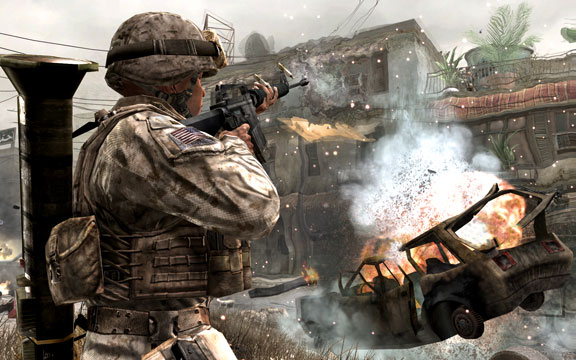
That being said, Modern Warfare 2’s single-player campaign resonated with me the same reason it has with so many others. It’s dramatic, stylish, and takes quite a few risks in terms of narrative and structure in order to keep players interested. (The oft-mentioned “No Russian” level springs to mind, but is far from the only example.) And while the story can be difficult to follow at times, it’s delivered with a blockbuster flair that had me eating it up regardless. Most importantly, it’s fun, and I’ve heard few people argue with that.
But none of the reasons I just listed explain why I really enjoyed it. In my opinion, Modern Warfare 2 succeeds because – whether its creators are aware of this or not – when it’s at its most dramatic, it manages to do what few other shooters, military themed or otherwise, manage to do: it scares me.
Allow me to clarify. When I say “most dramatic,” I’m not referring to the heavily scripted, quasi-interactive sequences – the slow-mo breaches, the field-clearing explosions, the tension-filled leaps onto helicopters - that I’m sure Infinity Ward considers its pride and joy. It’s clear that the architects of MW2 have found their niche in crafting an “on-rails” experience that is indeed thrilling.
But what I’ve actually found most compelling about Modern Warfare 2 (and to a lesser extent, Call of Duty 4: Modern Warfare and Call of Duty: World at War) is that through its moment-to-moment gameplay, my interaction with the game’s A.I., and even via the game’s controls, I feel as though I’m experiencing the audio/visual/kinetic equivalent of what it’s really like to be a soldier. As someone who abhors real world violence, this can be unsettling at times. But as a student of game design, it’s incredibly intriguing.
Everyone who’s played the Call of Duty games is probably familiar with what I’m talking about: You take a few careful steps forward. The next thing you know, you’re being swarmed by an onslaught of enemies from all sides. Immediately you rush to the nearest hunk of brick or metal for cover, popping up only for brief periods to quickly take them out. Spend too much time exposed, and risk having a hail of bullets sent your way, eliminating your ability to aim down your sights, and obscuring your view with a translucent, blood red haze. A flash grenade explodes, rendering you momentarily blind and helpless.
It’s in these moments that Modern Warfare 2 shines brightest. All the while, things like quick-time events and a forced, linear progression are working to make sure that everyone who plays the game has a uniform experience, and the most dramatic tension I feel during this game ends up coming from the sequence that the creators of the game had the least amount of control over.
The depravity and futility of armed conflict, the notion that you are but a small, relatively insignificant piece of a larger puzzle – these are the themes I see at work. Not just in Modern Warfare 2’s story line, but in its game design.
Don’t get me wrong – I don’t mean to poo-poo the developers of Modern Warfare 2 for putting such a remarkable effort into crafting these in-game moments. I just find it interesting that such no matter how great that effort might be to assure us of the contrary, people are always going to react differently to different things. And it’s that human element – the most unpredictable of factors - that ends up defining my experience.
I realize, however, that some people might have different opinions. Which leads me to the question: how do you feel dramatic tension unfolds most authentically? Is it through carefully scripted sequences? Or is it organically, via gameplay? Do we tell these stories to ourselves, or do we rely on game designers to tell them for us? I’m curious to hear a variety of perspectives.