Changing the Way We Review Games

Default_picture
Wednesday, August 05, 2009

Editor's note: Ewan argues, with a little help from game developer Jenova Chen, that it's not just games that need to evolve, but game reviewers. -Demian


Traditional video game reviews measure fairly limited criteria. How does the game look? How does it sound? Does the control system work? Many review outlets are so fixated on these standard qualities that they'll dedicate specific paragraphs or sections to cover and evaluate each one.

But games are more than just an amalgam of graphics, sound, and controls; increasingly often, they are much more.

Jenova Chen from Thatgamecompany ruffled a few feathers during his session on the making of Flow and Flower at this year's Develop conference -- he argued that games should appeal to a wider range of emotions, and that game reviewers are missing the point.

Flower Screenshot


The main thrust of Chen's speech was that games need to develop mature content, but in a manner more sophisticated than simply jacking up the violence and sexual content. With both Flow and Flower, Chen's desire was to create games that generate nuanced emotional responses from players.

Flow and Flower are both exceptionally unconventional games, and while they both received fairly high review scores, they were also criticized for delivering more style than substance.

One reviewer commented that Flow it was a "very pretty demo of what the SIXAXIS can do" (Hardcore Gamer Magazine).

A few years ago, Chen waded through a large group of game reviews and found the same phrases commonly repeated, such as ‘crystal sound', stunning graphics', ‘best FPS' and '60 hours gameplay.'

This is where he has determined that games reviewers are missing the point somewhat. His feelings are clear on the use of the traditional criteria: "That's like talking about a car and how fast it goes -- saying ‘it has great graphics' is like saying ‘this car has four seats.' Reviews should be talking about what a game makes players feel."

Mass Effect Screenshot

Most modern big-budget games have not changed very much in terms of core content in the last 20 years. They follow the same general structure; the main goal is to progress forward either through the game's story or through improving you character in order to beat stronger enemies.

Some games make this very obvious, such as the Monster Hunter series, and some dress up the standard progression with complex narrative, such as Mass Effect. But because games haven't changed very much in this respect, the way we review them hasn't changed either. The closest we will get to emotional comment on most games is on how rewarding the game is to complete.

This is not to say that developers have not tried to engage gamers on a more sophisticated manner. Quantic Dream and BioWare have both tried to add dimensions to their games by introducing emotional elements.

Quantic Dream went the whole nine yards with Fahrenheit (Indigo Prophecy in the U.S.), and tried very hard to put the gamer into the shoes of the game's characters. Quantic's new PS3 exclusive, Heavy Rain, looks to take this idea forward by creating a story that will persist even if one of the main characters dies.
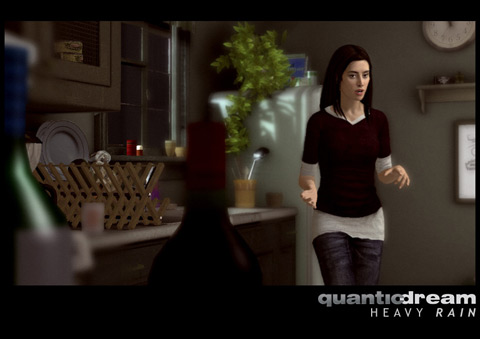
Heavy Rain Screenshot

BioWare engages the player through moral choices, which influence not only the way other characters respond to the player, but also affect the result of the story.

BioWare has reached a zenith with the Mass Effect trilogy, as players' decisions in the first game will have lasting consequences that carry over to the second and third games. The resulting emotional attachment between player and game characters creates another knob for the developer to tweak -- in the first game, for example, one of the player's party members must die, and the player must choose which one.

Both developers have worked to achieve the more sophisticated gameplay experience that Chen is advocating. So it's interesting to see how these games have been appraised by reviewers. Many gave no more than a cursory comment to the emotional engagement of these titles, concentrating instead on the virtues of each game's technical achievements in graphics, sound and narrative.

Quotes from Metacritic for Mass Effect paint the picture perfectly:

"The cinematic design is nothing short of masterful. This is a game that takes the aspects of film that make cinema so compelling and crosses it with the interactivity of games with unprecedented success. Linear storytelling feels quaint by comparison." (IGN)

"It's surprising that so many small annoyances and glitches made their way into a game of such general high quality. Still, most players will be able to look past them and enjoy Mass Effect for what it is: A terrific role-playing game with great production values and fun, exciting action." (Gamespot)

"Mass Effect is still enjoyable enough to warrant 24 hours of play (completion with sub-missions), and the stops it makes en route are visually stunning. It just doesn't find what it goes looking for: the myth and exotica to accurately follow Star Wars." (Edge Magazine Christmas issue 2007)

"Where it doesn't quite hit the mark for me is in the action stakes. Although it underpins the game with all sorts of excellent ideas that ought to make it a deeper, more intelligent and immersive experience, the simple truth is that the minute-to-minute combat simply isn't as intense and involving as you'd expect from a game in 2007." (Eurogamer)

These are some of the heavy weights of games journalism here. We have Edge, IGN, Gamespot and Eurogamer all relying on standard conventions to judge a game that was far from conventional. Some reviewers got the point though:

"A game of such rare emotion that we became attached to our characters to the point of missing them now it's all over." (X360 magazine UK Christmas issue 2007)

"It's a rare thing when a game comes along with the power to move a player emotionally... Mass Effect takes interactive entertainment to breathtaking new heights." (Gamespy)

Both of these reviews did also consider the technical merits of Mass Effect, but not without noting that the game offered more than an impressive interactive light show.

We will soon reach a point where we will have trouble building faster processors into smaller spaces, and when that day comes the leaps in graphical and sound quality will slow. Games developers are perfectly right to want to move in more creative directions to build games that will have much more emotional interaction.

Games like Mass Effect, Flow, Flower, and Fahrenheit are only the beginning. It is only fair that as game critics, we catch up. If we can explore the emotional content of games effectively, then we will do our part to help the industry mature in a more efficient and healthy manner.

We don't need to stop asking how does it look, sound ,and play, these are still important questions. The question we should ask alongside these is how does it make us feel? Answer that one and no one is a loser.

 
Problem? Report this post
BITMOB'S SPONSOR
Adsense-placeholder
Comments (16)
Default_picture
August 03, 2009
I think part of the problem with reviews is that games that make us "feel" anything other than a slight bloodlust are few and far between, and reviewers are used to writing up games in that light. Another problem is that games that [i]do[/i] actually try and make us feel do so in a manner that mimics more closely something along the lines of how a movie will make us feel for it's characters. When you play so many games that work out it's stories through cut-scenes, it's easy to glaze over those elements and focus on why gamers bought the game in the first place, namely the gameplay itself. I'd say the problem lies not only with the reviewers, but the game's designers themselves and how they're actually going about how they make us "feel." Not enough games these days make us feel something through their gameplay, at least in terms of narrative. What they make us feel through their actual gameplay [i]mechanics[/i] on the other hand, is definitely something I'd like to see more of. I remember reading a review of the first Resistance when it came out, and really enjoying the format. The writer basically was describing how he was feeling as he played the game, and it was quite a read. I enjoy reading reviews that way, but that style wouldn't work for every game.
Default_picture
August 03, 2009
That is a good point. I do think that the problem is partly down to reviewers though. If we can find a better ways to explain how the game affects us emotionally then developers can us the criticism to find better ways of inducing emotional responses. It is true that the emotional parts of games are very much passive in most cases (apart from those titles I mentioned in the article) are very passive in a manner that you'd expect from a movie. Actually, another good example of a game that creates emotional involvement is Half Life 2. By the end of Episode 2 I did feel very involved with the characters. This was done simple by having the cutscenes done seamlessly as part of the game using the game engine. You could still move around and watch the action how you wanted to so you still felt as though you were playing as opposed to the usual loading screen and then super-rendered cutscene. I guess I'm trying to say that if, as the critics, we change the way we talk about games then the developers will get more out of our reviews and will be able to improve their development processes for future titles.
Default_picture
August 06, 2009
Who says games have to make us feel anything emotional? While I agree with some points in your article, most importantly the fact that some reviewers review games the same, I disagree that emotional impact should factor into a review. I felt no connection to any character or issue in Mass Effect, as the moral choice system was cut and dry(top choice is good, bottom choice is bad). Should I factor emotion into a review when I felt none and the game was just fun to me? At the same time though, there are games that made me emotional and I would certainly write about that in the review it if happened, but I don't think every review needs to be held to the standard of being forced to include their emotional feeling towards a game. Some people just play games to have fun and escape and we shouldn't crucify them for it. If we want to help a developer make a better game, we need to talk about graphics, control, narrative, and pacing. Emotion is entirely up to the player as everyone feels something different to each game and experience. If you feel something, definitely include it in your review. If you don't then you shouldn't have to shoehorn something in you didn't experience. Loved you article Ewan.
August 06, 2009
:) Here's the thing: Most paid reviewers don't come from communication or journalism backgrounds. At best, they have some college experience, but for the most part they're gamers grown up (which, of course, is debatable). Another thing to consider is that not all games are trying to take that next step into literary status. Some games still want to be games, and the Nintendo Wii is a platform that pretty much caters to such titles. So, it might simply be enough for reviewers to consider each game in the spirit with which they're made and the audience they're likely intended for.
Default_picture
August 06, 2009
Reviewers have been talking about how a game makes you feel for more than a decade. Look at the review of Silent Hill 2 from the early 90s from all of the reviewers you listed, and every one of them mention whether or not they were scared. So, unless fear isn't an emotion, it is just false that reviewers don't take account of how they feel when they play a game. Perhaps, like me, those reviewers didn't find Mass Effect particularly emotionally compelling. Or, they knew that their readers were not interested in that kind of review. I am pretty sure that IGNs readership is mostly 15 year old boys, who mostly dont care about how the reviewer felt when they played the game.
Default_picture
August 06, 2009
Whenever I review a game, I always rate the game's Graphics, Sound, Play Control & Fun Factor. The Graphics refers to its visuals of course (how it uses the gaming hardware, how it compares to other titles, its art style, the effort put into it, etc.). The Sound refers to the game's sound effects, music and voice acting. The Play Control refers to how the game FEELS to the player (Is it easy to learn? Too complicated to pick up quickly? Has weird button configurations? Awkward saving system? Responsive controls? etc.). Fun Factor simply refers to how much fun I had with the game. THIS is where the "Feeling" part of the article would fit in. If a game is great in all other aspects but has nothing special about it, the game won't get a high Fun Factor score. It's that simple. So to say current review methods are outdated is ridiculous. The experiences games can create IS ALREADY factore dinto reviews...it's just that most intelligent reviewers don't feel the need to include a special category for "Feeling". It's the same as some reviewers including a "Story" component to ALL of their reviews. OKAY...so how are you gonna rate the "Story" mode in a Sports game? Reviews are NOT broken and I'm tired of sites nowadays trying to say gaming scores, standard categories, etc. are outdated. They aren't. Okay?
Default_picture
August 07, 2009
Nice Article
Default_picture
August 07, 2009
On the contrary, Scott, I think the current review system has a lot of issues, partly because a lot of the reviewers out there aren't able to take a step back and consider how a game should appeal to a wide audience. The biggest issue is no one can tell whether a game is good or a rental. When I was with Wii60.com, we tried to come up with a system that measured five traits that every game had, and five categories unique to certain sorts of games (for example, puzzle games do not have level design, therefore would not be rated on this). We then gave each numeric score a verbal summary, where a 50-74 was a rental, 75-89 was good and 90-100 was excellent. The problem was, there are just some times where coming up with a category was hard to do for some games. Not to mention that, in one's stomach, a game could feel like an 80 but, numerically, it added up to a 73. Playing games is all about emotion. Enjoying yourself is certainly an emotion. While various other aspects of a game should be taken into account, we have reached a day and age where most of them are pointless. Reviewers are focusing on the wrong categories. Nearly every game has impressive graphics and digital 5.1 surround sound, so how are you going to rate those fairly? It's like having a fluff score to just pad onto the average. Even games that technically look terrible, like Earth Defense Force 2017, don't look bad. My personal philosophy is that graphics and sound should only be mentioned if they somehow add to or detract from the experience. The Halo series has had a tradition of creating breath-taking environments, for example, while some games have had very unclear visualizations to indicate usable tools or paths that can be traveled. Same goes for sound design. If the graphics or sound are not really all that noticeable, then why mention them to begin with? Reviewers should have an idea about game design, but the problem is most have no clue. They like to think they do, but just looking at how most reviewers score games makes it clear that all they know is what they read in magazines as kids. The score system is confusing and, half the time, pointless, and often enough lies. Particularly when a game's scores are all over the ballpark, as is the case with some games like Bionic Commando. I've reached a point where I take notes on what works and what doesn't when I play a game, functionally, write my review recalling my experiences, and in the end attach a verdict that best fits my evaluation. The verdict is simple: Excellent, Good, Rental, Poor or Atrocious. It is easy for anyone to understand, doesn't grade a game as if it is put on a report card, and focuses on what is important. If the game is fun and worth $60 or not. To say the modern face of game reviews is fine is ridiculous, and someone that sees no issue with it is clearly part of the problem.
Default_picture
August 07, 2009
I think the biggest disconnect is that most games are designed with story and gameplay separated: you dabble in the shooting/action for half an hour and then have story told to you for half an hour. However, the story aspect in games has grown tremendously since the birth of videogames; we have come from two paddles and a ball in pong to stories about conspiracy and future way in MGS4. MGS4 is a prime example of this; the story is almost wholly told though cutscenes, and when cutscenes aren't intertwined with gameplay, reviewers will respond to story in a separated way. The combination of this separation of story from gameplay in games and the evolution of story(which many games still don't excel in yet) have prevented reviewers from talking about their emotions, which also may vary heavily. The fact is that it's easier to talk about what is guaranteed in the product rather than something that may or may not connect with your audience.
Default_picture
August 07, 2009
Actually besides emotion you should include price tag. A game like flower should only be bought at a price like 5-10 dollars. it isn't worth much more than that. There are lots of live arcade games that should follow this ethos along with reviews of said game.
Shoe_headshot_-_square
August 07, 2009
This is a fantastic point of view. Too many black and white criticisms of the reviews process out there -- great to see a more reasonable take that seeks the right balance. I've always said to people who don't like the more functional reviews -- usually the same people who desperately want to classify games as art -- that some gaming experiences just don't warrant talks about emotions, artistic value, etc. They're just simplistic games that are meant to entertain you on a somewhat primitive level.
Pshades-s
August 07, 2009
In fairness to those Mass Effect reviews that may have "missed the point," you're citing Metacritic-chosen quotations. Perhaps the full reviews were more focused on how the game affected them emotionally? Don't forget, MetaCritic not only makes up its own numbers, it also cherry-picks sentences to include with that number.
Default_picture
August 07, 2009
I am not necessarily saying that these reviews that'missed the point' were bad reviews. I did go to the original review where possible to double check the review to be sure that I wasn't criticising unfairly. My point was to highlight the fact that games have come a long way since Pong and the review process hasn't really. Yes, graphics, sound and control interfaces are all very important to the evaluating a game but a lot of developers are experimenting with more than just how it looks, sounds and plays(on a functional level0 and perhaps it's time we gave other aspects of games more attention in our reviews. Perhaps not so much for games that are purely designed for fun (most of the Wii's content for instance)but certainly for the more ambitious titles like Mass Effect and Heavy Rain.
Default_picture
August 07, 2009
If that is what you meant, why did you title your post "Changing the Way We Review Games"? Shouldn't it be "Changing the Way We Review Games that have elements of emotional involvement"? This is the second article in the last little while on Bitmob that purports to grandiosity, but actually never gives an argument in favour of it, instead continuing to whittle away at the ambition of the piece until it says basically nothing. You could have simply said "Reviewers should review games based on the content of those games, and the intentions of the game's developers."
Default_picture
August 08, 2009
Your criticism is appreciated and I was not strong enough in defence of my argument in my previous comment. But, did you actually read the article? I do clearly argue that it is time to change the way we look at games. Jenova Chen also made that argument at Develop this year. The bulk of games that we see for the 'hardcore' games do go beyond merely being fun. They range from trying to scare the living crap out of you to (Siren), recreating the horrors of war (Call of Duty) to making you grow to like characters as individuals not just as a collection of pixels (Mass Effect)and even just to try and relax us (fLOw and Flower). Even on the Wii games are not just fun, the make us sweat and ultimately help us feel better about ourselves (Wii Fit and EA Active) and ignite the competitive elements in us (Boxing in Wii Sports and Mario Kart Online) and this goes beyond what Pong or Mario did for us in the past. The sheer variety of the titles I mentioned shows that emotional elements affect the whole industry. If all we talk about is technical achievements (graphics, sound, controls etc) then all that will improve in successive generations of games is the technical aspects. Let's respect developers enough to give them the feedback they need to improve their games every aspect of the gaming experience. Like I said 'Mass Effect and Heavy Rain are just the beginning'. The point is, games are changing and it's time we changed with them.
Jason_wilson
August 08, 2009
Another point that should be considered: Read the reviews of writers who review games the way that you would like them to. If you want reviews that have that emotional evaluation, you should look for reviewers who evaluate games on that level. And if you can't find any that you like, start writing!

You must log in to post a comment. Please register if you do not have an account yet.