
Separator

Conduit 2 and the problems of motion-controlled shooters

Sunglasses_at_night
Thursday, May 19, 2011
EDITOR'S NOTEfrom James DeRosa

I've been wary of first-person shooters on the Wii ever since I saw the first details about Red Steel back before the system launched. But then again, I only play first-person shooters on the PC, so I'm probably a bit prejudiced. It would take a lot of convincing to get me to play an FPS with a motion-controller.
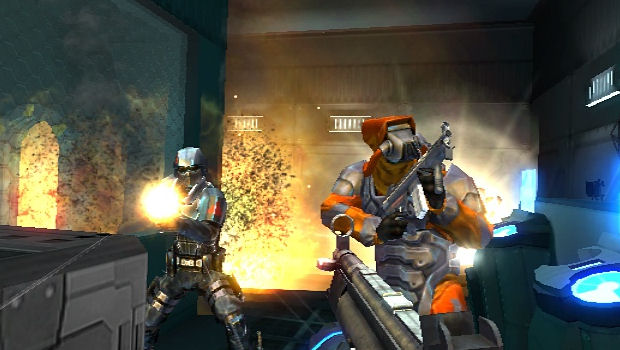
As is the case with many of the other games I think about nowadays, Conduit 2 interests me not because of how it works, but because of how it doesn’t. Apart from its stale and unambitious design decisions -- which I’ll admit, wouldn’t make for a good article at all -- it suffers from many of the same problem as other shooters on the Wii. It simply doesn’t feel right.

This isn’t much of a surprise. To date, no developer has cracked the formula that will get first- and third-person shooters working well with the Wii Remote or the PlayStation Move. Conduit developer High Voltage doesn’t seem to have brought any new thinking to the table in this regard. Infinitely customizable control schemes are all well and good, but I hardly think throwing the problem into consumers hands is a valid solution.

Perhaps, though, I’m getting ahead of myself. What exactly is the problem with wand-shaped controllers?


The idea of a resting position presents the first quandary. If you’re using a traditional dual-analog control scheme and don't have need to aim, you simply take your thumb off the right analog stick. Through the magic of modern technology, you’ll find that the stick returns to its resting position, and you no longer need to worry about your current view until you feel the need to change it. With a wand, you need to make a conscious effort to keep your cursor centered, which over anything other than the shortest of periods is tiring. If you lose concentration for even a fraction of a second, you’ll find your view drifting as the cursor reaches the edge of the screen.

The second main problem stems from the way you usually target enemies in a shooter. Analog sticks control both the camera and the targeting reticule at exactly the same time; you never need to worry about one or the other too much. Simply get an enemy in the center of the screen and fire away. With a pointer, you have to frame the enemy within the boarders of the screen before you can aim at them individually. This is why shooters on the Wii can often feel so inaccurate and sluggish.

To my mind, the only title that manages to solve this problem is Resident Evil 4: Wii Edition. It’s odd that this should be the case because Capcom didn't design RE4 for the Wii, but at any rate, the game’s existing design happened to fit in exactly with how the controller works best.

Resident Evil 4 works for two reasons. For starters, it only uses the pointer for aiming -- never for camera movement. This gets around the problem of a resting position. When you’re not aiming, the cursor doesn’t change the camera’s orientation at all.

In addition, it allows the player to use the analog stick to frame enemies and the pointer to aim at them. This separation of function works brilliantly because you don't have to worry about doing everything with the Wii Remote. In the case of motion-controlled shooting, many hands make light work.

Unfortunately, many developers can't use Resident Evil 4’s exact control scheme for their own games. Capcom’s seminal survival-horror title is a unique beast -- a prototype for games like Gears of War -- and it controls unlike most other entries into its genre. Its tank-like controls are the antithesis of a run-and-gun shooter, and its solutions for the inherent problems with the Wii Remote would never transfer over to a faster-paced experience. In a more frantic game, the developer couldn't use the Nunchuk to control both the camera and the character.

What we can take from RE4 is a lesson: In order to get a new controller to work in an established genre, we need to make some minor -- but fundamental -- changes to the games. The usual mix of adjustable dead zones and sensitivity settings aren't going to cut it. Halo, the game many feel was the first FPS to work with a controller, didn’t succeed simply because of its refinement of control; it succeeded because it was a game whose design diverged significantly from that of most mouse-and-keyboard shooters. It was a much slower game that relied more on tactical play than the sharp reflexes needed for Quake, Counter-Strike, or Unreal Tournament.

It’s not yet clear how -- or even if -- a traditional shooter can ever feel completely natural with a wand. What is obvious, however, is that the Conduit series is not blazing a trail anyone should follow. Rather than shoehorning new controls into an existing genre, developers should think about how they can change the makeup of the genre itself. Doing so may even move the entire genre into exciting and uncharted territory.

 
Problem? Report this post
JON X. PORTER'S SPONSOR
Comments (10)
Robsavillo
May 19, 2011

Try Killzone 3. The Move controls solve the issues you lament in my opinion (for example, you can use the iron sights/aim button to have the camera center on whatever target you have the recticle over; you can increase/decrease the deadzone and the turn speeds to make aiming like GoldenEye 007 and fluid movement possible without unintended camera drift) and offer enough customibility to adjust to almost any player's preferred feel. And the physical design of the Move controller means you don't have to "point" at the screen, nor do you have to make big guestures for the EyeToy camera to read input data.

This preview explains the concepts well.

Wile-e-coyote-5000806
May 19, 2011

Totally agree.  Killzone 3 worked really well with Move controls and I hope more games use it.  You do have to give yourself a couple hours to get used to it, and I recommend changing the dead zone to zero, but once I got going, I was taking down Helghast faster than I ever could with the dualshock.  It does have its drawbacks, and it takes a little change to the way you think (e.g. it's a bigger hurdle than it sounds to get over the idea that the target doesn't have to be in the center of the screen when circle strafing), but overall it felt much better to me.

Here is another video from the same guy that covers some more:

http://www.youtube.com/watch?v=JWF0yZCmpNo&feature=player_embedded

Jamespic4
May 19, 2011

I just had a weird thought that I've never heard expressed anywhere before: Isn't the computer mouse technically a motion controller? It's sort of an empty observation, but it's interesting nonetheless.

Robsavillo
May 19, 2011

That's not necessarily empty, James. Guerilla Games first attempt at adapting the Move controller to Killzone was to mimic mouselook, actually. But they didn't think it felt right, so they abandoned that.

I would still like to see a motion-controller option that does mimic mouselook, though.

Avatarrob
May 19, 2011
Being a big fan of the Metroid series, I was looking forward to Metroid Prime 3, and heard generally good reports about its controls. When I eventually got my hands on it, though, I found the motion controls to be vastly inferior to the Gamecube Prime games; yes, I could shoot with greater accuracy, but my movement was less precise, not more, and reaching to scratch an itch sent poor Samus into a whirling nausea-inducing frenzy. I agree about Res Evil 4; it was the best of both worlds, the movement given over entirely to non-motion elements of the controller, while the shooting benefited from the pinpoint accuracy and aiming speed possible with a motion controller. I'm still not convinced whether it was better than the Gamecube original, though.
Robsavillo
May 19, 2011

I agree about Metriod Prime. The motion controls seem entirely unnecessary since lock-on (Z-targeting) is central to the control scheme and gameplay.

May 19, 2011

Totally disagree about Metroid Prime.  The Wii controls are just so much smoother, I can hardly stand playing them with the Gamecube controller now.  Then again, I never really adapted to the dual-analog setup for first person games.  I prefer motion controllers in general to dual analog for FPS's, although both are vastly inferior to mouse-keyboard.

Sunglasses_at_night
May 22, 2011

I think overall the controls for Metroid Prime 3/Trilogy work well enough, but it kind of gets a free pass from me because it's not, at its core, a shooter. In other words there's enough other stuff in there to enjoy beyond killing things, so the less-than-perfect controls can be given a bit of slack.

Sexy_beast
May 19, 2011

I figured Omri would have something to say about this. Him and I spent a good 30 minutes speaking of the inapplicability of motion controls to shooters.

Default_picture
May 29, 2011

I would like to say that you can't just write off Wii FPS's just because you don't like them. I got into first person shooters with CounterStrike (1.6, not the unbalanced Source), and I love the Wii shooting set up. It's smooth, and it feels better than dual analog. I never liked this control style. It always feels sluggish. Even after playing plenty of CoD and Halo, I still don't like it. I honestly can't play the Prime games with the Gamecube controller. It just doesn't feel right. One of the guys in my dorm was playing through the Prime games, and when he finished with Echoes, I let him play Corruption on my Wii. He loved the controls a heck of a lot more than the Gamecube. The Conduit (I haven't gotten Conduit 2 yet) had a good set-up (and was generally underrated) that worked well for the Wii. I think this whole 'Wii can't do shooters' attitude comes from the same people who call themselves "Hardcore." They play FPS's on PC and PS360, but they never once consider the Wii viable for "core" games.

You must log in to post a comment. Please register if you do not have an account yet.