
Separator
Red Pixels Invading: Communistic Themes in Video Games
Default_picture
Saturday, August 14, 2010

Editor's note: I enjoy examining common themes when discussing books, so I'm glad that Joshua took a similar approach here with video games. Honestly, I think the industry could use a little more analysis like this. Insectoid alien horde or the inexorable communist machine? You decide. -Jay


I’m one of those people that feel that videogames contain a deeper meaning; of course, I was an English major — we think piles of rocks hide deeper meanings. So, as I click my way through Starcraft 2, my mind starts to wander while the dozens of SCVs scurry about the blue crystals. Call me McCarthy, but I believe that the primary struggle in Starcraft 2 is the battle between communism and capitalism.


Joe McCarthy didn't rock the Zerg rush

Think about it: to protect their way of life, humanity (the Terrans) are fighting an alien race (the Zerg) that swarms across the universe. Furthermore, a collective mind controls the Zerg  — or at least it did until a new charismatic leader (Kerrigan) rose up to take over the party.

I also present as evidence the character traits exemplified by Jim Raynor and his crew. Each Terran exhibits strong individual values, but more importantly, Raynor and Tychus are after capital to fund their war. They will do whatever it takes to discover new mineral reserves and fill their coffers, including desecrating sacred ground and displacing native populaces. Sound familiar?
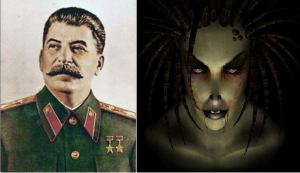
 

Joseph Stalin Kerrigan
Practically cousins

Regardless of what race you play, real-time strategy games are nothing more other than the subjection of the individual to the greater good. You don’t control one unit (an individual) against a group of enemies, but rather a whole collection of units. Consider how many units an average RTS player loses in the course of a round. This got me thinking of first-person shooters -- in particular Halo.


Let's do this ... for Amurrrrrica!!

Once more: a single entity controls the Flood (and to some extent the Covenant.) In the case of the Covenant, the governing body is an oligarchic/theocratic group of Prophets, whereas the Flood have Gravemind. Of course, nothing else better represents communism — or rather the fear of communism by western citizens — than the Flood: they literally consume everything in their path. Creeping communism? You bet your ass it is. Finally, the whole of humanity rests on one individual to take care of this threat — the Master Chief.

So what’s my point? We can draw a couple of conclusions, but primarily I'd say that videogames can be a great way to discover our deeper societal fears. American developers, like Blizzard and Bungie, subconsciously put the ideologies found in American culture into their games, and their enemies represent the one thing Americans historically have feared above all else: the destruction of the individual and the promotion of a collective state.

Even if you don't agree with my theory, I feel that making this kind of analysis is one method of demonstrating the depth of video games to non-gamers. Think of how long it took graphic novels to break into more mainstream culture; now, graphic novels are taught in school and turned into major motion pictures. All I’m saying is that one day, video games will be looked at as cultural documents, and the sooner that happens, the sooner people will realize it’s not just all blood and guts and a bunch of mouse clicks.


Joshua Duke is a writer and editor for Morality Points and contributor to The Program 101's gaming section. Contrary to popular belief, he has never known Joe McCarthy and bleeds red, white, and blue.

 
12
BITMOB'S SPONSOR
Adsense-placeholder
Comments (24)
Robsavillo
August 13, 2010


Fascinating article! In college, I majored in american studies, so this type of analysis is right up my alley.


I wonder how deep such an analysis goes in video games, too. Sounds like a great idea for a research paper.


Default_picture
August 13, 2010


I was actually thinking about how the Elite "revolution" in Halo kind of mimics the fall of communism in the late 1980s/early 1990s. Maybe that's going too far?


Me
August 13, 2010


I think it works as a humor piece, but no, I don't think there are deeper meanings behind Starcraft II and Halo. They're both sci-fi action movies.


Terrans, in the Starcraft universe, are not actually the good guys. They're portrayed as being rather primitive, brutal, and backwards for a spacefaring race. I'm pretty sure that In the sort of classic American ideology you're suggesting is present, Americans can do no wrong. They're not shown as tarnished figures but rather perfectly virtuous examples, and heroes.


I'd argue that Master Chief is just the typical Hero archetype.This is certainly suggested by his facelessness. There's nothing uniquely American about that. The Hero has Many Faces, and they're all bound to the nature of our species, not any one of its particular cultures.


Robsavillo
August 13, 2010


Dennis, sci-fi action movies have cultural meaning that go far beyond the author's intent. It's not inconceivable that a streak of anti-communism leaks into games through their creators' subconsciousnesses.


I do think Joshua's observations about the Terran in Starcraft are spot on, though. The conquering of other planets is a obvious extension of America's manifest destiny, and the main actors in the game all embody that rough individualism that runs deep in American culture.


Joshua, I'm not sure -- I don't play Halo games, so I can't comment on that specifically.


Me
August 13, 2010


Yes, I have a degree in film from a program with an severe arty streak. I know this very well. Reams of work have been produced on James Cameron's Aliens in the vein of investigating female figures, but I sincerely doubt that Cameron meant to introduce one iota of depth into that film. If it's there, he didn't mean it to be...


The problem with using the Terrans as specifically an extension of America's manifest destiny is that...conquering lesser peoples and destroying the land have nothing to do with American specifically. Why isn't this an allusion to the British? Or how about the Australians? The original Terran colonists in the Starcraft universe were, after all, convicts who crashed on a planet. Wouldn't an allusion to the Australians make much more sense? Rough individualism runs just as thoroughly through Aussie culture as American, so hey, why not say this is an allusion to Australia and not the United States?


My wife is a cultural theorist, and the problem with this sort of thing is that one can read anything into almost everything if they're clever enough to weave the language to do so. Like I said, I went to film school. I put up with three years of this sort of thing from the film theory majors. Sometimes a cigar is just a cigar. :)


Default_picture
August 13, 2010


Good writing should have a little humor in, regardless of its intent. I started this piece as a joke, but the more I thought about it, the more I realized some of the validity.


Terrans, I would say, embody the American ideal of picking yourself up from your bootstraps or making due with what you're given. I'd also say that the original colonists in America were pretty primal, brutal and backwards when juxtaposed to the British society they left (which, albeit, wasn't exactly pure as the virginal snow itself)


I'd argue that Halo works better for the communist/collective vs democratic/individual. While archetypes can mean a lot of things, ideologies can work across many archetypes. So yes, the Master Chief is an archetypical hero character, but it is his actions and the social pressures created by Bungie that has led me to my conclusion.


The Master Chief is the culmination of a genetics program designed to create the perfect individual. He single-handedly saves the universe in the first Halo, and it's only until the second game where we are introduced to side-characters, like the nameless UNSC marines and some other characters. I thought Halo was one of the loneliest games I've ever played. Furthermore, all the enemies the chief fights are governed by communist ideals. The Flood is dominated by one mind (the equivalent to the State in communism) and the Covenant are ruled by a small governing body, which is a lot like how the USSR ran.


I'm not implying that this is intentional, but that's not how ideologies work. They are governing principles inherent in any society. I'd actually argue that we, Americans, would have a lot more to ponder if these games didn't praise the individual over the collective, since both Bungie and Blizzard are American companies.


Robsavillo
August 13, 2010


Dennis, then surely you're aware that author's intent is not the only valid interpretation of a text?


Me
August 14, 2010


The issue I take is with the word "valid," Rob. There's no such thing as an "invalid" interpretation of a text. We can say "I think that [name of author] meant [insert interpretation] when [he or she] wrote [book]," and the author can come straight back and say "No, that's not what I meant at all!" and we can still argue that the proposed interpretation is valid by just using the explanation "Well, they didn't intend for that meaning to be there, but it's still there."


This is why, when I was in film school, I chose to discuss only the overt themes of a work, not the buried ones, and often professed my belief that creative genius is the ability to take an audience and make them feel precisely what the author wants them to feel, and think about things that the author intends them to think about, even if they eventually feel and think along different, branching lines later on. It's much easier to be vague than it is to be deliberate.


In the case of Joshua's piece, I think his conclusions don't really say anything about any depth buried in Starcraft and Halo. It's not really analysis. Rather, it's identification of the cultural biases held by the creators, which isn't quite the same thing as an ideology, I don't think. An ideology is a professed set of beliefs that ostensibly translate into action. Blizzard isn't professing an ideology about the superiority of the Terran way of life - they're just working off a series of tropes strung together that the audience will recognize and which therefore make for an engaging narrative. Bungie isn't making any kind of anti-communist statement, they're just using a Hero trope. Both companies are using these tropes because they are Americans, that I will grant you - but that's much different than taking the next step and saying that, because they are Americans, they must be anti-communist by default.


Really, this kind of analysis is better suited to games like Bioshock, though that's kind of been done to death - but Bioshock, at least, is the kind of game where the creator explicity meant to delve into deeper topics to give us some meat to chew on. Starcraft and Halo? I'm just not buying it. :)


(Also, the Covenant aren't proper communists, Joshua. That's a stretch. They're an oligarchy. Totally different forms of government by definition. So, is Halo making an anti-religious statement because the Humans are fighting against a religious alliance which is later proven to be full of crap? See, Rob? I can choose to read into that if I want, and write an entire paper about the anti-religious themes embodied in Halo, but do I really think they're there, even if I could make a case for them? No.)


Jason_wilson
August 14, 2010


Senator Joe McCarthy was an boozer nitwit who never produced proof for his allegations. It's such a shame that he damaged the lives of so many people. 


Jamespic4
August 14, 2010


@Dennis


I hate this definition of quality:


"This is why, when I was in film school, I chose to discuss only the overt themes of a work, not the buried ones, and often professed my belief that creative genius is the ability to take an audience and make them feel precisely what the author wants them to feel, and think about things that the author intends them to think about..."


The only way to achieve this is through the use of some measure of allegory. It is my opinion that allegory is unimaginative, unuseful, and egotistical.


Photo-3
August 14, 2010


I'm just gonna leave this here: http://nedmartin.org/amused/communist-mario


(Too bad some of the pictures are broken. It's still interesting food for thought, though.) 


Me
August 14, 2010


My wife asked me to add this lest I seem TOTALLY obstructionist and not actually trying to add anything to this conversation. :)


I'm an unabashed modernist. I believe in objective truth and authorial intent - but that doesn't mean I'm not open to this sort of thinking. It does mean that I push for strong defenses of interpretation that go beyond the surface-level observations that cultural theory and interpretation are sometimes based on from my point of view. That's why I bring up the "anti-religious" interpretation behind Halo, because I can. Is that as valid an interpretation as Joshua's? My wife tells me that multiple interpretations can be valid simultaneously. As an objectivist, this doesn't compute for me conceptually. It's something I struggle with. Can the Terrans represent both the Americans AND the Australians? To an Austrailian person they just might...so is one of these propositions more valid than the other?


Conversations like these make me feel like one of Mudd's robots...but I do get involved in them because sometimes I learn things. :)


@ James -


We could argue that all art is allegorical. We could also argue that all artists are egomanaical to think that anything -they- have to say is worth enough for other people to listen to. I'm not sure where you're going with that.


Img_20100902_162803
August 14, 2010
And I always pictured American culture to be like minded, similar to the pigeons in Finding Nemo.
Jamespic4
August 14, 2010


@Dennis The very notion that someone holds a interpretive stance different than yours negates the possibility of any meaningful objective truth. And what about interpretive works whose authors died without explaining what they mean? The fact that whatever interpretation the author had in mind disappeared when he died illustrates how weak his intent is as a truth that holds primacy.


There are no objective truths when it comes to art and its interpretation.


As for allegory, no, we can't argue that all art is allegorical because it's not. Check nearly any Postmodern movement (Dadaism for instance). An allegory is the only way to artificially insert indisputable authorial intent into a piece of art. That is to say, one-to-one correlatives are the only way to circumvent open interpretation. The problem is that this sort of creation is deeply tied to a domineering, egotistical, and downright childish sense of authorial control. I can think of no one who said it better than J.R.R. Tolkien, so here:


"But I cordially dislike allegory in all its manifestations, and always have done so since I grew old and wary enough to detect its presence. I much prefer history, true or feigned, with its varied applicability to the thought and experience of readers. I think that many confuse 'applicability' with 'allegory'; but the one resides in the freedom of the reader, and the other in the purposed domination of the author"


Anyway, if I think Starcraft is a parody of The Cosby Show, and I can draw parallel's from the text (game) and dig up evidence that supports me, then it is a parody of The Cosby Show, whether or not the creator intended it. The art itself is not a sacred cow; the response is. Thankfully, people's interpretations of many things are wonderfully textured and varied. I can give my gratitude to the author for creating the art, but if any author thinks I will trade his one indisputable truth for the richness and variety of the world's collective response, well, he can go suck an egg.


When you create something and give it to the world, there are no take-backs. Once you publish for public consumption, your interpretation sits right beside everyone else's without preferece. James Joyce could walk up to me right now and tell me what the hell he was thinking when he wrote Finnegan's Wake. Or David Lynch could tell me exactly what was going on in Eraserhead. And to both of them, I would say “Meh, that's interesting I guess.”


Hib1
August 14, 2010


I'm not implying that this is intentional, but that's not how ideologies work. They are governing principles inherent in any society. I'd actually argue that we, Americans, would have a lot more to ponder if these games didn't praise the individual over the collective, since both Bungie and Blizzard are American companies."


What I wonder is, are those games sending us this message because of the current writers ideologies or is it because the people who made those games are basing themselves on older sci-fi stories (Invasion of the Body Snatchers for example) that had those ideologic undertones?


The end result is obliviously the same but it's still nice to think about it.


Me
August 15, 2010


I read your response to my wife, James, and she said "I like that guy. He's a smart guy." lol


I dismiss pretty much all thought in the postmodern vein, because it makes the statement that all truth is subjective and in doing so, negates the very notion of truth. If nothing is true then this also means that there's no such thing as morality, no right and no wrong, and I can't accept a world that works that way. Science has truths, which may depend on specifically defined, exact conditions, but in those conditions the truths hold. If I throw something up in air on a body which has gravity, it will fall down. Truth. I won't belabor the point, but if truth exists then it cannot be relative, rather it requires specificity of condition, but that's not truly subjective truth because in those conditions, what is true is always true.


My issue with interpretation is that it doesn't say anything about the actual art, in my opinion, it rather says everything about the interpreter. If you think that Starcraft is a parody of The Cosby Show, that doesn't actually make Starcraft a parody of The Cosby Show. You haven't actually told us anything about Starcraft, you've rather told us something about -you- and why you might think Starcraft is a parody of The Cosby Show. Interpretation, IMHO, is a more egotistical act than imposition of authorial intent, because it makes the argument that "What I think is valid, ergo it must be the truth," when belief and the truth are logically unconnected.


I think what postmodernism is born from, is boredom with the truth. Existentialism, to me, is a lazy intellectual meandering away from the search for morality and trying to discover what the best way for human beings to live is, because if and when we ever discovered those truths, human beings of character would then have to either accede to those principles, or be branded amoral, or possibly immoral, people. It's much easier just to throw one's hands up in the air and say "Meh, everything's relative," and then go about our merry way.


In the current context of this conversation, Joshua's piece here tells me things about Joshua, not things about Starcraft. It tells me that Joshua is an American, who has absorbed his culture's tendency to see American supremacy in all things, who is expressing his belief that Americans are world-hopping conquerers who take what they please, and that he is also expressing the sensitivity to Communism that is inherent to what America is since the 20th century. He had chosen, instead, to focus on the anti-religious themes in Starcraft and Halo, I would suggest that this doesn't mean those themes actually exist in these games, but rather that the author of the piece, himself, was anti-religious.


I enjoy conversations like these because they illustrate that video games can inspire them, which I think is the point of Joshua writing this in the first place, merely because he can, and in that I think you've been very successful, Joshua. This is precisely the sort of conversation I have with my wife about movies, literature, and music, so the fact that video games can support the same sort of discourse supports your ultimate conclusion that this piece is driving at - that we CAN have these sorts of conversations around video games. :)


Also, James, I have to add that your quoting J.R.R. Tolkein is hilarious, because he's one of the most egomaniacal authors I can think of. All of this history of Middle Earth he wrote has always struck me as some of the most self-indulgent tripe I've ever seen come out of an author's mind. It's so completely extraneous to The Lord of the Rings, yet Tolkein took the hundreds and hundreds of pages to bother producing it. Not all world-building authors bother to commit the histories of their worlds, that background information running behind the scenes as they write, down on paper. I have to wonder about Frank Herbert sometimes, as well, and the glossary at the end of Dune. Ironically, that's what I found most fascinating about the book when I was ten and first discovered it, in part because I couldn't figure out what the hell Herbert was talking about without the glossary...but looking back now, I wonder if Herbert wasn't a little too enamored with the world he'd created.


In cases like his and Tolkein's, however, I grant them their egotistical self-infatuation because I think they were actually geniuses...and so I feel that ego is earned, and warranted. :)


Jamespic4
August 15, 2010


@Dennis I just like that we can have this discussion without it erupting into some sort of stupid flame off!


Me
August 15, 2010


@ Dennis- If you want to drive yourself crazy, I'd check out "Literary Theory" by Jonathan Culler.  He talks about criticism called 'reader-response criticism,' "which claims that the meaning of the text is the experience of the reader."  


You say up there that, "... if truth exists then it cannot be relative..."  But we live in a world that is constantly changing.  Science is all about observation, and what do you see in this world but the temporary... and the diverse?   


Me
August 15, 2010


Of course we can, James. Bitmob tends to be a little more mature than other sites, which is why I like writing here.


@ Ryan - Can you elucidate how the temporary nature of a thing relates to objective truth, truth not being a thing? I'm not with you yet. :)


Me
August 15, 2010


@ Dennis - Well, the uh, truth is, I don't understand the question... I suppose the answer is I don't know!  


How does objective truth relate to a video game?


Me
August 16, 2010


It doesn't - but it does relate to interpretative statements being as expressed as truths. :)


Default_picture
August 16, 2010


Hey, don't forget about pacman- doomed to consume until he dies followed by ghosts of financial burden. Even in death, Pac's mouth gets wider and wider, surpassing it's diameter until he disappears- in his mania of consumption, Pac has eaten himself.


That's paraphrasing Steven Poole, by the way. Even he had the sense to say that with tongue in cheek, but the point is, if you want to find a meaning to suit an agenda, you will find one.


Default_picture
August 16, 2010


As random as this article may appear at first glance, I've chosen my words very carefully. Let's not forget that Marxist criticism concentrates on materialism. What better game to choose to talk about than an RTS. The whole game is a management of resources and the contest between states.


Of course, in a Marxist examination, we would have to also look at the proletariat and how it would rise up against the bourgeosie. In this situation, the troops would be the proletariart, and the player would be the controlling elite.... which would mean, beware of a troop rebellion.


The digital revolution is at hand, comrades


Robsavillo
August 17, 2010


Dennis, I'm late coming back to this, but my point was that author's intent doesn't always matter. Reader interpretation is just as viable an analysis of a text as anything else.


You must log in to post a comment. Please register or Connect with Facebook if you do not have an account yet.