Home
Home

John explains elegantly why my sense of accomplishment in a game like Demon's Souls is far and beyond many of today's offerings (exemplified in this exaggerated College Humor video). Anxious as he is for the design philosophies of yesteryear, he should consider the upcoming Dark Souls.
Ninja Gaiden. Act 2.
As a five-year-old boy, it was impossible. I couldn’t conquer it, no matter how hard I tried. One of the reasons it was so difficult was the insufficient time I had to master the intricacies of the game. The Nintendo Entertainment System belonged to my brothers. I was only afforded occasional time with it.

Eventually, I aged. I got older and wiser. I became a man in my own way. With that manhood came the prowess that nature bestows upon men. Finally, at eight years old (and as masculine as I would ever come to be), I conquered that demon. You would have thought I had finished the game with the amount of screaming and cheering I unleashed upon my household. I had done the near impossible.
I had made it to Act 3.
There was a time when every inch of progress in a game was something to be proud of. A time less forgiving and relenting. It was a time when pull-your-hair-out-hellish-nightmare was the only difficulty setting. Back then, a game like Dead Space wouldn’t hold your hand every single step of the way. It seems like yesterday that the concept of getting offered an easier difficulty for dying three times was an unheard of option.
Yesterday is gone. Today we sit comfortably in our arm chairs as games give us the “idiot buttons” that guide us to where we need to go and offer us an easier time if we die too often. There was a time when games forced us to be honest while being devilishly unfair themselves.
But I loved that about them.
When Team Ninja’s Xbox reboot Ninja Gaiden was released, I was all over it. I enveloped that game with an obscene amount of love and praises. From start to finish, the game would punish you for foolish play. If you don’t block: dead. If you stay still for more than two seconds: dead. Admire Rachel’s breasts: instantly dead.
In Ninja Gaiden, there was a crossroads among the people I knew who played the game. It was the point of the game that separated those with the will of warriors from those who were just screwing around. I’m speaking of the first Alma encounter. If the game up to that point felt damn near impossible, this boss fight was the elephant that broke the camel’s back.
The choice was here. You could either try over and over again -- risking a cardiac arrest -- or you could throw in the towel. When it came to those who quit, all I could do was chuckle and offer a simple, “I don’t blame you.” But those who endured, learned the patterns, and tested their mettle would develop -- in that single fight -- all the skills they would need for the rest of the game. One fight was unforgiving enough to prepare you for what lay ahead.
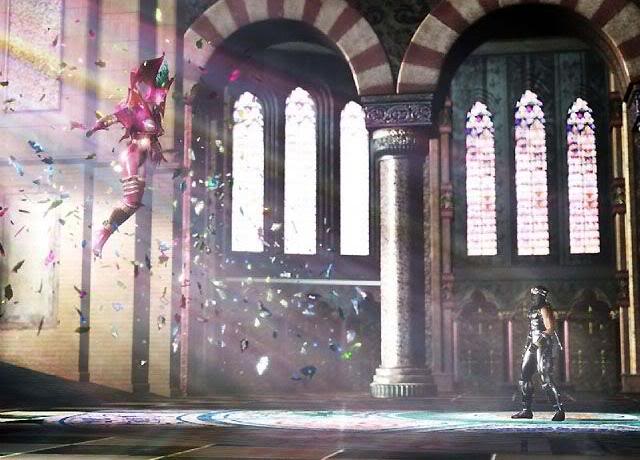
This is going to hurt you a lot more than it hurts...not...you.
I’ve been playing Demon’s Souls lately: A game so frustrating I find myself yelling at my hands. “Do better, damn it! Don’t you know how to parry! Riposte!” And so forth. The sad thing is that the angrier I become the less patient I play. That lack of patience leads to more deaths, which lead to greater frustration. I wouldn’t have it any other way.
The game is articulately designed. Sure, it is mind-numbingly difficult, but there are strategies to be used and -- not unlike its brothers from the '80s and early '90s -- patterns to be exploited. Is the Phalanx giving you trouble? Pour some turpentine on your sword and light that sucker on fire. Is the big scary spider throwing its balls of fire at you? Find something to hide behind and use your distance attacks.