

 Home
Home



I don't fully agree with Leigh's article either, but I think it's a very important point to be made.
As for Bayonetta's creator: Hideki Kamiya. You really don't belive that he's going for pure exageration in the game? This is the same creator as Devil May Cry, Viewtiful Joe, Okami, one of the Phoenix Wrights, and Mad World? The guy's got some pretty diverse and respected titles under their belt, and every single one of them stars a video game character that is a caricature in one way or another. Oh, don't get me wrong: the work is absolutely personally fetishistic to the creator. Kamiya came right out and said that Bayonetta was an idealization of what he'd like in a woman, and the dev team spent more hours 'perfecting' Bayonetta's hindquarters than almost any other part of the visual design. But I honestly don't have a problem with that - we should never say that that someone shouldn't be allowed to craft something of their own tastes into a medium, even if those tastes are overtly sexual.
But I outright reject the claim that Bayonetta was designed to sell on sex appeal. If that was the case, it wouldn't be arguably the most polished action game of 2010, and it would have a DOA-style camera feature. Oh, there were probably a number of sales that came from guys going 'ooh, clothes come off, imma buy this!' But I would be shocked if that was anything but a ludicrously small percentage of the consumers who took up the game.
Furthermore, the sexuality of Bayonetta isn't actually that marketable: the Sexy-Librarian S&M thing just won't move units - it's too niche. And, at the risk of sounding a bit bigoted, a game with a sexually dominant female protagonist will definitely not move units with the larger otaku croud over in Japan. If they had been going for that, they would have needed to set the game in a high school, and, renamed Bayonetta to Bayo-chan, given her tiny hands, a pleated miniskirt, and had her play in a band with her small, flat-chested female classmate and her clumsy, curvaceous, glasses-wearing female classmate while they engaged in nonsensical but annoyingly cute small talk. To support my argument: I just risked my own personal sanity to do a google image search of 'Bayontta body pillow' - only two valid results, one of which seemed to be hand-made, and the other of which was Bayonetta in her little girl form, where she is cute and relatively demure rather than audacious and bold. The majority of Otaku japan has a very identifiable fetishistic profile, and if it doesn't have the word 'onii-chan' in it, they're not biting.
In short, just like sexual doesn't necessarily equal objectifying, neither does fetishistic equal pandering. There's not enough of an audience for Bayonetta to pander to and still be successful. "
But I have reservations about the tone of discussion: it feels like you're saying that showing cleavage is innately equivilant to objectifying women, and that's something that I just can't get behind. As an example, while I'll agree that 90% of the titles you've listed are high on the inexcusable sleaze scale, I actually adored Bayonetta, over-the-top and somewhat childish sexuality and all. Lots of near-nudity? Yes, certainly, but that isn't necessarily equivilant to exploitative. I'm sure that by now Leigh Alexander's famous take on Bayonetta has made it's rounds, but I fully buy into her argument that the game is more uplifting than it is exploitative.
Thus my nervousness: do we need better, more realistic representation of women and sexuality in games: yes, absolutely, and we need it badly. Is the answer then to decry the slightest sign of leg or breast in a game as inherently harmful? I don't think so. In Leigh's words: "Bayonetta takes the video game sexy woman stereotype from object to subject." There is a world of difference between a game with sex appeal, and a game of outright pornographic design a la DOA:Beach Vollyball.
P.S. In case anyone hasn't read it, Leigh's Bayonetta writeup can be found here: http://www.gamepro.com/article/features/213466/bayonetta-empowering-or-exploitative/"
P.S. If you're on PSN, and don't mind playing a relatively scrub-like player, we could do endless sometime? "
Haven't played Lords of Shadow, but I can safely say that while T&A of the monstrous variety (a la Medusa) is part of the series. Are the fairies appropriate? Maybe, maybe not. I'd have to play to decide. "
That said, I'm deliriously happy that something like BlazBlue exists. I lament the loss of sprites in modern, mainstream gaming, and since Capcom's clearly not on that bandwagon anymore, BlazBlue fills the niche nicely. The mechanics also are incredibly different SF, KoF, and even what Guilty Gear had to offer. From the little I played of it, the engine seems much more environmental, and so you need to have a far better sense of your spacing - at least, that's how it seemed to me on the testrun I gave it.
I hope the BlazBlue community continues to thrive - if this fighting game boom is going to continue, it needs variety and a diverse base of consumers.
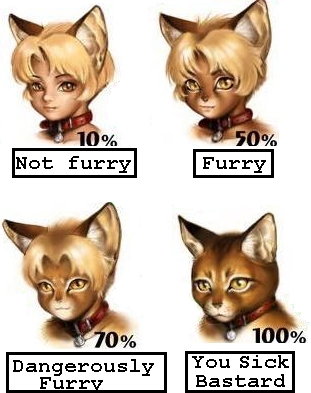
P.S. - While we can't see Taokaka's face, I feel the need to clarify furry classifications with a handy dandy chart. You'll notice that Makoto falls neatly within the 10-15% limit. Still obnoxiously fanservicey, though. Otaku, I Choose You is spot on.
 "
"
At the same time, though, I think that gaming as an industry needs critics - people who are going to take a game town for any flaw, who are really going to demand perfection. But as with almost any other industry, the reviews of a critic are less consumer oriented: critics are concerned less with whether the game will meed the standard of the consumers, but whether a game will live up to an internal higher standard. While we might now always want to trust critics when it comes to purchase decisions, they are absolutely critical in helping an industry grow and develop. "
That said, what Capcom's doing does make some sense: these games take a lot of time and budget to create, and DLC is an effective way of expanding their shelf-life and profitability. Fighting games thrive on interest and community, and I think that this is more than just profiteering on Capcom's part - I think it's a concerted effort to increase interest, and that can help the fighting game community. Overall, I would prefer they do that with cosmetic changes (SSF4 alternate costumes have been effective for me), but I can understand this approach too. I like Ono's idea of 'version' DLC - I think that's a graceful middle ground. "
On a side note: I've always wanted to see a spin on the Silent Protagonist, where the main character is actually, physically mute in an RPG. Could make for an interesting story, and it would result in the hopeful avoidance of long monologues. "
I can see where your coming from when you say that. In my defense, I'm not saying we should abandon the concept of artistic merit, I'm saying that we should adopt a vocabulary that is conducive to productive discussion. Semantics can be very important at times, as you well point out. But sometimes semantic arguments become stalemates, and I would say that we've reached that point. Breaking the concept down into smaller, composite concepts is just one way to help work past that stalemate.
I don't think we should abandon the word 'art' forever - just that we need to think about it with a different vocabulary. "



