Home
Home

You remember that scene in the movie Groundhog Day when Bill Murray sits and watches Jeopardy and knows all the answers?
Yeah. That's pretty much me. Minus the whole trapped-in-a-time-warp thing.
See, I played Buzz! Quiz World for the first time this weekend. Doing so taught me three things:
- I'm really freaking good at trivia games.
- I actually had the most fun when I lost the final match (the only match I lost all evening).
- It doesn't matter if you're winning or losing -- Buzz! is a lot of fun.
At heart, multiplayer games are about competition. But you don't have to win every time to enjoy it. That's the key to a successful multiplayer experience -- making sure players can remain competitive no matter the skill level or outcome.
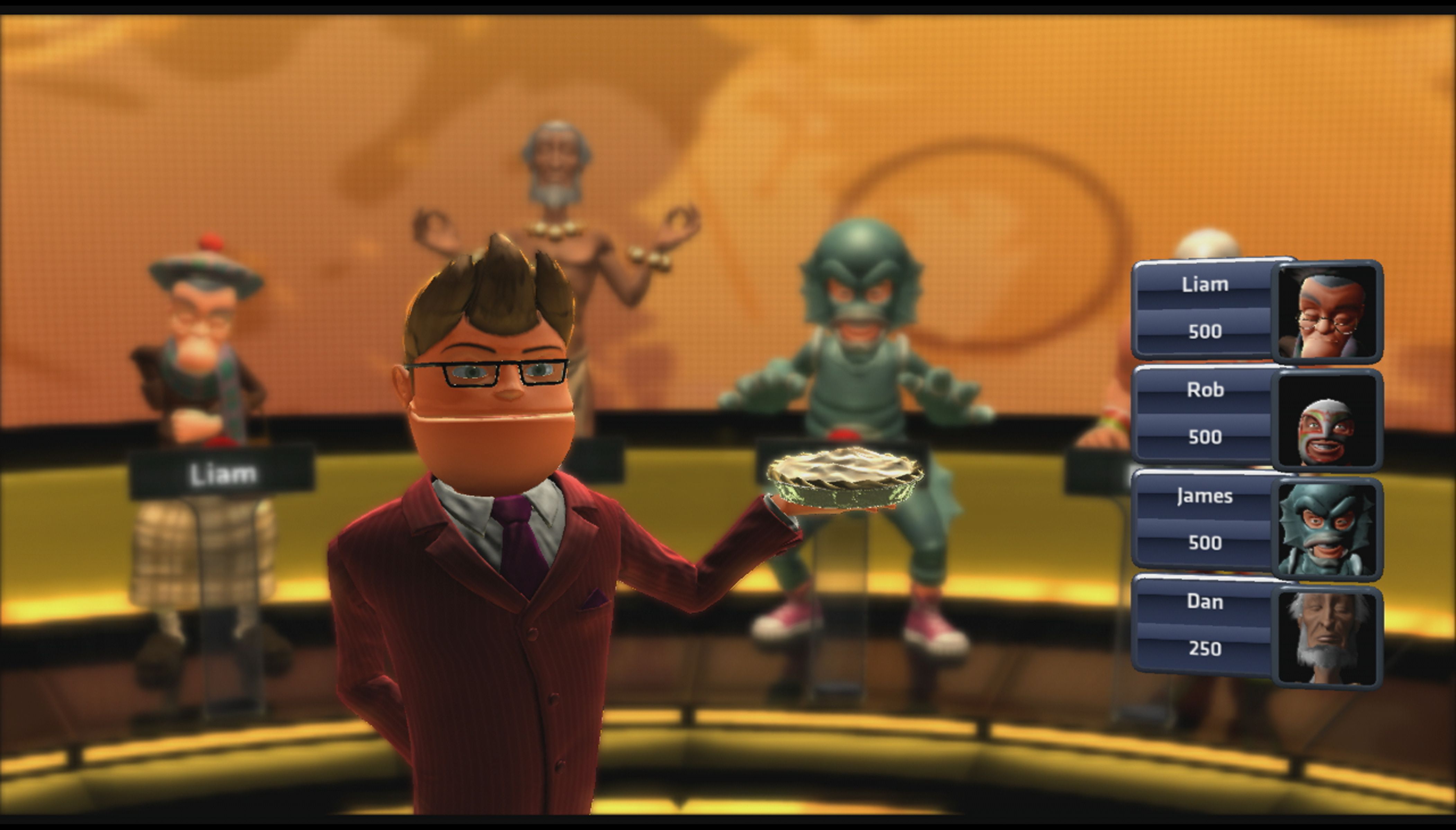
I mean, if we were just going by who got the most questions right, I would have won every time. Easily. (I promise I'm going to stop bragging at some point.) But that's not how Buzz! works -- the game provides a multitude of question types. Some questions are worth more if you buzz in faster. Some rounds allow you to steal points from other players. And sometimes you get a virtual pie in the face.
The motive for these different question types isn't just to provide variety. It's to level the playing field. Once my friends realized they weren't going to beat me to the answer (last time, I swear), they learned how to use the game modes to gang up on me. They began clicking in madly, stealing my points, and pie-ing my face at every opportunity.
In the end, thanks to their tactics and a string of good luck, I stood a beaten Buzzer. And I loved every second of it.
This same principle is the driving force behind the popularity of the Mario Kart series. While driving skill will help a great deal, the item boxes are the equalizers. If you're in last place, you'll get a lightning bolt or a star to help you recover. If you're in first, prepare for lots of banana peels.
Due to the frequency of special items, Mario Kart races rarely feel totally out of hand -- the game encourages players to keep going, because their fortunes could change in an instant.
The end result is that the "best player" doesn't always win in Mario Kart, and the player that does win perhaps did not deserve it.
The Halo/Call of Duty multiplayer crowds would be up in arms over Mario Kart-esque reversals of fortune. True, some entries in the Call of Duty series grant certain bonuses after a string of deaths, but they pale in comparison to the rewards offered for success. This leads to a rich-get-richer dynamic that punishes weaker players. And in fact, the death streak rewards have been removed from Call of Duty: Black Ops, making it even more difficult for inferior players to keep pace.
But the Call of Duty reward template is nothing compared to its multiplayer ancestor, Counter-Strike, where the rich literally get richer every round. If you die in Counter-Strike, you start the next match with a basic weapon and less money to purchase a better one. On the other hand, if you play well, you get more cash, so you can buy better weapons and do even better.
It's a vicious cycle that discourages me from wanting to play because I can't compete -- let alone win. The online format pretty much guarantees that someone in your particular match will be better than you. And if he's better, he's going to win.
So which multiplayer philosophy is better? Maybe it depends on whether you're playing online or off. I just know that I'd rather feel competitive in every game I play, regardless of who I'm playing with.
And you can trust me -- I know all the answers. Usually.