

(First post! I've lurked on bit mob for quite some time, and have decided to join up formally and start participating. I really love the environment here, so hopefully I'll fit in.)
For those that are somehow unaware, Schwarzenegger v. EMA is now officially receiving the Supreme Court’s attention. The basic sum of the legislation that the governor of California is attempting to pass is a ban on the sale of violent video games to minors, on the grounds that they are unable to make the decision of what is harmful to consume for themselves - basically, that violent video games are, like alcohol and cigarettes, harmful to minors, and that the state has the responsibility to prevent he sale of such things to young people who do not know any better.
Now, this has been discussed to death, and if you are reading this you are no doubt tired of hearing about it. To put a summation on the consensus of a vast majority of the briefs submitted to the Supreme Court: this violates the first amendment right to free speech. But one part of the conversation I consistently see wherever I look is the inevitable individual asking why this is the case. It's a good question - the legislation actually says absolutely nothing about what game companies are allowed to create, just who they are allowed to sell it to. So why does free speech enter into this? And what's all the fuss about in the first place? Do we actually want our kids playing Kane and Lynch II?
I've noticed that these comments come with higher frequency from non-US citizens, especially those from the UK and Australia. I should mention at this point that the point of this article isn't to boast some bogus US-supremacist argument about how freedom of speech makes us better; both the nations I've just mentioned, as well as the many others around the globe that have stricter government regulation on product sales have a perfectly legitimate way of doing things. For those that don't know what I'm talking about, in the UK and Australia (and a number of other countries), Schwarzenegger's law is already passed, and the sale of mature-rated games is both established and regulated by the governing bodies.
(As an aside: it is important to note that video game sales progress nicely in those nations with a minimal amount of fuss and only occasionally banned titles. While I don't support this current legislation, we can at the very least look to that fact and hope that, should the court rule in favor of Schwarzenegger, all is not lost, and there are systems like what is being proposed already in place around the world that work effectively).
With this somewhat cultural question in mind, I thought I might give the perspective of a US-citizen on why this is so important to us, and why we are worried. I think it's fair to say we're not actually concerned with the stated intent of the law: I think only the most unreasonable among us would say that it's good for kids to spend all of their time playing Manhunt 2. Our concern is where the legislation could lead to, legally. We've all heard the damnable slippery slope argument before, of course, and it's important to note that the slope is never quite as slippery as I think we'd secretly like it to be. But in this case there is some legal precedent that causes us a little more concern.
I'll try to lay this out as logically as possible, so bear with me:
First, let's talk First Amendment: as much as we Americans like to bring it up, probably very few of us could actually quote it – I know I can’t. Let’s take a look:
“Congress shall make no law respecting an establishment of religion, or prohibiting the free exercise thereof; or abridging the freedom of speech, or of the press; or the right of the people peaceably to assemble, and to petition the Government for a redress of grievances.”
With any luck (I’m having trouble getting BitMob's editor to format for me) the part reading “or abridging the freedom of speech, or of the press” will be emboldened. That’s what we’re dealing with here. In general, the freedom of speech/press is considered to be the freedom to make intellectually creative work that says whatever we bloody well want it to say. Creative freedom. We can say whatever we want in comic books, movies, music, online, even in video games.
But there’s another component, which isn’t actually stated within the amendment itself, but which has always been a part of this: the freedom of speech also includes the freedom to unrestricted sales. That is to say, the legal precedent in the states is that if a product or service comes under the heading of ‘speech,’ then the sale of that good or service cannot be restricted. This is why we disallow the sale of tobacco and alcoholic products to minors, but not the sale of R-rated movies. As such, if the supreme court rules that the sale of violent video games should be restricted, it will legally establish video games as not being protected under free speech.
(It should be noted that media considered pornographic is NOT protected under free speech, and is illegal to sell to minors. A product can be labeled as pornographic based on either sexual or violent content. In the States, explicit violence is almost never labeled this way, while explicit sex is. Most of the world would say this is extraordinarily silly, and I agree with them.)
Next, we need to talk about the ESRB: Those outside the States (and often those inside the states) are sometimes surprised to learn that the rating boards that exist for our various entertainment medium are not governmental organizations, but are independent firms within the industries themselves. The film industry most famously has the MPAA, the music industry has the PMRC, and there are several others. For video games, it’s the Entertainment Software Rating Board (ESRB). This is where the famous E, E10+, T, M, AO rating system comes from (AO being material considered to be pornographic – see end note previous).
The important thing is that this is not regulated by the government. The industry developers and publishers voluntarily submit their products to this rating board, and the industry retailers voluntarily conduct their sales strategies according to these ratings – corporate policy for almost every retail store in America is to not sell any M-rated game to a minor.
The cynic would say that the system doesn’t work, but the cynic would be incorrect here. A 2008 study conducted by the Federal Trade Commission found that while self-regulation by video game retailers was laughable in 2000, the video game industry is now better self-regulated than any other industry. A minor now has only a 20% chance of being able to successfully purchase an M-rated game from a retailer (compared to 85% in 2000). By comparison, a minor has a 48% chance to purchase an R-rated DVD, and a 35% chance to be able to purchase a ticket for an R-rated film screening. Personally, think that this is somewhat sad, and would like to see these numbers decrease even further – but on a comparative scale, 20% success rate is rather impressive.
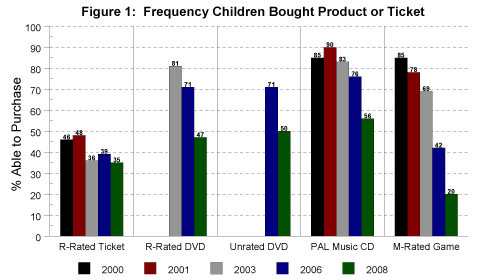
As for the ESRB itself, the general consensus is this: the ratings themselves are fair and justifiable (something that, looking at video game ratings as compared to both music and movie ratings, I would agree with). The publicity of these ratings, however, needs improvement, as a large number of video-game illiterate parents do not understand the rating system.
Now, bearing the two prior pieces of information in mind, let’s talk about the repercussions of this legislation.
What actually is the problem?
First of all, the wording of the legislation is ambiguous. There is reference to the labeling of the ESRB. Rather, the law concerns the sale of any game portraying violence in a realistic way to a human or character with distinctly human features (I should point out that this is the approximate wording as of my last readings). What this means is that just because a game doesn't have an 'M for Mature' on the cover, doesn't mean it is safe. If you used the right legal language, and argued for a certain definition of realistic violence, you could easily make a case that, say for example, Mario or The Legend of Zelda is inappropriate to minors.
I realize that these are perhaps extreme cases, but let’s look at some of the T-for-teen titles that have come out this generation: Lost Planet 2, Battlefield: Bad Company, and WWE Smackdown vs. Raw are all things that a quick google popped up. Could you see an well-meaning but overprotective government official crazed on a mantra of “Think of the children” looking at these games and deciding that they are entirely too frighteningly violent? I certainly could.
And that brings up the second part of the point: the ESRB has been around for a while. As mentioned above, they do a good job of rating games (though a less admirable job of publicizing those ratings), and the industry has grown accustomed to them, effectively implementing its own measured to prevent minors from getting their hands on M-rated games. To put it bluntly: the thing that this legislation wants to happen is already happening. Effectively. With minimal fuss. As a matter of practicality, let’s assume that the government is capable of doing an equally thorough job: why do we want our money (via taxes) to flow into something that the industry is already doing itself? And that is assuming that the government could do the job effectively, which I frankly doubt. I think it is not a stretch to speculate that the ratings would be harsher, more creatively valid games would get the dreaded AO rating, and that the requirements would be less thoroughly enforced.
Additionally, the presence of a legal restriction on sales is quite likely to cause a recession of mature-oriented titles. While it is not assured, there is a potential for many retail stores to stop stocking M-rated games all together, which will cycle back to the publishers and developers, and an entire platform of speech could be cut off. I want to stress that this is not assured to happen, but the possibility is entirely there. We’ve seen it before, in the 50s with the comic book industry. If you don’t already know about the censorship and hardship that the US comic industry went through in the 50s, I’ll point you towards Google: it’s a well documented period of time.
All these, of course, are practical reasons that this legislation should be ruled against. I like practical reasons, they give substance where substance is lacking. However, I don’t necessarily feel that it is inappropriate to introduce some idealism into the discussion, so here goes.
One of the core tenants of the Unites States governmental ethos is that if a government is not needed, it should not be involved. Even if it doesn’t lead to bad things immediately, it will very likely to lead to bad things eventually. We, as United States citizens, consider certain things to be rights inalienable. These rights come with responsibilities. One of those rights/responsibilities is to do the job right ourselves so that the government does not have to do the job for us. There are numerous areas in our lives that we have failed to live up to the responsibility of this, so we lost the right, and federal government was forced to step in to fill that role. But one area where we have not failed is in this one: the sale of video games with violent content is already well regulated, and we as citizens and as an industry should not have the right to do it ourselves taken away.
Now, if the government was interested in funding a campaign to further improve sales those sales statistics I showed earlier, and to publicize the ESRB rating system so that we could get obnoxious 12 year olds out of the Xbox Live servers, that would be another thing entirely: I hope that eventually we could see such a cooperation occur, as I personally feel it would be much more effective, respectful, and mutually beneficial to all parties concerned.