Editor’s note: Part of my love for video games is dissecting their inner parts, which means breaking down the systems that govern play. Suriel makes a strong case that players will be more satisfied with their victories when they understand exactly how a game's design works. -Rob
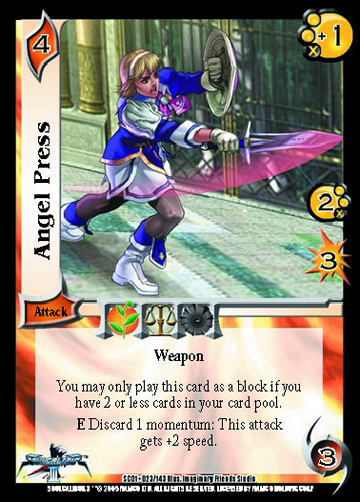 In December of 2009, Steve Horvath, vice president of marketing and communications for board- and card-game publisher Fantasy Flight Games, announced that the company would no longer continue to support the Universal Fighting System (UFS), a card game based on fighting franchises such as Street Fighter, Soulcalibur, and Tekken.
As huge fan of UFS (though, I had stopped playing in May of last year), I decided to revisit what cards I had left and mess around with some new decks. I quit because of the money-sink that any collectible-card game eventually becomes, not because I had fallen out of love with it.
UFS was complex even by its peers’ standards. The game was governed by a set of rules that define how play unfolds, but its design was based directly on fighting games. Players controlled one character and performed and blocked attacks through control checks. Rules consisted of symbols, card difficulties, effects, and phases that took place in set orders1 -- all things that intimidated casual players.
A recent mantra of many developers and publishers today is that simpler is better -- that complexity is off-putting to key demographics who just want to enjoy a game. It's certainly easy to connect complexity with difficulty because an increased number of limits can seem restrictive, and therefore, more burdensome to manage.
But like harder video games, the sense of accomplishment that comes from achieving victory under such restrictions and obstacles can be far more satisfying than a system without any sort of limits or rules.
Read more >>


 Home
Home








 If you asked most people to write down their opinions of the average gamer, the word charitable would probably not be on that list. However, this perception may soon change. Video-game charities pop up every day, and the amount of money they donate is far from insignificant.