
Separator
Agree to Disagree: A Call for More Open Debate in Podcasts
36752_1519184584690_1386800604_1423744_1678461_n
Friday, March 12, 2010

Editor's note: Heated debate is always more interesting, especially when you've got a dog in the fight. Suriel makes the case that more video game podcasts should strive to spark that kind of exchange between participants. I'd only add that these programs also drop the non-gaming banter in the beginning and get right to the topic I tuned in to hear. -Rob


When I listen to a podcast, I usually imagine myself in the room with the participants. I converse with them in my head, take their viewpoints to compare them with my own, and arrive at my own conclusion -- not unlike that which you might do with real-life group of friends.

I don't agree with everyone's point of view, but that's only to be expected. I usually enjoy the discussion more when I debate someone else's points than when I agree with his arguments.

This metaphysical experience works best when the breadth of perspectives that a podcast provides creates genuine discussion on a topic and when those opinions are as varied as possible. What I've found is that an assortment of expressed thoughts on a podcast is the exception rather than the norm.


I won't go so far as to say that most podcast commentators share the same opinions on everything, because that's not true. The problem is with the confrontation that comes with disagreement; if someone says something that is in opposition with the rest of the group, they need to back up their statement immediately.

Contrast this with writing, where you have all the time in the world to compose your argument. Although many people share different opinions on many topics, if you fail to verbalize your point-of-view effectively you might end up looking foolish.

But when debate works, it benefits everyone. The 1UP Yours podcast was at its best when Luke Smith and Shane Bettenhausen bickered at length over Sony's and Microsoft's strategy for the current generation of consoles. Although the arguments tended to get very juvenile at times, to hear both sides of an argument instead of a boring consensus was worth the griping.

My favorite edition of the Giant Bombcast is the 2008 Game of the Year episode, where the participants bashed heads in deciding which release was most worthy of the title. Although I didn't necessarily agree with their final decision, the engaging discussion that lead up to their result enabled me to accept their choice.
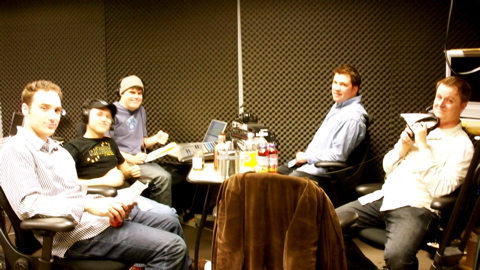
Not pictured: Heated Debate

To force people into a discussion they'd rather not have is difficult, especially when they're close friends. The arguments dished out in a recording booth undoubtedly spill over to the outside. But this type of debate is valuable to both participants and listeners.

For the listener, it allows them to engage in the conversation vicariously through a person whose opinion on the matter they share. When everyone is in strict agreement without much debate, those who don't agree feel left out of the conversation because they can't relate.

When podcasts provide a wider range of opinions, more people feel like they're in the conversation. If a listener feels as though the podcast never ever shares his opinion, they're less likely to listen to that program regularly.

Every once in a while, It's fun to disagree with someone. But when you simply can't see where a person is coming from, it's difficult to debate fruitfully for an extended time. If a podcast can manage hosting members who appeal to several audiences, the program will have a greater chance of getting more people listen to what the participants have to say both individually and as a group.

It's a difficult problem to address, honestly. If your podcast lacks variety, should you host someone merely because he's likely to disagree with you? Perhaps, but that runs of the risk of the program appearing to merely boost sales.

Discussions have to flow naturally. If you can manage honest debate about a topic that provides new insight to both listeners and commentators, the podcast results in better entertainment for everyone.

 
11
SURIEL VAZQUEZ'S SPONSOR
Comments (10)
Eyargh
February 26, 2010


You make a compelling argument. On my friends' and I's podcast we probably do this a lot. I think a lot of the time when it's the case that everybody on are good friends, certain subjects will come up that will elicit a "OH, let's not get into THAT again response" from the people involved. Most often I think our problem is that we either take the childish route in our arguments, or we end up coming to an uneasy agreement on whatever subject it is. It's funny, we've honestly thrown out entire episodes because they were fucking boring and unoriginal to listen to.

Bitmob
February 26, 2010

I really miss the ridiculously heated arguments on 1Up Yours. I saw comments from people who hated the show for "taking everything too seriously," but as someone who could be accused of that myself, that style appealed to me. There are still a lot of game podcasts that I like, but I haven't found another one with arguments that heated, that still had some logic to them.

Default_picture
February 26, 2010

I don't listen to podcasts often, so it's probably unfair of me to judge them, but I'd probably be more inclined to listen to them if there was more debate as well. I mean, I wouldn't want things to progress into shouting matches, but I think more different opinions could really add to a game's discussion.

Default_picture
March 12, 2010

I always felt there should be a "Crossfire" type show, but for games.  That could be difficult unless you found a good group that varied in their tastes and could keep the arguments reasonable but entertaining.

Lance_darnell
March 12, 2010

I loved the famous arguments between Shane and Luke! I actually think podcasting is missing an outspoken voice that tells it like the voice sees it. Pixel Revolt does a good job of looking at different points of view and then coming up with a synthesis.

March 12, 2010

I think Rebel FM is a podcast that hits the right balance. Anthony, Arthur & Tyler plus guests bring distinct game preferences to the table (and distinct voices; sometimes I can't tell the difference between other casts of podcasters even when people aren't talking over one another) and you'll hear just as much disagreement as consensus. They will back up their perspectives as fervently as they will concede another host's point of view. The usual vibe though is one of exploration, discovery and insight. Even when I might disagree I feel like there would be room for my view were I at the table. 

Legendary arguments are fun sometimes but I prefer my podcasts to be reflective rather than combative. I like the illusion that I've been invited over to a buddy's house for some friendly gamer geek banter where I might get exposed to a game or idea I hadn't considered.

For a flame war I'll hit the boards.

Redeye
March 12, 2010

I agree. Open debate is often very engaging. People just naturally avoid it because it's difficult to keep it civil and reasonable.

Gaming podcast wise I was never quite in on the ground floor. I came into the 1up podcasts rougthly as every one of them was losing valuable members from the dream team. Still Their was often some very interesting conversation and I loved a lot of the old personalities.

Img_20100902_162803
March 13, 2010

I'm ready to argue with anyone.  Call me.

Default_picture
March 15, 2010

This is one of the reasons we started adding people to the Player One podcast after the first few episodes. My original co-host CJ and I found we agree on far too much.


However, I think the Shane/Luke example only works to a certain extent. I found as that show went on that the two of them seemed more like they were playing a role than actually debating one another. When the bickering got to the point where it started to overshadow every other part of the show, I stopped listening and never went back. Debate is great. Juvenile shouting matches for the sake of "entertainment" only works for so long.

You must log in to post a comment. Please register or Connect with Facebook if you do not have an account yet.