Home
Home

Jeremy's idea for this list is pretty cool. He gets to wax nostalgic about 8-bit classics while at the same time offering insightful criticism about the current states of more than a few megapopular franchises.
October 18, 2010 marks the 25th anniversary of the NES according to Nintendo. That means a quarter of a century has passed since the second rise of video games and Nintendo’s dominance. But the NES itself has already been talked about to death. Instead, we’re going to celebrate the past by taking a look at the present. 2010 has been surprisingly full of franchises continuing their NES legacy. Let’s take a look at each of these franchises -- both then and now -- to see what has changed and what has remained the same.
Mario
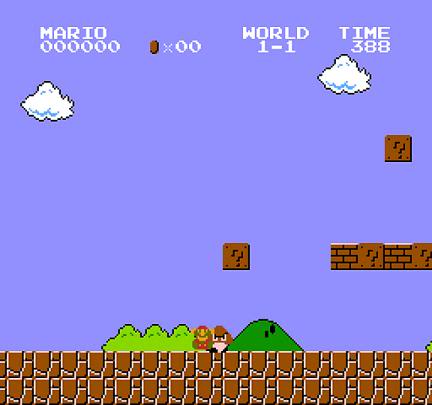
NES: Super Mario Bros. was one of the most influential games of all time, setting the standard for platformers and expanding the definition of what video games entailed. Its eight precisely designed levels are still highly playable even to this day. And its sequels continued this tradition, both exploring new expressions of the platforming genre and evolving the formula into something new. It’s safe to say that the industry would not be where it is today if it wasn’t for Mario.
2010: Today, Mario hangs in both the 2D and 3D plane, but 2010 was all about 3D Mario. Super Mario Galaxy 2 took the formula that Super Mario 64 started and went completely wacky with it, compartmentalizing the level design through groupings of planetoids. And while this was an invention of the first Galaxy, the second one wasn’t afraid to go completely crazy and churn out even more fresh ideas. While Mario is moving around in 3D space, the level design remains linear for every Star, staying truer to its NES roots than 64 or Sunshine ever did.
Metroid
NES: The nonlinear platformer owes everything to Metroid, Nintendo’s ambitious experiment in progression through exploration. Not only did it challenge the popular standard of running from left to right to progress, it provided a wealth of incentive to explore as well, from the necessary upgrades to additional missile packs. And while it didn’t have an in-game story to speak of -- for the most part -- its thematic touches impressed in their minimalism, especially Samus’ big reveal at the end. It was a bold game that gave way to even better things as developers refined the formula.
2010: Metroid is still trying to push into new territory, though not in the direction everyone expected. After Super Metroid perfected the nonlinear 2D platformer, the folks making Metroid began to show a desire to make it something more than it was. Because of this desire, they added a more in-depth story in Fusion at the cost of some of the series’ trademark nonlinearity. The culmination of this was Metroid: Other M, an attempt at making a big-budget game with over-the-top narrative to match. In the process, they stripped away even more nonlinearity. It became one of Nintendo’s rare misses, with unfortunate voice acting, a laughable story, and simplified gameplay.
One thing the designers got very right was making a 3D game feel like a 2D one without compromising the advantages of 3D, creating a more direct evolution from the original 2D games than has ever been seen. Now if only we could get the original NES game’s nonlinear exploration back….
Kirby
NES: Gamers largely overlooked Kirby’s NES outing when it came out because Nintendo released Kirby’s Adventure quite late in the system’s life. That's too bad because it was one of the best games for the system, with charming visuals, a wide variety of fun mechanics, and great level design. The graphics were especially impressive, as they pushed the system to make visuals that no one ever thought possible on the NES. It was incredibly satisfying in every way.
2010: Beautiful visuals come into play once again with Kirby’s Epic Yarn, though not in the traditional way. Everything is made of yarn, felt, and other assorted textiles. Better still, the gameplay results from the graphical style, making it more than just hollow window dressing. Epic Yarn carries over Adventure’s groundbreaking visual evolution and adapts to the times by trading in hardware prowess with sheer ingenuity.
Blaster Master
NES: Blaster Master was one of those weird NES titles that mashed disparate elements of different genres together into one game. Here, you control a tank-like vehicle in side-scrolling levels where you can enter rooms that are top-down stages, like Commando or Ikari Warriors. The result was one of the more unique titles for the system, providing a nice compromise between stage-based titles and purely nonlinear ones. And though the difficulty comes from an unreasonable continue system, this title was a staple of the NES library.
2010: Over the years, attempts to resuscitate Blaster Master have utterly failed to capture the quirky goodness of the original, with crappy sequels populating multiple systems. But Sunsoft’s recent revival has finally produced a worthy follow-up wtih Blaster Master: Overdrive for WiiWare, a new game with updated graphics done in the style of the old game. While it doesn’t bring much new to the series, it does provide some modern niceties like save points. In the end, it’s great to have the series back in a respectable form.
Dragon Warrior/Dragon Quest
NES: Enix’s world-shattering RPG phenomenon had humble beginnings on the NES. Localized as Dragon Warrior, you were a lone warrior in the center of a fairly compact world, with little direction. There wasn’t really any formal structure to speak of, and you were expected to poke around gathering items until you found your way to the final dungeon. The inclusion of a walkthrough in the manual was welcome, but something can be said for minimalist, open progression. Three other games appeared on the NES, adding in party members, a job system, and a new spin on RPG structure, but the core remained the same even as it became more focused.
2010: After seeing a couple of games on Sony systems, Dragon Quest makes a return to Nintendo with Dragon Quest 9 for the DS. At a glance, it is the same as the old games, with a linear structure slowly giving way to a more open one. However, several key features push the series forward, including a refined job system and robust community features. Dragon Quest may be a series of tradition, but it still finds room to innovate in ways that stay true to its NES roots.