Home
Home

It might well be presumptious of me to call myself a 'Dev', as though I have a string of successful indie games under my belt and a legion of adoring fans hammering the 'donate' button. Dream-chasing can be arduous and unrewarding, and working in the video games industry is one of the longest and most treacherous career paths around. I've finished a game or two, sure, but no-one's paying to see my next one.
Many of you will be familiar with game development's learning curve. It's rare to meet someone with an interest in video games who hasn't thought about making their own at one point or another. I'm sure this rigorously scientific graph will strike a chord with a fair few people:

It's all too easy to be discouraged by the seemingly effortless success of others at an immensely complex and difficult task. The long, drawn-out nature of game making means that many people lose motivation and fall apart before the finish line. Most devs start out because there was one game they played that stuck in their mind - one game that made them realise just how much the medium can achieve. Half-Life, Dwarf Fortress and Mega Man are some popular examples. If there's an idea in your head; a yet-to-exist game you want to play or a personal story you want to tell, then I would like to share something with you: the game that I look to whenever I feel like it's pointless to continue.
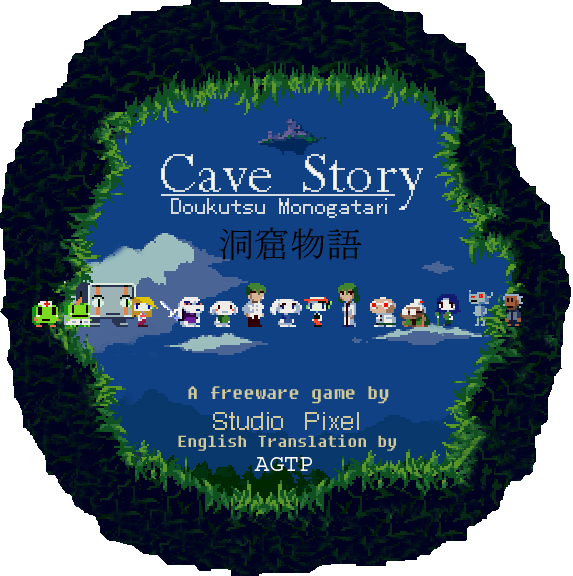
I would never have played Cave Story if a friend of mine hadn't bought me a copy of the Steam re-release as a present. He hadn't played it (he knew almost nothing about it), it just struck him as something I might like. I'd heard about it in passing a couple of times, but never thought much of it. The official description on the website read:
Cave Story is a jumping-and-shooting action game.
Explore the caves until you reach the ending.
You can also save your game and continue from where you left off.
With hindsight; a description so utterly inadequate as to be ridiculous. I would go so far as to name it the greatest misdirection in the history of gaming. Pixel demands that you go into the game expecting nothing more than an action-oriented platformer, a fun diversion. Cave Story requires no hype, no trailers, no interviews and no introduction. It is the perfect example of a game that is entirely self-contained, bringing you everything it has to offer - a deep and involving story, emotional investment in your actions and a viscerally beautiful experience in both sight and sound - using nothing but the tools of the medium.
The problem in writing this article is that the sheer quality exhibited by each and every aspect of Cave Story's design is overwhelming. I cannot write about it in the way I wish to, since my incoherent babble would only make sense to those who have played it. It's like trying to eat a mouthful of the perfect trifle in the perfect way - you'll never fit every layer between those cruel human jaws without tarnishing the overall experience of such a deep and well-engineered dessert. The only way I can think of to convey the value of this game is to break it down like any other into its arbitrarily-decided component parts and explaining why they work so well, but even then I will fail to explain properly. Really, the best thing you can do is to go - now - and play it through in its entirety. Twice, I'm afraid. Otherwise my description (lurid and flowery though it may be), will be just as laughably inadequate as the three lines Pixel used to describe it.
Once you've done that, I would like to speak to you over the page.