
Civilian Casualties of Game Design

N27502567_30338975_4931
Monday, October 18, 2010
EDITOR'S NOTEfrom Brett Bates

Brad's article prompts an interesting question: Just how realistic do we want our military shooters?
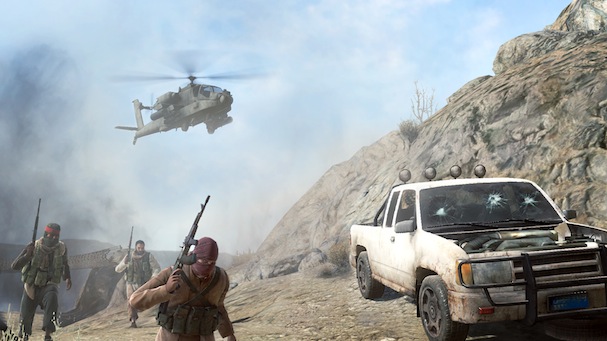
Medal of Honor

Critics have spilled plenty of ink over the Taliban controversy in the multiplayer component of the recently released Medal of Honor, but playing the game’s single-player campaign has brought to my mind another sensitive topic: the question of civilian casualties in warfare. While the presence of non-combatants and killable civilians has long been a staple of open-world action games like the Grand Theft Auto series and PC role-playing games like Ultima and Fallout, it’s something often conspicuously absent from military shooters.

Developers design many of these games so that civilians are not even a factor, such as setting the action on Mars, on a derelict ship, or in a time after a disaster has conveniently decimated the population. However, Medal of Honor is set in a real-life, present-day conflict and simply can’t avoid the issue. The question remains, is it possible to create a shooter where the presence of civilians on the battlefield is a real factor, or is it simply too difficult to do so in an interactive medium without inviting controversy?


Modern Warfare 2 is the most obvious example of a game that pushes the limits by including the extremely contentious “No Russian” level. In it, the player is asked to participate in a terrorist attack on a busy airport. Unlike many controversies that hit the mainstream press, “No Russian” remains contentious even among core gamers. I don’t put much stock into conspiracy theories about how developer Infinity Ward included the sequence for the express purpose of causing a dust-up, but there are legitimate concerns about whether the level was in good taste.

On the other hand, many arguments I’ve heard against level’s inclusion seem to stem from a complete misunderstanding of how the fits in with the larger narrative. (Spoiler ahead.) The reason you are ordered to go forward with the attack and not simply take out Makarov and foil the plot is because General Shepherd, your only contact with the government, is the villain. He recruited and placed you there for the express purpose of provoking war with Russia.

Infinity War deserves credit for pushing forward with something so provocative. “No Russian” was simultaneously a way to make the player participate in an atrocity that was quite literally beyond their control and a way to deconstruct the criticism that their games are simplistic shooting galleries where you just shoot everything you see as fast as you can.

But Modern Warfare 2 still doesn’t go as far as to include civilians in the actual theater of war. Despite levels that take place in Afghani towns, Brazilian slums, and suburban America, there is not a single civilian to be seen on the battlefield, and you are never asked to make a snap decision in the heat of battle as to whether you are looking at a militant or an unarmed villager.

Even more so than Modern Warfare 2, the Medal of Honor reboot places you in situations where you’d expect target discrimination to be a factor. In fact, the game warns you on multiple occasions to “check your fire” and be mindful of friendlies and civilians in combat zones. But in the entire game you really only see one civilian. This occurs during a non-interactive cut-scene where you watch one of your teammates perform a non-lethal, stealth takedown. There is also one prerendered cinematic that involves friendly fire against allied forces, but when you are actively controlling your character, civilians are not a concern. Every other person you see on the battlefield is an enemy or one of your squadmates -- who just complain a bit when you shoot them.

Perhaps it is asking too much of Medal of Honor to include situations where you might inadvertently shoot an innocent, especially given the reverence for our fighting men the game champions, but the absence of them is made all the more glaring when developer Danger Close touts that the game's story and design are grounded by realism.

Another title that suffers from a similar problem is the 2008 title Far Cry 2. The game is set during a civil war in a small, fictional nation in Central Africa. You play a mercenary hired to track down and take out the arms dealer who is profiting on the violence. In the country, you find that most of the population has fled and two factions are fighting over control of the region. You score diamonds (the game’s primary currency) by pulling jobs for one warlord or the other, often helping to perpetuate the violence you are ostensibly there to end. You must also take occasional missions to earn malaria medication -- usually of a more humanitarian bent, such as helping a local priest arrange for refugees to evacuate.

But again, the game itself cannot live up to the narrative. The town that serves as your main quest hub is a tense demilitarized zone where the faction leaders barely coexist, but none of that conflict carries on into the rest of the game world. Once you are out of town, the enemies become random and generic and universally hostile to you and you alone. The story implies a constant battle for territory between the two factions, but you’ll see no evidence of that, nor will you encounter any of the refugees actively being displaced by the conflict. Those you do see are always huddled safely in an NPC’s safehouse where there are on display only for the few seconds it takes to hand over some passports. It’s a clear case of the developer’s ambition outstripping its grasp.

Ironically, I’m advocating for games to introduce an element of collateral damage not because it will make them more fun, but because it could make them more interesting. It would be easy to pop in a few civilians and create a fail-state should the player kill them, but that doesn’t exactly sound like a good time.

Allowing players to gun down non-combatants without consequence is just as unsatisfying a solution, but there’s hope. We are lucky enough to be gamers just as the medium is beginning to really blossom and grow beyond the stigma of mindless amusement. Their interactive nature allows video games to challenge us as players in a manner that goes far beyond hand-eye coordination. Already, many independent developers are mining the depths of human experience to create games that are more than “fun,” but this potential will never be fully realized unless more mainstream developers are willing to take bold risks with their titles.

If that includes more thought provoking, Fox News-baiting sequences like “No Russian,” I look forward to the conversations they will spawn.

 
Problem? Report this post
BRAD GRENZ'S SPONSOR
Comments (8)
October 19, 2010

Great article.  I, too, would love to see more consequence in our military games which should lead to greater creative and artistic freedom.  But there's certainly a fine line between bringing the realism of war to players and glorifying war for shock value and profits.  If the proposed "realism" and consequence in a game is presented tastefully and within context of the game as a whole, I'm all for it.

Default_picture
October 19, 2010

My concern here would be the entertainment vs. art factor, but that's nothing new. This is inevitably the primary cause of my concern in any game based on a real war/conflict. 

In one sense, if video games are a narrative art form, they should be able to cover war in all its nastiness, collateral civilian damage included. All other mediums can and have captured the horror of war quite effectively. 

But on the other head, the inevitability is that these games are going to be played, at least in part, by the kinds of people who laugh and give each other high fives because of especially gory headshots, which has very little to do with an artistic representation of war whatsoever.

Balancing these two aspects of the game is tricky, and in my mind the answer is always whether you're playing multiplayer or not. Playing any game multiplayer automatically removes you from the artistic experience, and puts you into a more entertainment setting. Single player can tell a story, and be as realistic and visceral an experience as the devs want to be. Multiplayer can be realistic and visceral, but I don't enjoy playing multiplayer games that verge on the irreverent. If MW2 had allowed you to play the No Russian level in multiplayer, trying to shoot your buddies between crowds of innocent civilians, mowing them down in the process, I would have found that completely tasteless, and not wanted to play the game whatsoever. 

Stoylogosmall
October 19, 2010

I love realism attached into games, however I feel that there is still a loud voice out there going against tackling real issues in video games now (religion, politics, current events, etc.). We've obviously seen that the medium has the capabilities of expressing these certain forms of realism, but the mere thought of you, as the player, "acting out" the action still scares some (hence why many can't stomach the "No Russian" level).

It still doesn't excuse developers from pushing further and further. There will always be controversey with this topic of realism in games (just like movies before, and music), and I feel it is a good thing because it matures the medium and allows developers to further innovate and bring on new ideas, not only in gameplay, but story telling and narrative.

And going on what David said, you put out an art piece (any art piece really) and you're going to have different viewpoints on it, and different experiences. Some people probably laughed histerically at the "No Russian" level, and some people will think that Medal of Honor is pro-Taliban and anti-American. It's all in the presentation and the message that is meant to be conveyed by the artist(s), which people fail to grasp, much less comprehend, when they pass judgement.

Default_picture
October 19, 2010

I have a litte correction to add to this article. I don't know whether it is because it is the uncensored version from china, but im my modern warfare 2 there are civilians. Remember the mission in the favelas where your hunt down rojas? In the lower part of the favelas there are a lot of civilians running around and shooting one results in instant mission failure.

And I think this is the best approach to civilians in shooters. It makes the player think twice before he shoots.

Another example which I found interesting was red dead redemption. I know it's kind of off-topic because it's not a war shooter but what surprised me is that as a player you don't always know who the bad guys are right away. For example I tried to play John Marston as lawful as possible but during the first hour of gameplay a man came runnig towards me being followed by two mounted men shooting at him. Instinctively I shot the aggresors in order to help the poor man. As it turns out, he was a criminal running from the law. That moment was kind of weird because I had a really bad feeling about what I had done.

I think it is necessary to have innocent people in shooters to create a maximum of realism. It is also important for the developers to force the player to distinguish between good and bad. I think it would be even better to award the player for sparing civilians or disarmed enemies.

Jayhenningsen
October 19, 2010

"uncensored version from China" - Isn't that an oxymoron?

N27502567_30338975_4931
October 19, 2010

@Rauno: I have no recollection of that in MW2, but it was the one game I don't have installed at the moment and didn't replay to capture screenshots while writing this. Let's see if I can find it on YouTube!

OK, here's a clip showing the level: http://www.youtube.com/watch?v=6_l43ZatZsc

Good catch, but it does look like the civilians are pretty clearly characterized as such. I was thinking more in terms of the kind of judgement calls soldiers have to make in Iraq and Afghanistan where they have to make a snap judgement as to whether that's a pregnant woman or a suicide bomber with a brick of C4 under her burka. Or clearing a building and finding a family you can't be sure isn't aiding the enemy, things like that. In MW2, the Brazil levels are a little different in that Caracas isn't a war zone. It's more like a police action in that case and the non-combatants are clearly demarked as such. But your point is well taken.

Default_picture
October 22, 2010

@Jay: No it's not :) For example the "No russian" mission is fully playable in the chinese version while the european version is censored so you can't kill civilians. Same thing with the intro in Modern Warefare 1: In the intro you were free to look around while in the european the view was scripted.

@Brad: I got your point and I totally agree with you.

Jayhenningsen
October 22, 2010

Rauno - I meant that more as a joke, but thanks for the clarification. It seems odd to me that in games with cartoony graphics like World of Warcraft, China forced Blizzard to make huge changes, such as not being able to depict bones and certain types of undead creatures. In counterpoint, they allow more realistic violence against civilians than the Europeans did.

I know these stem largely from cultural differences, but it seems a little strange to an outside observer.

You must log in to post a comment. Please register if you do not have an account yet.