
When you really think about it, death has a lot of functions across a wide variety of genres. Developers can use it to teach, to build tension, to further their dramatic goals, or to add weight to decisions...and those are just the uses I thought up in three seconds. It truly is one of the most versatile aspects of game design.
Online battles result in unfathomable amounts of casualties.
In-game death both haunts and amuses me. Defining death is pretty hard when it comes to virtual worlds. Because it is so easily and frequently used, I can’t help but get the feeling that it isn’t final or significant. Mowing down a couple of goons lacks the emotional punch that it does in other mediums. It's hard to take death's finality serious when game makers toy with it so lightly.
The death mechanic has turned into a simple means of punishment and reward. Transforming death into amusement stands on controversial ground, but miraculously, it also translates into interesting and fun experiences. This ultimate fate can rear its head before it even registers with the player. The simple pull of a trigger shamelessly ends life.
Death is successful and influential in games because it is universal and thrilling. Many games use it to drum up action set pieces, while others use it as a means of teaching and creating fun -- not necessarily an obstacle but a challenge. Either way, death is simply a method for drawing a contract between the developers and the player. The game says, “Can you handle this?” and the player replies, “Sure...and then some.”
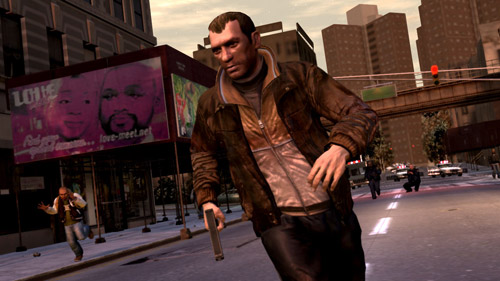
Perhaps because of its prominent use of death, Grand Theft Auto 4 is a
controversial game.
Developers depict death so realistically and trivially that it tends to create dispute. Advocates against violent gaming are understandably fearful, but they often fail to see what violent titles are trying to achieve. The fact that death happens over a split second makes it seem like game makers treat it lightly. When many characters die, gamers instantly forget them. This simplicity of annihilation is the most striking concept of death in video games. Kill streaks in Call of Duty: Modern Warfare 2 show how it can happen in an instant, over and over again, and many people find that satisfying.
The very basis of the mechanic is so simplistic. Creators have transformed and readjusted to fit a wide variety of genres. By working as everything from a teaching tool to window dressing, death can add tension in a complex ways. Whether it's zombies that are chasing you or a couple of weak grunts suddenly becoming one too many, developers can create a diversity of interesting scenarios. With a little bit of creativity, death can do a lot more to hold an audience captive.
A notable title that implemented death well is Portal -- specifically, the scene where GLaDOS forces the player to euthanize the Weighted Companion Cube. The game somehow builds a friendship between the player and an inanimate object. The friendship results in a heart-breaking conclusion. Instances like this capitalize on video games' unique interactivity aspect to convey emotional loss that stems from death.
Even though developers so widely implement death, it still strikes me as one of the most complex and miraculous ingredients ever added to the gaming lexicon. I have spent hundreds of hours fighting to survive in video games, but I still think it will take a considerable amount of time before we fully understand the power of this mechanic.
I intended this article to be a part of the October Editor's Choice writing challenge, but due to busy schedules -- on the part of both me and my partner -- I did not submit it on time. Thanks to Rachel Jagielski's insightful editing help, I'm beginning to understand the way in which I write and implement her advice into my work.