
Publishers must stop pass-locking multiplayer modes

Rm_headshot
Tuesday, February 07, 2012

Occasionally, you get an absolutely hysterical press release in this business, or an article entirely based on one. Case in point; Publisher/developer Electronic Arts tried to make some hay last week for not online pass-locking any content in its upcoming Syndicate reboot. That became news-worthy because such things now qualify as unusual.


Might I suggest next time you just use the door?

If you're unaware, the online pass partitions off a certain portion of the on-disk content for first-time users only. Input the one-time-only code that comes with a brand-new game, and you get the full works. Otherwise, you have to pay extra to get it as downloadable content. Publishers call it an anti-piracy device, but that's a lie. If they wanted to discourage piracy, the code would unlock the entire game, not just one corner of it. No, they want the online pass to kneecap the used-game business, pure and simple.

Personally, I count the online pass as a fairly ingenious device when used correctly. But no sooner did I list out my rules for a good online pass than I threw in Resistance 3 and Battlefield 3, both of which broke my guidelines by locking the multiplayer modes. Twisted Metal and Mass Effect 3 will follow suit.

That's unacceptable, reprehensible, and detrimental to the industry all at once.


A lot of this goes right back to the debate World of Warcraft provoked years ago: Do you own the game you legally bought? According to Warcraft developer Blizzard, the answer is no, you don't. They own all the content you interact with in-game, and you cannot sell or trade it outside of their strict control. An online pass presumes the same thing, allowing a publisher to control access to content stored on a disc in your legal possession and enforcing your compliance with a licensing agreement you tacitly accept merely by loading the game.

But I can sell or trade a used book, a used CD, or a used DVD from right off my shelf without asking permission, completely intact, and nobody can stop me.

As far as I know, nobody's mounted a legal challenge to a game publisher's licensing agreement quite yet, but I have to wonder how well it would stand up in a court of law given how packaging doesn't spell out all the details at the point of purchase. Throw that out, and pass-locking on-disc content becomes a class-action lawsuit waiting to happen.
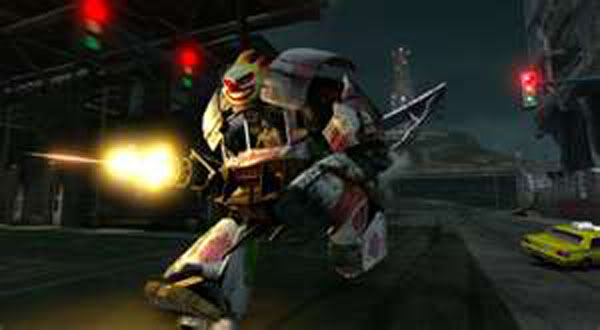
Twisted Metal
Smog this, DMV!

And while I'm here, allow me to challenge the notion that publishers pass-lock content for anything other than commercial gain, as opposed to guarding against financial loss. EA now typically online pass-protects multiplayer modes in projected hits (Battlefield 3, Mass Effect 3), so don't think they opened up Syndicate in an altruistic display of heroism. No, they're re-launching a dormant franchise from the '90s, and they don't want to hobble its chances by selling half a game. Same goes for SSX...its online pass doesn't block an entire mode, but will affect how fast you unlock gear.

Sony feels Twisted Metal can ride its reputation all the way to the bank. Syndicate doesn't earn that level of confidence from EA. Mass Effect 3 does. Demand determines accessability. They lock their content accordingly, without regard to the game itself or the people who might want to play it.

These decisions look great on a balance sheet, I'm sure, but those are disastrous moves and here's why: Mode locking keeps people from playing the game, and any plan requiring used-game buyers to pay extra for something they bought on the cheap qualifies as advanced dementia.


Whoa, wait, is that a jet pack? Does that mean I can armor lock?

So let's run the slow-motion apocalypse scenario for a moment. Online passes start locking multiplayer modes in most games. Safe to say that Microsoft gets the first pinch as Xbox Live subscriptions dip, since used-game buyers can't use premium memberships anymore. Those losses get passed right back to the publisher when it comes time to negotiate console license fee...the price every game pays to play on their platform of choice. Long-term profits take a hit as multiplayer populations drop faster than usual -- no used-gamers to pick up the slack for retiring players.

Then maybe GameStop decides to renegotiate its margins with the offending companies as a survival move. Not a position any publisher wants to be in with a major retail channel, particularly if Best Buy eats it in the next few years, which seems increasingly possible.

Plenty of things could interupt that decent. The nosedive might never progress so far. But simply put, mode locking doesn't produce any winners. Online passes can work and work well, but when you block half the game, you're treating customers like criminals. Good luck finding a business model where that turned out well.

 
Problem? Report this post
RUS MCLAUGHLIN'S SPONSOR
Comments (30)
Default_picture
February 07, 2012

Codes that can only be redeemed online cannot be used to section a whole game at this point because plenty of people still don't have constant Internet access for their consoles.  Try to institute something like a CD-Key couldn't work for this exact reason.

Games are slightly unique in that they cost so much more money upfront.  A person buying a used DVD makes a publisher lose $20.  A person buying a used game can make a publisher lose $60.  That is quite a bit more money on the line.  For this reason, I can understand why publishers are so quick to recoup costs any way they can.

Of course, that doesn't make what they do right.  Even for someone like me that buys most games that aren't a few years old new, I have to take the time to put in the damn online code before I can play (not to mention any pre-order bonuses or retailer-specific bonuses).  These codes are simply a bandage to the used games problem and will probably be replaced with something worse when someone figures it out.

Robsavillo
February 08, 2012

Publishers don't need to require their games' CD-keys to have online authentication. PC games' CD-keys locked away everything on the disc since inception, before the Internet.

And it's quite a stretch to say that publishers lose money from used content -- you're forgetting that the first buyer already paid the publisher for that particular copy, and unless you're ready to erode property rights, the publisher has no rights to property that it's sold to someone else.

Default_picture
February 08, 2012

Agreed Rob. Publishers are not victims in this equation. Used sales hurt them probably about as much as online piracy does, which is to say, not very much. However the people who really do get hurt (and a differentiation that most people forget to make) are the developers (except in very rare cases where the developer is also the publisher, as with Valve).

Robsavillo
February 08, 2012

Um...no. I respectfully disagree. The first buyer already paid for the copy in question. Both the publisher and developer (through a contract with the publisher) were already compensated for this individual sale. If the first buyer decides to sell that game to a second buyer, neither the publisher nor the developer have ownership rights to that copy, i.e., they have no rights to earn money from the sale of that copy.

The real problem here is that publishers (and developers) want money every time a single copy of a game exchanges hands. This is a clear assault on long-established legal precedent regarding copyright and property rights (i.e., the first-sale doctrine).

Default_picture
February 08, 2012

Rob, no I think we do agree, but we're not seeing eye to eye on the details. I'm not disputing the ownership rights of the consumer to resell the product. The point I was trying to make is more on the subject of the sale of a used game over a new copy, not the compensation to publisher or developer for that used copy. I personally believe that the used market should and needs to exist. Where the issue arises is when used copies trade hands multiple times while new copies sit on the shelves. Admittedly, this a problem in the tactics of the retailer, and not one for the consumer. However, make no mistake, the publisher sees profit first, and the developer gets what is left over (usually after the funding has been repaid). Does this make the publisher responsible for having doled out the money to fund development? No. However, it is a fundamental problem when the developers themselves are seeing very little return. Used sales over new sales complicate this matter by removing more possible revenue for the developer. It's a complex issue, and the details are very much in question. Personally, if I could purchase directly from the developer, and cut out the retailer and publisher, I would (and do, when the opportunity presents itself). 

However, I am not disputing the ownership. I fully believe that the consumer has the right to do with their purchased product what they will. On that we definitely agree. Make no mistake, though, that the developers are much more beholden to the publishers than you think, and their fate is linked to what the publisher does, whether bad or good. If they sell one game and never another new copy, while the one passes hands between all the people of the world, I can guarantee you that that developer will be the one to suffer while the publisher chalks it up to a financial loss and moves on to their next venture.

Robsavillo
February 08, 2012

The thing is, though, that it's a hefty assumption on part of anyone to make that a used-game buyer would have bought a new game had the used game not been available.

Obviously, we're talking about a price conscious consumer, and we already know that this consumer believes $60 to be too high (otherwise, she would not be considering buying a used game). We can no more say that used games are purchased in lieu of new games than we can say that games are pirated in lieu of being purchased. It's the same faulty logic.

In other words, if people are buying your game used overwhelmingly, then your game is priced to high. Without the used option, these consumers may not have ever bought your game at all.

Default_picture
February 08, 2012

Sure, CD-Keys don't need Internet access to function but without it they are that much easier to hack around.  Even then, they are laughably easy to get around in their current state.

I absolutely agree that the publisher should have no rights on a copy of a game that has already been sold.  I just think that in their minds that equates to a new copy of the game that would have have been sold if the used copy didn't exist.  While this isn't always true (some people only buy used), that is probably how they see it.

Default_picture
February 08, 2012

Price-conscious has nothing to do with people buying used at Gamestop. If you walk into a Gamestop to buy a game that came out a week ago and pick the copy that costs $55 instead of $60 you're not being a price conscious consumer -- don't give yourself that much credit. 

I also think it's clouding the issue to say the publisher wants money "every time the game changes hands." The publisher wants money from every person who buys and enjoys their game, especially if they enjoy it enough to spend time in multiplayer.

Default_picture
February 08, 2012

To say that we can't say that used games are purchased in lieu of new games is false, I believe. Essentially, we have three types of customers. We have people who always buy new for whatever reason, people who always buy used, and people who fall somewhere in between. The people on the fence are the people in question. People who buy used all the time we can rule out, because the odds are good that nothing will ever change their mind. The people who buy new are obviously not the problem. The real problem, as Adam pointed out, are the people who are on the fence about buying a game for $60 when the used version is $55. Honestly, for the person who is willing to make that kind of a tradeoff, we're not talking about price-conscious. We're not even talking about a game being priced too high. The difference in price spells that out rather clearly. It's also not about the person who chooses to buy a game that's 2-3 years old for $15, instead of $30. I wouldn't even try to argue that point. But can you honestly justify putting $55 into Gamestop's pocket instead of $60 into the hands of the publisher/developer who made the game? Now, I realize, that most people don't think beyond the $5 difference. However, this goes back to the discussion at hand and the meat of the article. If the publisher wants to offer less to the person who would pay $5 less to a pawn shop for a used version of the game, I don't see how that can be argued. This is not to say that the person who purchased it new in the first place doesn't have the right to sell it for $20-$25 to the pawn shop. It isn't even really in the same argument.

At any rate, the people on the fence are the ones that are in question, and we absolutely can say something about them. For some, $60 may be too much to pay for a game, but not when they are buying the used game for a mere $5 less. That absolutely does hurt the developers. 

Robsavillo
February 09, 2012

OK, time for some (GameStop specific) facts.

1) Only 4 percent of used-game purchases are of games released within the 60 days prior of purchase. We all know game sales are front loaded to the first few weeks. So this means that people are not buying $55 used games (Although, let's be fair here and acknowledge that heavy used-game buyers are likely to have an Edge card, and thus, they receive an additional 10% off. That makes the purchase $50.) when they intended to buy new. Most people buy games new when they come out, not used.

2) 70 percent of proceeds from trade-in value goes directly into buying new games. This means that most people (and by a large majority) are buying new games and then selling them later to buy more new games.

Look, I get it. That we're here discussing the business end of the industry means that we're bigtime fans of gaming. We all want developers to succeed, and thus, many of us tend to overidentify with game studios. We're fans, dammit, not mere customers.

News flash, though: The industry doesn't treat you like a fan. You are a mere customer, and their attitude toward us is clearly evident in these types of money-pinching schemes designed to wrestle ownership and control from us.

I'm just about done having this argument, honestly. If the industry wants to cut off their own legs out from underneath themselves, so be it.

Robsavillo
February 09, 2012

Also, check out GameStop's public financial reports. In the latest report, go to page 33. GameStop sells more new hardware and software (2010 numbers: 18.1% and 41.9%, respectively -- that's a clear majority) than used products (2010 numbers: 26.1%). But the retailer also profits more much more from used products (2010 numbers: 46.2%) than new hardware and software (2010 numbers: 7.3% and 20.7%).

If the industry cuts into GameStop's best source of profit, which allows them to open more stores in more locations (and therefore, sell more new games and consoles), the industry should expect to see a decline in sales of new games and consoles, too.

Default_picture
February 09, 2012


Rob, I agree that the Gamestop argument is a tired one, and while it is still a valid problem, it is something that is extremely complex and will see no solutions from people like us (I also do appreciate the debate, and the citations you have provided). I merely brought them up in my example because they are the largest video game retailer in the world. I believe this problem extends beyond them, but I would like to address some of the valid points you made (Keep in mind, I only take issue with people who purchase a used game within a short period of the game being released). In the first article you quote, the Gamestop exec gives the figure that 4% of used sales come from used games sold within 2 months of the game’s release. Now, this figure is obviously chosen for a reason (it SEEMS very low), but I’ll use it anyway. Using the 2010 report that you kindly pointed out, the total revenue for Gamestop in 2010 was 9.474 billion. If approximately 26% of this is used sales (couldn’t find the info you pointed out on page 33, but I’ll take your word for it), that means that 2.463 billion in revenue comes from used sales alone. Now, let’s take 4% of that for all used games purchased within 60 days of being released for the year, which equates to approximately $98,529,600. Now, that’s no small number when you consider that that’s the revenue purely for that 2 month period of time. If we carry that out to sales of a used game within 6 months of being released (in my opinion, more realistic since this is the average time it takes for a game to drop in price, both used and new), that number swells far beyond that. So, while it may seem like the numbers are low, rest assured they are quite significant. Also, I don’t believe for a second that Gamestop will ever have any trouble opening more stores, whether the industry is cutting into their used sales or not, nor will their ability to open more stores or not have much effect on the number of people buying new products or industry numbers. Where I am from, there are 3 Gamestops within a three block radius of each other, all catering to the same clientele. However, Gamestop aside, we can say this about most retail shops that deal in used sales of games that were just released (Gamestop just happens to be the biggest offender).  

My point remains the same. The developers suffer from used sales. It’s just a fact. Publishers try to offset this by making sometimes ill-informed decisions that end up hurting consumers. It’s a game of push and pull, and by and large, we’re not invited. And yes, we have this discussion because we care, but I identify with developers because I care about the games that they make, and I generally want to see them make more. I also identify with them, because by and large they ARE us. A large majority of developers got into it because they love the hobby just as much as we do. Those are just two reasons I can think of to support them as much as I can. And while what publishers are doing very well might cut the industry off at the knees, you can be sure that Gamestop cares not a whit about whether the industry is holding the axe or they are.

As a last note, it does not matter whether the number is $5 less or $10 less. If consumers were truly price conscious, they could find acceptable alternatives. There do exist places online where games can be purchased new for the price of a used copy at Gamestop. That, to me, is the definition of being price conscious. There really is no excuse, except for being lazy, and to those people I believe that if you lose out on a multiplayer mode because of a decision like that and end up having to pay extra to get it, you essentially get what you paid for.  

Robsavillo
February 09, 2012

Page 33 of the report, not of the PDF file.

You're mixing up the sales and the profit percentages. Twenty-six percent in sales means the percent of products sold, not the percent of profit made. GameStop saw 46.2% in profits from used products in 2010.

Bottom line: GameStop sells more new stuff than used stuff. Way more. That's irrefutable. But they make more money from selling the used stuff than they do the new stuff. The margins on used products are higher, and because GameStop sells used products, they have money to open stores in new locations, hire more employees, and therefore, push more new products, which they sell at a higher rate than used products.

You should believe that GameStop wants to open new stores. In 2010, they allocated $75 million to open 400 new locations.

"The developers suffer from used sales. It’s just a fact. "

It's not, and you haven't argued a reasonable case. You have a lot of conjecture and anecdotes, a misinterpretation of the numbers, and a hefty dose of assumptions of revenue loss.

Default_picture
February 09, 2012

Look, I realize that this is a no-win situation. I'm not sure how I can mix up the profit margins on used sales when they are essentially 100% profit for Gamestop. If you would like to factor in how much they pay for the used product, fine, but the profit margin for them off of these sales is still huge (even if you do not factor in those people who originally bought the product for the new price and sold it back for a fraction of the cost, which is even more money in Gamestop's pocket). Also, I'm not disputing that Gamestop sells more new than used. That was never in dispute. The dispute was about the impact of the people who purchase the used version of a product when the new version has been on the shelf for sx months or less. My point in breaking down the numbers was that the numbers that are given are a creative obfuscation. Essentially, they only use the numbers that look small, and not the ones that are large. And I never said that Gamestop has no interest in opening new stores. My exact statement was that I don't believe for a second that Gamestop will have any trouble opening new stores, regardless of their used sales. It is a healthy assumption on your part that the lack of used sales of games within that small period of time when a game comes out would be so damaging as to cripple Gamestop's ability to open new stores, hire more employees, or stock new product. Conversely, if you believe that this number would be so large as to be so damaging, how could you not admit that the sum is no small one that they reap at the expense of the industry (by that I just mean money that cycles endlessly inside Gamestop and never sees the people who put out the product in the first place)? Either way, it seems to prove the point. 

At the end of the day, you believe what you believe, and I believe what I believe. In fact, I'm glad to know that we've both done our homework on the subject. It means that there are people out there who know more about the subject than just a few simple facts. However, though you may believe that I am full of conjecture, anecdotes, misinterpretation, and assumption about the loss to developers, I would remind you that you have provided no real evidence to the contrary. Perhaps we do need to just agree to disagree.

Avatarheader
February 07, 2012
I completely agree. Online passes are an insidious way of generating more profit that only hurts the honest consumer. But how do you stop it? With things like Call of Duty Elite and the fact that franchise fanboys will buy a Collectors Edition before a game is even out yet (which I am definitely guilty of) and not vote against this with their dollars, how do you send a message to the publishers that this is unacceptable in a way they'll understand? The next Call of Duty will sell like hotcakes whether the online component is locked to used games or not.
Default_picture
February 08, 2012

How do they hurt the honest consumer? The honest consumer will buy games new and pass the profit to the publisher and developer.

There184
February 07, 2012

If someone doesn't buy any new games with online features, and doesn't care enough to spend $10, why would they have an Xbox Live subscription in the first place? They want to spend as little money as possible on games and aren't a fan of multiplayer.

Edit: the fact that book and film publishers can't discourage used sales doesn't make it right there, either.

Default_picture
February 07, 2012

This has only prevented me from buying Resistance 3 used at a Blockbuster that was selling everything down to the carpet in the store. Otherwise, these passes aren't a big enough obstacle for me. However, there was a time or two when a certain publisher did not include an online pass in the box when they sent their games out for review. That was annoying, but it was resolved easily.

If it wasn't just multiplayer games (and only just SOME multiplayer games), I'd feel better about it in general. But again, thing haven't escalated enough to the point of lunacy. The only justifiable reason I see is that if a large enough group of people are buying this game used, you are missing out on the sales and potentially the server cost of this content.

100media_imag0065
February 07, 2012

I've said it a billion times, probably half a billion on Bitmob alone, but I don't buy any game new when it has an online pass. I purposely buy it used in protest, and I have passed the word along to as many people as I know to do the same. My favorite backlash is happening right down the street from my at my local EB Games store, where all 3 of the workers there purposely go out of their way to sell used copies of new games that have the online pass in them.

They keep a tally under the desk of how many new sales they robbed from pubishers stomping all over consumer rights with the online pass scheme, and it is a pretty penny to be sure. Apparently, the other 4 EB stores around my area are doing the same and they tell me that they are trying to make it a nationwide thing...but I would have to see it before I believe it.

The best part is, if their plan to rob publishers of sales when that publisher uses an online pass actually spreads to more and more EB Game stores, they will never be told to stop. EB Corporate makes a ton more money off used sales, to they aren't going to tell their employees to stop convincing everyone to buy these games used. Granted they make sure the person isn't going to want to play the multiplayer before they tell them to buy the game used instead, this way they make sure that person doesn't get home and give a company like EA $10 to play online.

Right now, the biggest game that they sold the most used copies of is Resistance 3. They purposefully sold so many used copies of that game to protest the online pass that they STILL have more than half of the original shipment that went unsold. Absolutely brilliant! I really hope the word keeps spreading to the other EB stores around the country. Maybe then publishers will back down with this robbery that they call business.

I can't even remember the last game I bought new. Almost every game I want to play has an online pass in it, so I just wait a week and sure enough there are used copies at my local EB stores. I used to buy almost all of my games new. As a matter of fact, I am saving a ton of money buying everything used now. Maybe they should keep using the online pass after all, this way I won't have to buy any new games ever again!

Default_picture
February 07, 2012

If you care about supporting the developer for making a quality game, how is supporting this "buy used" movement going to help them? I've seen too many good studios go under. I can't help but think that pirated and used games helped them down that path. Online passes aren't helping the developers, only the publishers. But new game sales help keep the developers relevant and fundable.

Lolface
February 07, 2012

Not as often as you would think. After all, does purchasing L.A. Noire new help Team Bondi?

Also, you could just buy used games from Gamefly, and you get the unused online pass free.

Default_picture
February 08, 2012

Matthew, Team Bondi is a bad example. They were facing an uphill battle (not to mention a legal one) in terms of finances right off the bat. They were doomed from the beginning, because of mismanagement, and while new sales helped to pay the developers SOME of the money they were owed (last I heard, many of the developers had their own lawsuits going just to get paid for the work they did), the company of Team Bondi itself was in ruins. So, in a sense you're right. But again, that is a very atypical situation. However, there are many cases where developers close up shop because they are not able to remain solvent in the face of poor sales. Now, whether this is due to used sales or just a poorly made game, that could be argued. However, one thing that cannot be disputed is that new sales ALWAYS benefit the developers, while used sales net them nothing. 

Default_picture
February 08, 2012

As a brief sidenote, I'm speaking about games that have just released. There is no argument about games that are years old. As with the list you provided, good luck even finding a new version of any of those games. The real problem in this equation lies with the sale of used games that have just released. Just wanted to clarify that. 

Default_picture
February 08, 2012

FYI, online passes DO help developers. 

Default_picture
February 08, 2012

The sad part of all this is that the great war between Publishers and Retail giants only hurts the people who really matter in this equation. The people who actually play the games, and the people who make them. The consumers and the developers are caught in the middle, and none of this benefits either of them. This situation only complicates matters. 

Default_picture
February 08, 2012

Amazed at the number of people taking dramatic philosophical stances against this issue. Gamestop is leeching money out of the game industry by taking profits directly from consumers and not passing anything on to publishers or developers, i.e. the people who actually make the games we all enjoy so much, and everyone is lashing out at the publisher's attempt to get a cut of this by tacking on an optional $10 fee that doesn't touch anybody who buys games new.

Default_picture
February 08, 2012

Why is it that everyone is decrying things like project ten dollar and day one DLC for giving money to the publisher? I get that locking content on the disc is not cool, but things like limiting multiplayer(Space Marine) or limiting DLC to people that join the DLC network(while rewarding them with DLC, that would be Mass Effect 2) is probably the easiest way for developers to still get money, while still allowing players to buy games at a lower price.
The games industry isn't like movies or film, where you hear about a 120 million dollar budget, and then it turns around and pulls a 1 billion dollar profit that mostly goes into the pockets of the investors that funded the film.
The profit margin is a lot tighter for both game studios and publishers. Some make it huge, like Notch, but very few do. Most of the projects that devs actually want to make, in other words, the niche games that don't fall into the yearly titles like EA Sports, Medal of Duty Warfare Field: Modern Company 3, Racing titles, and lisenced film titles, don't really turn much a profit. Bioware have happened to strike gold with everything they make, but look at their little brother, Obsidian. Each year, I wonder how they manage to stay afloate with as many failed titles as they have. My point is, Games are not Film or Music. The investors don't get nearly as much of a return as you think they do, especially considering that EA nearly failed once, and THQ is slimming down a ton, and might fail. Locking content isn't quite the right way to go about it, but day 1 DLC is not hurting you as much as you think it is.

Stoylogosmall
February 09, 2012

Online passes for video games would be like buying a radio for a used car from the original manufacturer. You don't really NEED it, but it'd be nice to have once you open the box. 

While I agree with everyone's opinions on this matter (especially the parley between Rob and Matt), one needs to understand that as much fun and artistic video games are, video games are still a BUSINESS, and the businesses involved in it (whether it be EA, Activision, Infinity Ward, Gamestop, etc.) want to get their piece of the pie. And whether that's selling used games, online passes, or DLC, it will be a trend to the end...

Unless people stop buying them, or being interested in them in trend-settings. If you think online passes are shit, publishers won't even consider foregoing them if they are still seeing profit from it. Same with used games. Gamestop sells used games because they make pennies on new games and systems, and they need some kind of regular profit to make the umpteen billion stores they have out there. But there can be good in all of it. 

Think about pirated games. Although bad in a both legal and ethical sense, it can serve some good because you know people are playing it. Last year Crysis 2 was the most pirated game, which was torrented close to 4 million times. When you think about it, imagine how many of those millions of users will actually stand up and say "You know what, I'd buy Crysis 3 if it came out!" That'd open up a slew of more new sales on the next go around. **in no way do I condone pirating games!**

I have a feeling I've turned myself cross-eyed with my reply. Basically what I'm trying to get at is that as much hate anyone can have against any of the above mentioned money-making opportunites, they all serve some kind of purpose, the "ends justifying the means." However, if you don't like online passes, don't buy one (I have yet to buy one). If you don't like used games, don't buy one (I haven't bought a used game in over 6 months, trying to quit...it's like quitting smoking, I swear). 

Default_picture
February 11, 2012

Honestly I don't really see what the big deal is about these online passes.  It's not like they're charging more for people who buy new.  They're just trying to get some money out of the people who buy used, and in a fairly clever way.  Of course I don't play many games online anyway, so maybe I just don't have the outrage reaction that I should.  But it seems to me that if you care about playing a Battlefield or what-have-you online, you're probably buying that game new anyway, and pretty early-on.

On the other hand, I guess it is cause for concern when publishers do these things that attempt to defeat or marginalize the used games market.  While I don't buy used myself, I do buy almost all my games long after release, after their prices have dropped, and I imagine that probably wouldn't happen so quickly (if at all) if the used games market didn't exist.  So it is a little worrisome, this whole "war on used games" thing, but the online passes... I just don't think that's as big a deal as some people make it out to be.  UNLESS, that is, the online pass is required for more than just multiplayer.  Which was the case with ME2, now that I think about it.  And the thing had an expiration date, which turned out to be just a month after I bought the game (I woulda been so pissed if I'd waited just that much longer).  Online passes for single-player content/DLC is bogus, and the expiration date thing is reprehensible.

Default_picture
February 11, 2012

I didn't think the required online multiplayer pass was a big deal either. I thought it just makes it harder to pirate the games. I mean, it made sense for me to register with EA's Origin service and a few other things, so that I could receive my extra limited edition goodies. But the concept realy hearkens back to the old Sierra Online days, for me at least.

I don't think developers will ever require online passes for single-player content. That would really stink. Bethesda did something to restrict Rage though. I thought the whole seal-the-sewers idea was a bit much.

You must log in to post a comment. Please register if you do not have an account yet.