Home
Home

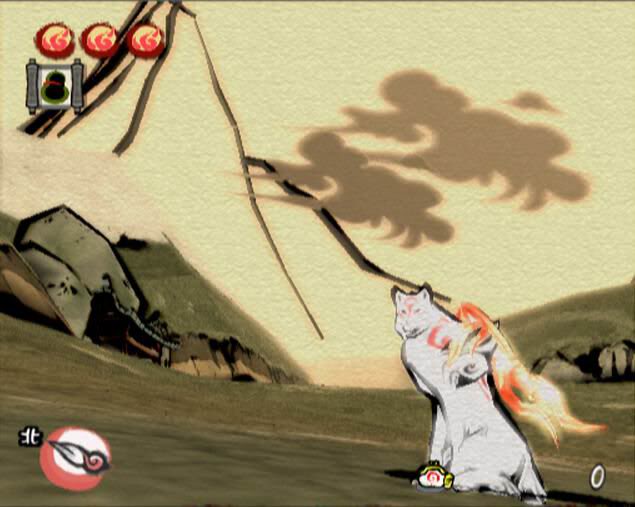 A few weeks ago I started playing Okami for the second time since its original release in September 2006. I did so on a ‘new game plus’ using my original save file, complete with all the abilities, items, weapons, and money I had when I first finished the game.
After playing for a few hours I had a tragic and unwelcome realization: I was bored -- with Okami; one of the most beloved, unrecognized and beautiful games ever made.
For a while, I tried to wrap my head around how this could be and what it meant. Has the game aged so poorly? Was it never as good as I thought it was? Did I just buy into all of the hype, praise, and mass depression following its commercial failure? What does this mean for the upcoming sequel we never thought would be (Okamiden)?
Desperate for answers, I came to the erroneous conclusion that the game’s gorgeous art, which was so pretty on my old CRT TV, just didn’t look as good on my new HD set. I scoured the Internet, searching for a cheap used copy of the Wii port, as well as an answer to my question: is Okami worth buying twice?
As I poured over screenshots and footage of the Wii version, I realized that there was nothing wrong with the way the original looked on my new TV. My nostalgia, to which I am extremely susceptible, was blowing my memory of Okami’s visuals to hyperbolic heights. Meanwhile, the Wii version, with its super-saturated colors, only seemed to betray the muted, watercolor aesthetic of the original. Widescreen and brighter colors were not the answer.
So, I decided to give Okami another shot. Only this time, I started the game up from scratch; no massive health bar, super-powered weapons or pope’s ransom worth of cash. I was just a poor, weak deity, progressing through the game as originally intended. After replaying those first few hours, I struggled to put the controller back down and go to bed.
Without a complete health bar, I actually had a reason to avoid enemy attacks. Without upgraded, end-game weapons, I wasn’t one-shotting demons to death. Without an overflowing wallet, money had value again; without four full astral pouches to resurrect me upon death, food became important again. Most importantly, experience points had relevance again, as did all of the side-quests and optional tasks that reward them. Basically, the game had purpose; purpose it lacked when I started as the Shinto God Victorious, scoffing at the mortal world and its problems.
This experience led me to a somewhat convoluted conclusion: gaining power is fun, but having power is boring.
 You could say that this is a selfish concept. Okami casts you as a benevolent deity, but my only impetus for playing the game -- for helping mortals, restoring nature and dispelling curses -- isn’t benevolence, but personal gain. For every good deed, I’m rewarded with an explosion of colorful orbs that are vacuumed into my avatar, making me more powerful. Contrast this with the real world, where we’re often taught to believe that a good deed is its own reward.
But in the game world, the lack of reward is very limiting. Being powerful makes a game’s numerous and varied offerings redundant and unnecessary. Basically, I was bored with Okami on new game plus because I wasn’t being forced -- or even encouraged -- to explore everything the game has to offer. Being powerful just made me apathetic.