Home
Home

When I wrote my initial thoughts on BioShock last month, part of my goal was to relive and explore the game in my mind because I had so little time to actually sit down and play the real thing.
Since then I have managed to proceed deeper into the heart of Rapture than I ever thought possible (mostly by playing after the wife and kid went to bed) and I want to keep writing about what I've learned, what has changed, and what I look forward to in the final chapters.
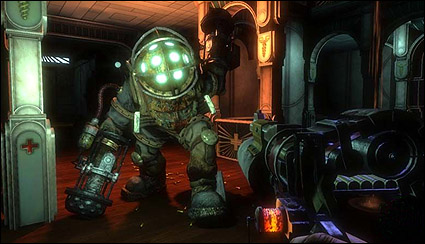 First and foremost, Rapture continues to impress and surprise me as a world to explore. While no level thus far has matched the sheer unpleasantness as the initial Medical Pavilion, each new area that I see manages to bring something different. Arcadia is overflowing with flora and fauna and half-buried bodies in the soil.
The Farmer's Market includes a full wine cellar. Fort Frolic has artistically-arranged corpses that aren't always corpses. I can tell that when this game is over, I'm going to have to read more about it to find out all of the little things I've missed.
I certainly haven't missed any opportunities to strengthen my character who now carries an entire closet's worth of armaments with him at all times. These weapons are not the most creative choices (you're fired all these guns before in other games, particularly if you played Half-Life) but I must proclaim my fondness for how they look.
The machine gun is a Tommy gun, making me feel like I'm taking down Al Capone. The grenade launcher has clearly been assembled from scraps, with the primary ammo being made of soup cans. As these weapons are upgraded, they receive small visual changes to reflect the modifications.
When I improved the shotgun's firepower, little steam valves were added to the side because they supposedly increased the propulsion speed of the ammunition. It may be one step away from James Bond's "rocket guns" in You Only Live Twice (or Homer Simpson's "speed holes" if we are being less charitable) on the silliness scale but it fits the chaotic world of Rapture to a T.
One of the unique "weapons" in BioShock is the research camera, a wonderful idea that I feel could have meant so much more. Sneaking around Rapture and photographing my enemies covertly (or overtly, if my shutter finger was fast enough) was a lot of fun, even if the loose scoring system means most pictures were little more than tapping the button as fast as I could.
The game rewards you with power-ups and damage bonuses, both of which prove quite useful as each new area features increasingly stronger opponents (more on that later).
Once all the research is complete, however, there is simply no reason to ever take another picture. The images are purely ephemeral and are not saved, so even if you come across a particularly strange sight or horrible scene you cannot photograph it for your own amusement.
The camera will not even take any pictures of enemies that have been fully researched, so eventually the camera cannot be used at all. While this is one way of letting players know their goal has been achieved, it seems like an awfully crude way of doing so.
I am reminded of the endlessly entertaining photography options in Dead Rising, a game that predates BioShock by two years. By grading every photo on a variety of scales (including more variables than simply "Action Shot"), players were encouraged to keep taking pictures whenever they came across (or purposefully staged) something unusual.
With the marvelous world of Rapture to play with, this could have been a real opportunity to tickle the aspiring photo bug in gamers everywhere.
Failing that, it would have been nice for the research camera to at least take actual pictures that could be saved to the hard drive or even shared with others. As video recording becomes a more common feature in console gaming, this does not seem like an elaborate function to include in a video game with a first-person perspective.
Instead, the BioShock photography missions are merely a brief diversion from the usual routine of "kill everything that moves."
In fairness, that routine has been remarkably satisfying because it has been so wide open. I am free to sneak in the shadows and snipe Splicers through open doorways or I can simply sprint through each room and take on all comers at once.
Rarely does the game force my hand when it comes to combat, although it does occasionally glitch itself in order to enforce scripted sequences. For example, when hunting down Silas Cobb in Fort Frolic, I got myself in a corner with a clear shot at him before he "activated," and no matter how many crossbow bolts I shot him in the head with, he never budged.
On the other hand, the "stand and fight" sequences I have seen so far have been quite a thrill because I could deal with my opponents however I felt like it. When I held off the Splicers who were storming Dr. Langford's laboratory, I used Telekinesis to hurl the bodies of the fallen against each new foe to come around the corner.
When I had to protect myself long enough to redirect the magma flow in Hephaestus, I got to construct an elaborate defense network of trap bolts and proximity mines. I was able to turn the dial without stopping to fire a single shot. Creative battles like these far outweigh the odd glitched encounter.
Combat has also become a bit more interesting with the introduction of the Houdini Splicers and the proliferation of Spider Splicers.
While all Splicers shout and babble, making them easy prey, these two have unique movement abilities that allow them to bend the rules. Spider Splicers can crawl on the ceiling and move very quickly, while Houdini Splicers can flat-out teleport.
This has made exploring Rapture much more challenging as I cannot be certain when a maniac might suddenly appear and try to set me on fire.
The regular Splicers have been getting tougher as well. Those who once carried pistols now sport machine guns, and the pipe-wielding thugs now have an electric current running through their mad, mad bodies. Beyond that, everyone just seems to take more punishment now.
Even though the game offers me a steady upgrade path for my weapons and abilities, the Splicers' strength curve has clearly exceeded my own growth. I still outgun them and outsmart them in every way, but my earlier complaints about the combat now seem premature.
I wish I could say the same thing for Big Daddies. While the earlier types have been replaced with "elite" Bouncers and Rosies, their tactics have not changed in the slightest. With the amount of firepower I now control, killing them is no longer a decision that carries much weight at all. A full canister of electric gel leaves them dead or near death, and the stunning effect guarantees me enough time to change weapons and finish them before they can counter-attack. Sure, the Little Sisters still cry, but this far into the game I barely acknowledge them anymore.
What's more disturbing is how they barely acknowledge me, considering how many of them I've harvested by now. When I was surrounded by Sisters in that tiny safehouse, all they could offer was a half-hearted "You're mean" or "Stay away from me."
Again, if this is my "punishment" for killing these creatures because they look like children, it's not effective when weighed against how many resources I was able to earn in the process. I now have more ADAM than I could ever need.
Or am I missing the point? Rescuing Little Sisters would have meant earning slightly less ADAM while receiving unique rewards from Dr. Tennenbaum, offering me abilities I cannot simply purchase now despite my power surplus.
This means I cannot earn the "Tonic Collector" trophy, nor the special hidden trophy reserved for not harming any of the Sisters (Yes, I peeked, but not until after I started harvesting). The Little Sister moral dilemma may be a failure but the game makes it clear that rescuing them is the better way to go in the long run.
It just would have been nice if this was reflected someplace besides my imaginary trophy collection.
However, I will reserve all story speculation until the game has ended, even though I am bubbling over with questions, ideas and theories after the big "twist" was revealed when I met Andrew Ryan. I never expected that encounter to go down as it did. I just assumed he wouldn't be in his office or he would at least try and fight me first.
Don't mistake my surprise for disappointment; the entire sequence, starting with the photo-covered board outside his office, was exceptional. If anything, I fear this climax (or anti-climax, in a way) may overshadow the rest of the game. Either way I look forward to finding out for myself how the tale of Rapture ends.