
Editor's note: As part of his ongoing series "Where Do You See Gaming Going?" Isaiah examines game writing -- from actual storylines to implied narratives seen in games such as Left 4 Dead. Be sure to answer his questions at the end of the article. -Jason
We have come a long way from Tetris. I remember trying to decipher the canned speech and scrolling story of Streets of Rage; it was a welcomed change to the yellow circle eating the blue ghosts. I can recall trying to make sense of the plot in NES's Rescue Embassy Mission and why it was important to avoid those meddling bullet-filled spotlights. I would like to think that with this history of writing in games, good writing was just as important then as it is now. Only "then" constituted a vastly different audience than the diverse demographic of the "now" we live in.
As with the evolution of graphics in video games, game storylines and plots appear to have entered their own uncanny valley. With every attempt to further immerse players in a world, the average and even the exceptional writing in games shows the many hurdles that have consistently shown this media in limited dimensions.
The funny thing about our current multifaceted gaming culture is that there is still a need for games that rely on their bare-bones components more than its story. We still need our Marios, our Street Fighters and of course our Tetris. These games emphasize what all games need to be at their core -- fun. The concept of a game or any form of entertainment being "fun" doesn't necessarily mean you are erratically waving your arms around trying to get a pixel from one spot on the screen to the next. The concept of games being fun should be because they are engaging, challenging, and in some cases, simple. Aeris dying in Final Fantasy VII and losing Argo in Shadow of the Colossus are both moving points in those respective games. Some have cried at those moments. Thanks to a competent writing and development team, both of these games are still fun.
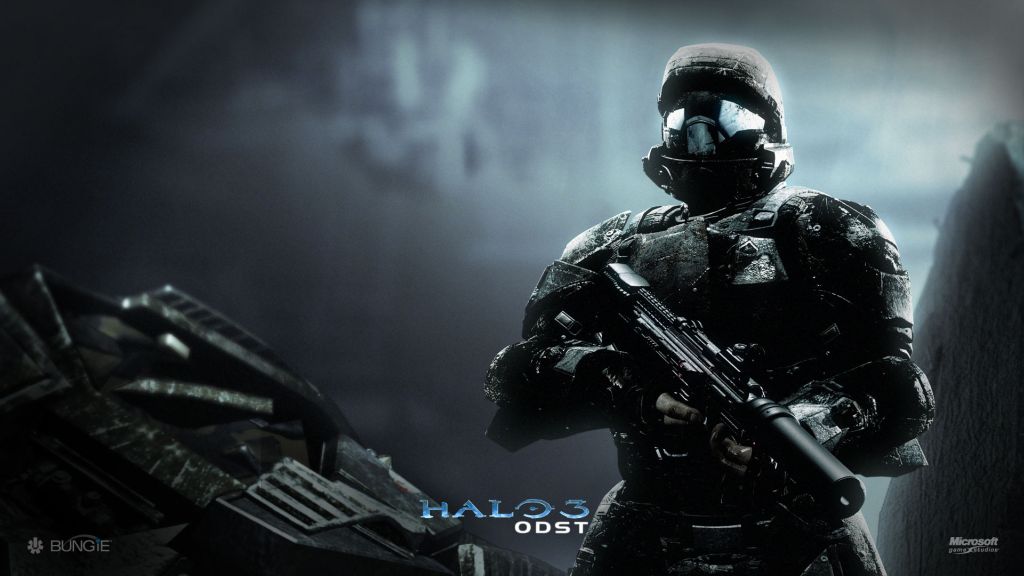
A couple months back I read an interview in Edge where developers from the game studio Ninja Theory talked about how often storywriting conflicts with game development. This theory-turned-fact, that storytelling in games is more obstacle than necessity, was never made clearer than in the climax of the very games heralded for their artistic narratives. Our BioShocks, Uncharteds, and Batman: Arkham Asylums aren't capable of keeping us "fully entrenched" in their worlds without throwing an "impossible final boss" scenario at us. I accept this.
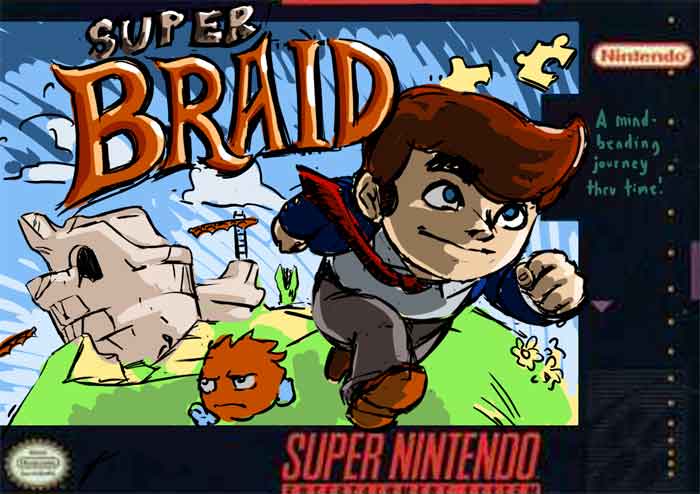
Writers and developers make compromises, and as gamers we hopefully get to play the happy medium that they strike. We can be content with the current gems in this era of gaming -- after all, games have come so far. But it seems that the writing in games has shown itself to be functioning on two extreme ends. Writing in games like Braid appear to be where developers can take the most chances.
As a high-production low(er) budget game, Braid could have been "just another run-and-jump adventure game," but Braid introduces a video-game mechanic in the rewind feature. Truth be told, I would've much rather Braid have been a game where I "stomp on stuff, rewind and save a princess," but I appreciate the creator's vision and passion to make the story the focal point of the experience.
We should also view games with implied narrative as a viable device for immersing players in a world with a well-thought-out story. Left 4 Dead illustrates this with the writing on the walls from soon-to-be zombie food survivors, and Shadow of The Colossus's hyper-minimalist approach to language and gesture proves that games can be totally engrossing with the use of small intelligent devices to help players understand the world around them. Aside from a deity speaking gibberish and blood-scribbled walls, how useful is the "implied narrative" in a generation where developers have to cater to an audience that generally wants everything spelled out for them?
My questions this time around are: Where else can you see writing in games improve? As gamers, do you see the necessity to involve more complex stories in games, or do more traditionally developed games present an easier-to-digest layer of immersion? Who would win in a fight: Mario or Drake?

Honestly, I can't see in-game writing going anywhere until it's recognized as another way to enjoy the game. Right now, it's merely an afterthought for the most part, or, as Ninja Theory mentioned, an obstacle. Hearing that someone, somewhere in the game development business considers narrative as an obstacle just makes me weep deep inside.
It doesn't have to be complicated. After all, how many games can be summarized as "saving a princess"? Quite a lot. It's what you do with the narrative that makes it work. If, indeed, you set up your narrative as an obstacle, then you only have yourself to blame.
I think game narratives work best when the developers aren't writing a set story, but giving the player the tools they need to make their own story. I've talked about this before but for me, one of the most narratively rewarding games I've ever played is STALKER. You have a world, characters, tools, objectives, etc. but your own personal narrative emerges between all those points. "Writing" isn't entirely relevant; in fact, it usually gets in the way.
At the same time, having a narrative structure is vital. I think Mass Effect works towards an ideal middle-ground that I hope becomes more popular in how story-based games are made. ME gives you a lot of "fixed points." In some ways, it removes a lot of control from the player. For example, Shepard is always a "good guy." Not necessarily a GOOD guy, but he/she is always on the side that's fighting the clear-cut "bad guys." That isn't left up the player. However, the particulars of Shepard's personality, the decisions he/she makes and how he/she is defined by those decision, and his/her relationships are. The player fills in the details within a firm, rigid outline. Even in ME it's limited and far from what I would consider ideal, but it's a step in the right direction.
Of course, it doesn't always work so well. Take GTA or (from what I've heard in reviews) Red Dead Redemption. These games give you freedom in-between those "fixed" points, but the narrative never takes that freedom into consideration. It never changes anything to reflect the fact that you just spent the last half hour rampaging through the city with a rocket launcher. Dialogue options could remedy that, but that would be a big change to what those games are trying to be. The only hypothetical remedy would be to have the cutscenes and conversations react to what you do, which would probably be impossible.
Take Dwarf Fortress, for example: truly emergent narrative. Tons of variables and procedural developments that constantly change based on what you do (and don't do), as well as a million other factors. Obviously, it would be a pretty Herculean -- if not downright impossible -- task for a modern game of today. That's why DF is made of ASCII art and lots of text. :P
As for the actual questions...
1: I think interactivity is key and will be more of a focus for writing; whether it's building a strong world to enable a player's personal narrative or making strongly visually informed world like Rapture or Arkham. In the case of the former, I think it will continue to get as good as technology allows. In the case of the latter, I just think the developers have to be willing to sacrifice those "videogamey" elements. I would have been much more satisfied with the end of Arkham Asylum if it ended with a sort "ultimate" stealth room and the "boss fight" had just been: you walk up to the Joker and punch him. Anti-climactic? Maybe, but so what? They tried the "climactic" route and it disappointed everyone.
2: Does it have to be either/or? I think that games that strive to have interesting stories should strive to have more complex writing. And games that just want to be games should do just that. If anything, I'd like to see developer stop trying to shoehorn stories into games that fall in the latter category. Section 8 is an example: a straightforward multiplayer shooter. It's single-player was really only a tutorial... except it wasn't, because so much of it was changed from the multiplayer. Why, I can't say; it didn't have a story that needed to be told and it's obvious they didn't want to make one. So what was the point?
3. It depends on too many variables. How powered-up is Mario? What gun is Drake using? Most importantly: whose world's physics are in play? ;)
Oh yeah: really great article!
Thanks Christian and its Drake's real world, but Mario is as powered up as can be sans having a Yoshi and a Star.