

It's a little sad sometimes when our favorite games don't grow old as we do. But with Pokémon White, Jared has found new meaning in an old formula. Hey, even a series like Pokémon has to grow up sometime.
As I played through the early stages of Pokémon White, I was shocked at how rote and familiar it was. Not that I should have been surprised -- the Pokémon series is one of the best examples of formulaic video game design in the history of the medium.
You know what you're getting into: Choose a Pokémon, leave home, fill up the Pokédex, challenge gym leaders, win badges, beat your rival, defeat the crime syndicate. They're all hallmarks of the series since its debut in Japan in 1996. Pokémon White didn’t seem to be reinventing the wheel here in 2011, as far as I could tell.
Basically, I was a little worried. But something happened when I got to the first of several bridges you cross in Pokémon White. Something that felt...different.
Before I bought the new game, I read the promotional material touting the newly animated Pokémon sprites, three-on-three and rotational battles, slightly prettier graphics, and an assemblage of 150 brand-new Pokémon. All of that sounded nice...and none of it sounded very ground-breaking.
And when I actually got my hands on it, I felt that my worst fears had come true. “Here’s a new game that feels like an old game,” I muttered to myself when I chose my first Pokémon (Tepig for the win, ladies and gentlemen) and immediately entered a battle with the first of two rivals I would have to fight my way through. (“Two rivals,” I thought, “Wow, how fresh!”)
Slight differences be damned, the game quickly went into repeat overdrive. You meet a biologist who wants you to explore the region and collect info on all the critters that live there, using…wait for it…a Pokédex!
And then you leave home. And then you meet Team Plasma (i.e., Team Rocket with a mysterious PETA bent). And then you challenge a gym leader. Rinse, repeat, and thanks for the memories.
“Oh well,” I thought to myself. “At least the sprites move.”
I was 8 years old when I first flew through Pokémon Blue, and I was 13 when I gave up on Pokémon Ruby. I’m now 20 years old, going on 21 come April. In the past 13 years, I have done some serious growing up. My voice got deeper, my thoughts got heavier, and my life got a bit more complicated. In short, I’ve grown older.
But Pokémon hadn’t grown older. It didn’t follow me into adulthood at all. It seemed to have stayed behind, saying good-bye to me as soon as I had reached a certain height. “You must be this young to ride,” it seemed to say.
I got older, but who cared? Not those that made Pokémon. They seemed only to care for the new breed, the new kids who would carry on the legacy of those who made this series a hit. The rest of us, now in our twenties, would have to move on to something else. We would have to grow up.
So I was ready to give up on Pokémon White. Why bother trying to continue with the inevitable disappointments that were sure to follow? The game felt old, it felt trite, and it felt like it wasn't made for me at all.
Until I reached Skyarrow Bridge, that is.
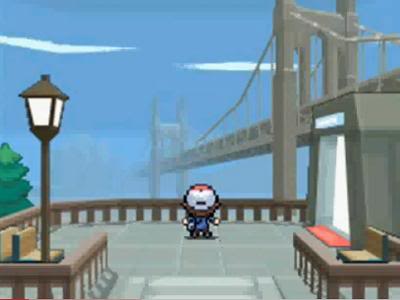
When you first see the bridge, the in-game camera suddenly cuts in very close, closer than it has ever been. You are treated to a stupendous view of the Skyarrow Bridge, in all its grandeur.
As you trek across the bridge, the camera then pulls way out to show you just how big this thing is. Its length stretches far beyond your field of view, and you become excited by the mere possibility of that length. Never before has a Pokémon game ever called so much attention to anything as this game had called to this bridge.
On the other side, things started to get much better. The gym leaders began to get harder, the quest seemed to get bigger, and the story really started to shine.
And, for the first time ever in a Pokémon game, that story had weight, actual weight. It was the story of a boy traveling with his Pokémon companions. Of a group of friends going out into the big world for the first time. Of exploration, discovery, and adventure.
The story of a child growing into a man.
It felt as though that bridge -- while connecting me to a new city in-game and a vast new world to explore -- was also closing a gap that had been growing for years since I had given up on Pokémon. I had never felt such an uncanny connection to a Pokémon game before. This was my story. This was the story of all those that grew out of Pokémon and got jobs, got girlfriends and boyfriends, got educated. This was the story of the boys and girls who got older and moved on and how they did that.
And then it hit me. Pokémon had finally grown up.
After years of simple games with simple goals, here was a Pokémon title that wanted to show me that it hadn’t forgotten about the kids who made it a success to begin with. It hadn’t forgotten about me.
And that made me all the happier to cross that gap and come back home.