

My valkyrie lay unconscious from exhaustion, both of my samurais had become insane and laughed hysterically as they were hit, my bishop had died thanks to my faerie mage butterfingering yet another spell, and the thief that my party had picked up in Arnika was busy complaining about being somewhere he wasn't supposed to be. And my gadgeteer?
Out of ammo.
Thank goodness for reloads.
Taking a break from the next-gen with an old school RPG like Wizardry 8 was something I'd been trying to get back into since I had gotten my copy months ago. It's regarded by many as one of the last of the "old school" RPGs on the PC, one filled with enough statistics, spell charts, and class changes that its 70+ manual could barely contain within its small typeface.
And it was hard, hard in a way that only Sir-Tech could make it be, and it definitely wasn't for casual gamers. The maddening amount of detail from the number of weapon skills that characters can endeavor to learn to how easy it is for your party to be turned into wormfood if they're weighed down with every little dagger that was picked up along the way to the grave was intimidating at first, but became second nature by the time I saved the world in one of three endings. I tried out all three. For some reason, the "evil" ending gets its own little movie. Hmm...
Not every "old school" RPG was as brutal as W8, nor were all of them required to be. Being a relative newbie in the world of Wizardry, it was also a lot more challenging in getting used to its nuances. As a result, not everyone will like it, but as an RPG milestone, it's certainly worthy of attention as a classic example of the genre because of how it took the kind of risks that we don't see too often from other RPGs today on any other platform, not just the PC.It was also the last game from a now defunct Sir-Tech, a bold swan song ending the 20+ year run of the series with a gloriously, magic packed bang of steel and sorcery.
Its save-import feature allowed veterans to carry over their favorite characters from the previous title as a reward for longtime fans that had held onto their saves, especially considering that W7 came out nine years before W8 and its remake, Wizardry Gold, had come out in '96. Depending on their actions in W7 and the ending that they had seen, players could start the game at different locales.
It was also risky not only because it largely depended on whether fans held onto their files, but also in the sense that one of W7's endings could start players off with a dead party in W8, forcing them to start from scratch (or another savegame from a better ending). Since I started off with a new party, the spaceship that carried me to the world of Dominus had safely crashed after being shot from the sky, killing the pilot that my party (which had miraculously survived) were supposed to guard.
This is also a concept that many PC RPGs had used - such as the Bard's Tale series - although most kept it to only character stats. The Shining Force III trilogy would also use a similar mechanic and even go so far as to carry over the results of certain actions from one scenario to the next. More recently, Bioware would be using a similar approach with the Mass Effect series with their own expanded take on the concept.
One thing I didn't expect to see was an in-game parser, the kind that probably would have been more at home with interactive fiction, to keep track of important topics allowing me to quiz NPCs for additional info. I could also add words to the list and type in things that weren't there and get a reaction, but veteran players (or those familiar with the lore of Wizardry) could even dig into it and find a few references to the previous game.
There were also puzzles requiring me to combine objects and try them out, adventure game style, along with several riddles, and I was surprised to be quizzed in a ritual test as a blinking cursor waited with baited bytes for my answer. It felt good to dust off the notebook again.

Text on the bottom, massive list on the right, and an empty field below that list to type in your own topics made talking to NPCs an interesting experience for players delving into W8's story and setting. On the bottom left, you could also pickpocket, use magic on, try to recruit, or skewer this poor guy. And his guards. And most everyone else upset with you. Well done, buddy.
W8 also has a titanic amount of solid voice acting behind nearly every line, not to mention that you can assign voices to character portraits for your own party to bring a little personality to the numbers. I set my bishop to sound like an absent-minded, grandfatherly, professor type while my felpurr (a cat person) samurai may have done time on the set of a Kurosawa classic complete with wisened sayings such as when we resurrected him from death...which was a semi-frequent event.
Each voice type, and there were quite a few to pick from ranging from "Aggressive" to "Eccentric", must have a slew of customized replies set in for each one because it was as if they always had something to say. These "personalities" didn't so much as drive the characters as they created the perception of each one as an individual. It was also extremely risky from a design standpoint since not every player may play through the game with different characters or swap voices out midgame simply to hear how every iteration reacted to special events in the central quest, but I very much appreciated that Sir-Tech had decided to go that extra mile.
My valkyrie wasn't quite Red Sonja, but hearing her gutteral yell of "Victory is MINE!" after critically killing a giant ant or my smart assed Gadgeteer mutter "What? No applause?" for the same thing never got old. Hearing a character, especially an NPC, complain about letting them die in the first place was even better. Anyone working on the set of Doctor Who may also want to check to see if there may be anyone missing, but I'm pretty sure that the android monk in my party wasn't cast in any episodes.
He should be, though. He's pretty clutch when it comes to kicking extortion minded Rattkin goons into road paste while intoning "EXTERMINATE!". My evil sounding 'hero' had plenty of choice lines, especially at the end when victory was ours. On leveling up, he'd mutter "Beware! My power grows stronger.". But he was a good guy. Really!
W8 also has an eclectic variety of professions and races to explore making it a challenge for me in deciding on how to build my party at first. Races include humans, draconic "dracons",faeries, and sasquatch-like "mooks" among others, all with their pluses and minuses. Classes are also as colorful ranging from your basic Fighter-type to Ninjas, meaning that if you wanted to make a faerie ninja (as the box says), you can. Seriously. The only class missing was "Pirate", although your Rogue can get that title depending on how far they level.
Swapping classes was easy enough at every level up as long as your character had the stats. It might not have had as many jobs as a Final Fantasy Tactics type title, but the choices were just as game changing and provided a number of bonuses across the board for each PC, carefully balancing each other out. That's not to say that EVERY party combination will work wonders, but players are free to plug away with any number of whacked out builds and create as many characters as they want to pick from. Want an all-ninja party? Go for it.

An android monk that sounded like a walk-on for one of Doctor Who's Daleks. Would you believe that this is only the first of four pages of stats?
Storywise, the game mixes together sci-fi and fantasy in a huge, sprawling quest filled with plenty of text, again most of it voiced with superb acting, helping the story come to life. Thanks to that and the writing, found myself drawn into the universe of W8 which also made enjoying the game a love and hate relationship. The story I enjoyed. All of its characters, especially my own party, made the game great fun. The combat, not so much, and is where most of the aggravation came from.
I am not a fan of level scaling in an RPG. Some might like it, but I don't for the simple fact that I like to feel that my characters aren't in a race against a rat for XP (and yes, there are plenty of rats of the 'crawling on all fours' to the 'walking upright' variety here). Being able to grow your characters and stomp on lesser foes is something of a ritual in RPGs since the early days of tabletops. Sure, scaling creates its own challenge, but makes it hard to appreciate the more tangible results of your party's own progress.
For a more recent example, the level scaling in Oblivion wasn't as bad, but I couldn't help but wonder why roadside bandits kitted out in a small fortune of gear had resorted to hanging out in the middle of a forest waiting to rob peasants wearing sacks. Do you know how many trips back to the store that will take and how many cloth pants one would need to sell just to get glass gauntlets? But I digress.
W8 scales combat almost to the point of frustration. It also likes to spawn random encounters behind your back in areas that I had thought were cleared out...if only long enough for a quick in and out.
At first I was wondering why it always felt like I wasn't getting anywhere with my party until I realized that the levels of the NPCs facing me were relatively similar. The better that my party would get, the better that the enemies would also be. I would occasionally run across something at a lower level than my party, but more often than not, I didn't until I had gotten further into the 'teens.
After hitting levels 17 -21, I finally felt as if I were getting somewhere but before that happened, there were quite a few occasions where I had almost walked away from it for a few more months. And in this game, leveling isn't a quick affair. Characters are still very mortal even into the endgame.

Until I hit the late teens, evil unicorns like these would eat my party for breakfast, lunch, and dinner. Running away...which actually involved running...was my party's favorite past time in those early hours. As you can also tell, the interface was loaded with info. You could customize it to see as little or as much of it as you wanted.
In W8, levels were important as one would expect out of an RPG, but character skills were also improved through use. In wanting to train up my samurai's dual wielding skill, I gave him a second weapon and went to town, watching as he slowly improved over time with the points earned at every level-up acting as a small boost that I could opt to use to speed things along. It's also a mechanic that I like seeing in an RPG, so seeing it here was a welcome surprise. The only thing is that it isn't dependent on how many bad guys are killed in battle. Even if he or she slew everything on the field of battle by themselves, they'd probably only earn one point.
The areas do have an upper level limit for the mobs, however, but until I had gotten past that hidden line, there was much struggling, grinding, gnashing of teeth, and plenty of 'experimentation' (i.e. dying). Did I mention W8 could be hard? Did I also mention that if it isn't hard enough, that it comes with an "Iron Man" mode where it saves only when you exit the game and if the party is wiped out, it also wipes out your save? Gone. Kaput. Kleenex moment. But it's an option for those that want it to be as hardcore as possible. Apparently this was something offered in earlier Wizardries, nearly all of which share the same reputation of being as challenging.
The world of W8 is also in 3D making it similar to Beth's Elder Scroll titles, but on a much smaller scale. It works, and some of the areas are polished with plenty of imagination, and it also makes a bigger deal in forcing you to think more tactically in the game than one would initially see. Enemies can be seen traveling in packs or alone and they'll often make their way in your direction if they happen to detect you. They'll often try to surround your party, attacking from the sides and from behind so if you hid your mage back there, I hope you also put someone with some fighting skills near them to try and help out.
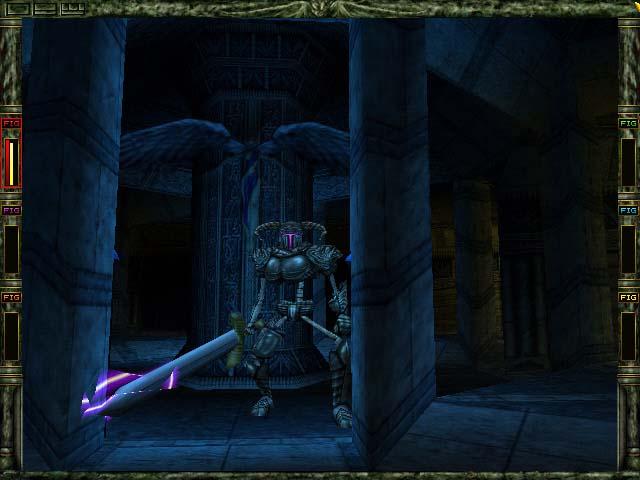
These guys used death magic. Often. Lingering spell effects (like burning) were also a favorite and if you think poison, disease, and paralysis disappeared at the end of a fight, think again. And pray another group of monsters don't just happen to find your party after narrowly surviving a beat down which happened more often than I would have liked.
Ambushing enemies around corners, tricking them into choke points, backing up against walls to limit avenues of attack, hiding behind the hills and gullies of the land are all valid ways of journeying across the world of Dominus if you want to avoid anything unwelcome. At least that much I got.
Unfortunately, I often found that there was no real choice especially early on. Enemies tend to track you down unless you transition to another area or run far and as fast enough away from them. There are also a few clipping problems allowing enemies to blast you from what should have been a solid wall, or launch spells with impunity from around corners when you can't see them. The enemies in W8 love ranged attacks whether it's acid spit, chunks of flesh, thrown daggers, arrows, dreaded spells, and will pound your party mercilessly unless you stop them.
Combat can be resolved through rounds or simply toggled to continually run with the default options for your characters (usually suicide). During each round, you can also move by either running or walking.
Running moves your party further, but drains your stamina faster. Lose too much stamina and characters too tired to fight will fall over unconscious, making them a more than welcome target for the claws, spells, bows, and guns of the enemy just waiting for an easy mark until the next round if they're still alive. The good news is that there are potions and spells to keep that from happening. The bad news is that unconscious (sleeping or paralyzed) members receive almost double damage for lying there.
But enemies are just as susceptible to the same things that your party is. Bosses can actually die from a lucky critical. One fight ended in the opening round because my samurai had managed to get off a lucky crit. While it might not have made for a great showdown with someone like FF7's Sephiroth, I loved seeing this. It's even better to see if the party is surrounded and crits simply come together to clear the way. It doesn't happen often, but when it does save the day, the wreckage of the enemy is awesome to behold.
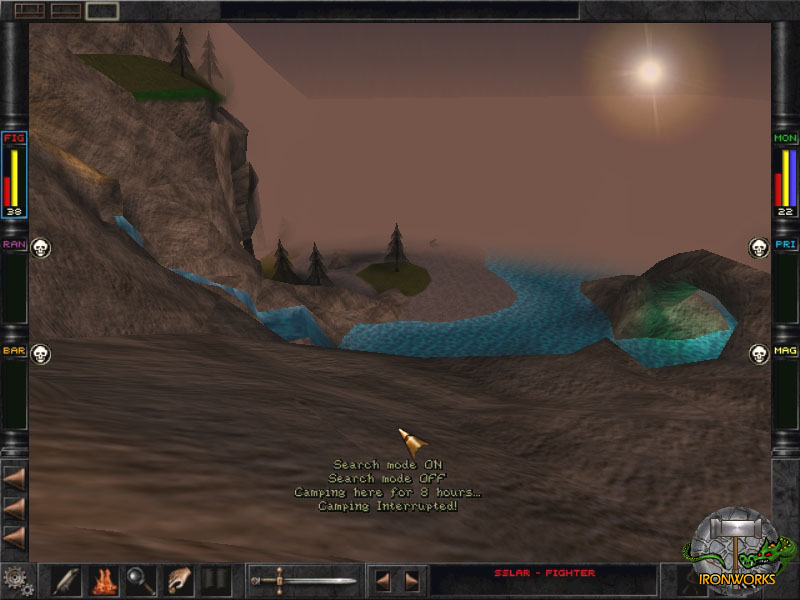
The graphics may not be the prettiest, but they're functional enough if you let your imagination fill in the blanks.
As nice as it was to see every enemy in 3D down to the individual members of every patrol, another sore point about combat soon cropped up making me wish that they put in a way to toggle the animations on or off and quickly move the enemy around on the field. As it is, even when setting their combat movement to maximum speed, battling particularly large groups can be a grueling experience sucking the joy out of playing the game.
Facing off against ten or twelve enemies can easily take ten or twenty minutes to resolve as they are moved, one at a time, across the battlefield, not counting the battle animations for their spells either for themselves or aimed directly at you. The worst part is that there will be quite a few instances where there are always more to deal with. And if enemies run? Chasing them down to end the battle added even more minutes unless you just let them go which I started doing, only to run into them later since I was going in the same direction.
One battle took nearly an hour to resolve because I was busy moving my party around and basically trying not to die especially when the enemy had summoned elementals that hit as hard as Tyson in his prime. I didn't come away with so much of a sense of accomplishment as I did of wasted time in simply waiting for the PC to move everyone around.
But I kept wanting to come back, if just where that tunnel might lead, who else I could hire into my party, or if the villanous Dark Savant had found another way to screw everyone over. Poring over the lists of spells to pick from, assigning skill points to the vast repertoire of skills each character had, and watching the results of their latest victory to see how much further my characters had gotten better elsewhere made W8 feel even more like a bittersweet piece of old candy.
Hearing Myles complain about letting him die in battle after bringing him back to life, gathering up ingredients for custom armor and weapons, using magic to influence NPCs or a thief to pickpocket them blind, accidentally getting the storekeeper killed when combat spills over into his shop...
Well, that last wasn't my fault. Not all of it, anyway.
Like I said before...thank goodness for reloads!