Home
Home

Editor's note: This one surprised me -- how can a nation of DS gamers look down on older console players? If you've run into this, too, post in the comments. -Demian
For Michael Rousseau's Pressing Issue community assignment, I was asked to write about differences between Japanese and American gaming culture. Here's my take on playing games in the country responsible for hooking most of us in the first place.
I mention this at the end of every essay I write, but it bears repeating now: I live in Japan. I say that not to brag but to offer vital context about who I am. I grew up playing Japanese video games and when I had an opportunity to visit in 2001, I knew I wanted to find a way to live here, so I did.
I cannot deny that my interest in gaming cultivated my interest in Japan. Imagine my surprise when I got here and discovered that few if any people shared my enthusiasm for the medium.
Make no mistake: Video games are definitely culturally significant but largely as nostalgia. Nobody celebrates youth and childhood quite like Japan, and the runaway success of the Famicom (later released as the Nintendo Entertainment System in the West) cemented video games in the hearts of millions of Japanese people.
I see an open affection for games in Japan that simply isn’t visible in the United States. The famed electronics districts in Tokyo and Osaka (particularly the retro-game store Super Potato) aren’t just places to buy old games -- they are elaborate “towns” built on precious memories, with glimpses of gaming’s past in every alleyway.
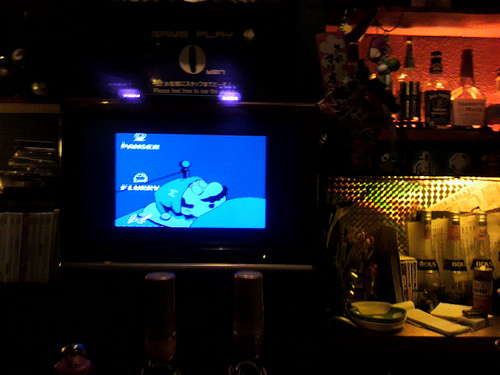
The game-themed bars of Tokyo, like 8-Bit Cafe and Muteki Mario, are adult playgrounds dedicated to reliving the electronic thrills of yesteryear. Here’s an idea I didn’t even know I loved until I saw it for myself. Now I’ll never think of Super Mario Bros. 2 again without remembering that all nighter I pulled back in April.
Then there’s the “game centers” which are so abundant, arcade games are more accessible to me now than when I was a kid. I know a place where you can pay 50 Yen to play Super Mario Bros. in an arcade cabinet with an actual Famicom controller. It might not make much business sense, but I love that it exists.
Yet a rift stands between remembering games as fun and playing games today. I can find any number of people willing to talk about video games they used to love. For fun, I like to whistle classic video game music in class and see if the teacher recognizes it. Whether he does or not, we can joke about it afterwards.
However, should the conversation turn towards my current-gen console collection or my enthusiasm for the Tokyo Game Show, two little words suddenly dominate the conversation: game bakkari (“all you do is play games”). I have tried protesting, citing the fact that I have a full-time job and a family to care for so my gaming is limited to an hour or so after everyone else is asleep, but it doesn’t matter. An adult who plays video games is immediately pigeon-holed as some kind of oddity.
It’s particularly frustrating when my wife says something about my gaming habits, because, unlike me, she really does play games non-stop. Her default pastime around the house is solving Sudoku puzzles on her Nintendo DS. She has spent more time on Sudoku in the past month than I have on all the games I’ve played this year combined -- and I maxed out a character in Borderlands!
Perhaps it comes down to a portable vs. high-definition console divide. The Nintendo DS and PSP are wildly popular in Japan, and local game development has shifted to prioritize these platforms over traditional “TV games” (as video games are called in Japanese). So my wife can play Sudoku all day while still leaving the television free for my son to watch his favorite shows. If I play a game at home, that’ll be the only thing anyone can watch in the living room.
As someone with a life-long passion for video games, I’m elated that Japan holds the medium in a reverent (if limited) light. I’ll endure their cries of game bakkari so long as they continue appreciating gaming’s past in their own wonderful way. The way I look at it, every game becomes retro eventually. Perhaps in 2022 I can talk to my coworkers about Bioshock and Portal. Until then, I’ll be playing “nothing but games” by myself each night before bed.
Photo credit: arcade image by Telstar Logistics/Todd Lappin.
Daniel Feit was born in New York but now lives in...right, already covered that. Besides Bitmob, he has written for Wired Game|Life and Film Junk. Follow him on Twitter @feitclub or visit his website, feitclub.com.