Separator

Memorable quotes from the Commonwealth Club's debate on violent video games

1072475
Saturday, March 19, 2011

Commonwealth Club violent video games debate

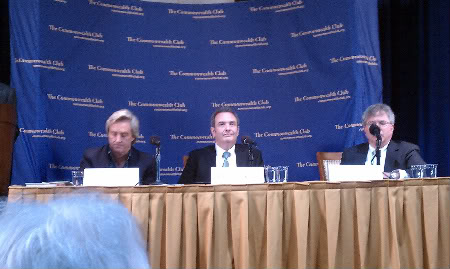
From left to right: Jim Steyer, founder of Common Sense Media; George Rose, executive vice president and chief public policy officer of Activision Blizzard; and Michael McConnell, director of the Stanford Constitutional Law Center.

Within the bustling heart of San Francisco's financial district last Thursday evening, the Commonwealth Club played host to a hot-topic debate that sought to explore the possible link between children's exposure to violent video games and their likelihood to commit violent acts. It also discussed the possibilities and ramifications of a controversial California violent video game law criminalizing the sale of M-rated games to children under 18 sponsored by State Senator Leland Yee. The U.S. Supreme Court is currently reviewing the constitutionality of that law.

Yee was slated to share his beliefs on the issue during Thursday's debate, but the senator was mired in legislative talks to untangle California's pernicious budgetary problems. His wingman was Jim Steyer, head of Common Sense Media, a "think of the children" organization that advises parents on explicit content. You probably know CSM as the group that raised a big stink to the Federal Trade Commission in 2007 about the ESRB's downgrade of Manhunt 2's rating from Adult to Mature after developer Rockstar Games released a censored version of the game.

Also in attendance was George Rose, executive vice president and chief public policy officer of Activision Blizzard. After serving as part of the company's legal counsel for over 14 years, Rose's stance was predictably opposed to any sort of restrictive law. Michael McConnell, who heads Stanford's Constitutional Law Center, was an impartial participant brought on to share his predictions on how the Supreme Court will deliver its ruling.

Check out some of the thoughts from each of the debaters below, and as always, feel free to express your own thoughts about this topic in the comments section.


"There's no question that there's demonstrable, scientific evidence of violent games having an impact on children. The American Academy of Pediatrics have stated that violence in movies, TV, and games has a direct cause to a rise in aggression." --Steyer, opening statements

"We believe that creators of video games have the right to make violent games; the only issue is limiting violent game sales from minors because of the impacts on their lives, and requiring that only an adult can purchase these kinds of games." --Steyer, opening statements

"Sure, let's just go ahead and allow the video game industry to regulate itself. They're always going to have the children's best interest at heart, right? Industry self-regulation is not a credible argument. The goal here is to find a way that respects free speech while protecting the best interests of kids." --Steyer on defining the limits of what is permissible for industry oversight

"The industry shouldn't be punished for something it hasn't done. It should instead be lauded as a testament to self-regulation. It's absurd to think the industry can't regulate itself. A government regulating speech is exactly why I fled the Soviet Union. " --Rose, opening statements

"This statute is based on what many consider 'junk science': handfuls of studies made by people that love to quote themselves. They have no merit whatsoever, especially when nearly every court and scientist in the country has said that there's no foundation between violent games and an increase of violence in kids." --Rose, opening statements

"I'm not doubting anyone's good intentions, but Yee's law is both overinclusive and underinclusive and one of the most convoluted and constitutionally disabled statutes that ever existed. Its holes aren't like Swiss cheese; it's like a donut." --Rose, opening statements

"To be blunt, we fire people on the spot who don't follow the age-limit policy." --Rose on the steps taken to punish stores not enforcing age limits

"If Call of Duty ever fell under the 'restricted' category, no stores would want to sell it, and it consequently wouldn't be made anymore. End of story." --Rose on whether Activision Blizzard could cope with Call of Duty becoming a restricted game

"I believe the Supreme Court will be concerned with trying to decide this case without being too broad. Essentially, the vagueness of this entire issue is very troubling. What is an image when you think about a game? Is a zombie a human image? Is an animal with humanoid characteristics a human image?" --McConnell, opening statements

"The Supreme Court isn't likely to say that this kind of statute is constitutional, but I also think they won't go so far as to say that these types of statutes are necessarily unconstitutional. They'll probably strike down this particular case because of vagueness, and then assume a 'wait and see' approach to determine how this kind of media develops, perhaps for a more detailed statute in the future." --McConnell, opening statements

"This country is schizo to begin with. If you consider sexual content, it's quite OK to engage in the actual activity, but it's totally the opposite to display it on TV. Is there a culture of violence? More importantly, I would be more concerned with what my child sees on the nightly news than in some game. I think my kid is quite capable in differentiating between a virtual and a real human being." -Rose on if he's concerned with games contributing to America's "culture of violence"

"That sounds simplistic. These are nuanced issues that require balancing. At the end of the day, I don't think there will be a broad, sweeping decision by the Supreme Court. We as a society are trying to find the best way to raise our kids in a media-centric world, while respecting the freedoms of speech and creativity at the same time." -Steyer on why the government should be involved in any capacity

"I disagree with this whole notion of games being the only interactive form of media. I consider all works of literature to be interactive. If you're reading them, and being involved with them on a mental level, then it's probably one of the most interactive activities you can engage in. No game can compare to works of literature or works of art in terms of interactivity. To say that pressing a button on a joystick makes a game special is a very oversimplified way of looking at games and art as a whole." --Rose on the interactive nature of games

 
Problem? Report this post
BITMOB'S SPONSOR
Adsense-placeholder
Comments (24)
Default_picture
March 19, 2011

This debate reaffirmed my belief that most critics of gaming know little to nothing about gaming. The Mass Effect controversy, the Bulletstorm Fox News Report, games as rape and murder "simulators"...they all point to ignorance. All of these easily-refutable charges could be dispensed with if critics bothered playing the games (or did actual research).
IMHO, if gaming were considered a legitimate artistic medium, they’d be more immune to unconstitutional legislation like AB 1179.

Sexy_beast
March 19, 2011

I'm confused, are we supposed to be scoffing at the men who are for stricter regulations and who believe violent video games lead to violent behavior in children?

Default_picture
March 19, 2011

The calls for regulation are based on three proven falsehoods:
1) Gaming is a kiddie hobby (thus, kids are the only ones playing GTA IV)
2) The interactive nature of video games make them inherently different (and more dangerous) than film and TV, which regularly feature more egregious violence and sexuality. It's easy to forget that the MPAA's ratings are voluntary.
3) A more restrictive rating will somehow free developers to create more experimental, mature content. They discussed this at the debate. As with the NC-17 rating, a mandatory 18+ rating (backed by the threat of a $1,000 fine) would heavily restrict developers' creative freedom.

Inception
March 19, 2011

I'm all for developers having creative freedom, but I just have to say it...

If you can't make your game good enough without a bunch of blood and well, or the, "anything goes", I have to question the capability of the developer.

But this is such a broad, and sometimes elusive topic on what's okay and what isn't, that I generally stay out of it.

Sexy_beast
March 19, 2011

And the nonsubjective views and irrational reactions from the gaming community are based on three assumptions:

1) Legally restricting children from playing adult-oriented games will somehow affect them, even if they are well over the age of 20.

2) The saying "practice makes perfect" is one that applies to anything EXCEPT video games, and that there is absolutely no chance that someone with a messed up mind could become even more messed up by killing polygonal hookers and motorists.

3) A more restrictive rating will somehow hinder the freedom in which developers create games, even more so than the amount of creativity they already hinder themselves from, due to the fact that games are more about business than creativity.

Inception
March 19, 2011
@ Ryan: I agree with pretty much all that you said.
Default_picture
March 19, 2011

@Ryan
How often do theaters show NC-17 movies? And the MPAA's ratings are voluntarily-enforced. They're not the law of the land (or even just Cali). AB 1179's "18" rating would be government-mandated, backed by the threat of a $1,000 fine. You don't think retailers might be a tad wary of stocking such potential time bombs? And if retailers won't stock them, you don't think this will hinder developers' creative freedom in any way?
Not to mention the ambiguous nature of violence that is "heinous, cruel, or depraved" (among other qualifiers). It's clear that certain politicians have an agenda that runs contrary to the gaming industry. Are these the same individuals we want deciding what constitutes a "violent video game?"

Sexy_beast
March 19, 2011

Jason

You do me a favor by saving me the trouble of pointing out that adult ratings hinder sales due to two things, public image and retailers. The problem itself is not the rating, but the view towards that rating -- a lot of it being misinformation, due to the fact that NC-17 films never show in theaters, however many of them make it to store shelves in their uncensored form. Not many people know this. If you're going to combat anything, combat the public perception of these high ratings.

I don't want to see video games any more restricted than the next gamer, but special care can and should be taken to be sure that children don't get their hands on ones meant for adult audiences. Too many times do games slip through the cracks and into kids' hands. Yes, a lot of the blame should go towards the parents, but it's also time that the industry should grow a set of balls and stop playing the "no fault" card.

The industry can't be serious about the content of games and their interactive qualities one minute, when it benefits them, and then be nonchalant about it the next when it doesn't. Such behavior is two-faced and does nothing but tarnish the image of the medium.

The reason no M-rated titles broke the Top 10 this year was because there were no heavy hitting IPs to do so, not because M-rated titles sell worse. And this "last decade" has only lasted a year, dude. Give it some time. Besides, M-rated titles experience success all the time; whether or not they break the Top 10 is moot.

And I'm not talking about the government issuing a ratings system. That's a completely separate topic, not to mention will likely never happen, anyhow. I'm talking about issuing fines to retailers for selling M-rated games to minors without parental consent (rated by the ESRB). There is an extremely rare chance that this will affect retailers' willngness to sell M-rated products, because there is too much money in it. They will, however, be more serious about preventing children from playing games clearly not meant for them.

Default_picture
March 20, 2011

@Ryan
Most of us can agree that kids shouldn't be playing GTA IV or Manhunt. But wasn't that the entire purpose of the ESRB's rating system? I don't think we want the alternative--government bureaucrats deciding what constitutes a "violent video game."
There were no heavy-hitting M-rated IPs in 2010? Red Dead Redemption? Heavy Rain? Mass Effect 2? Red Dead cracked the top 10. HR and ME2 didn't. Others, like Halo: Reach, Modern Warfare 2, Black Ops, and Assassins Creed: Brotherhood did. And they could all qualify for AB 1179's "18" rating. You're correct that M-rated titles sell handsomely. But $1,000 is an awful risk to take. Retailers might not take that risk.
I apologize, but by "last decade", I meant 2000-09: http://www.vgchartz.com/article/6901/the-top-selling-video-games-of-the-2000s-single-amp-multiplatform/
No one's talking about a "government ratings system." But if California AB 1179 passes, then the government will decide what constitutes a "violent video game," mandate that an "18" be placed on said box, and fine retailers who sell these games to minors. That's the extent of it.
We both want to keep M-rated games out of kid's hands. We merely disagree on the path to attain this goal.
Btw, I edited my earlier comment because in the US, five M-rated games *did* crack the Top 10. I still think retailers will be wary of $1,000 fines.

Sexy_beast
March 20, 2011

Jason

I don't think you understand what I'm trying to suggest. I'm not suggesting that the government judge the content of a game. I believe that there should be a law in place (no, not AB 1179) that prohibits and, yes, fines retailers from selling M-rated games to children. The ESRB would deem a game as Mature, and then the law would go into effect. Heck, it's against the law to sell a Playboy to a child. Games feature much worse content, both graphically and by volume, so it's only fair that they receive the same treatment.

I can guarantee you that retailers will not keep M-rated games off of their shelves, were such a law to come into being. They would lose far too much money; making such a move would be a terribly horrible business call. Besides, you can easily find an "unrated" (technically worse than NC-17) film in any entertainment retail store. Trust me, the game industry wouldn't feel a thing from this.

It's easy to assume that something like the ESRB could just come into being, and then everyone magically follows the rules. Every day, I see people here in San Francisco crossing the street to signs that say "Don't Walk". The ESRB rating on the game case is a small sign, a tiny little suggestion, that most people tend to ignore. There are two Gamestop stores that I shop at here in the city, both of which I have seen sell Mature games to kids (at least they looked pretty young). When it comes down to it, the industry has done virtually nothing to address the issue of selling adult games to minors. And a large part of me thinks it doesn't really care. It would rather spend all of its time refuting claims, rather than addressing possible concerns.

You say we "disagree on the path to attain this goal", yet I haven't seen you make any suggestion towards doing so. By all means, please do provide your two cents, if you even have an idea. Because, quite honestly, I don't think stern words and a wagging finger will prevent retailers from being careless about who they sell to. Really, that's all they get these days when they goof up.

Redeye
March 20, 2011

Theirs plenty of perfectly good ways to stop violent video games from getting into kids hands, but in my opinion allowing politicians to make definative decisions on the matter is a slippery slope. Once politicians get the slightest conciet that games need to be regulated some grandstanding moralist will use it as precident to snowball in stricter and stricter legislation about what should and shouldn't be in games. We do not want to end up as a country that bans games for being too violent or too sexual for public consumption like Australia particularly since any game being banned in our market would have it's potential audience drastically fractioned. This would also be a huge boost to the piracy movement that the industry doesn't need right now.

Sure it's easy to bluster about how kids shouldn't get their hands on violent video games, but in the modern day information age it's a lot more complex to stop that from happening. Half of the games are sold online by a computer these days and if the parent doesn't regulate that themselves all this legislation would do exactly dick to stop kids from getting ahold of it anyway. Then some politician would freak out and try to ban or severely restrict digital downloads. At the end of the day the industry has to self regulate and parents have to take responsibility for their own buisiness or the compounding issues involved in parents raising their kids would lead to a stem to stern gutting of the industry that will still do nothing to solve the problem.

Default_picture
March 20, 2011

@Ryan
I find it extremely unlikely that any state or federal agency would attach a fine to a self-regulatory ratings system (i.e. the ESRB). More likely, they'd substitute their own judgment for the industry's (similar to AB 1179). But for the sake of argument, let's continue.
Regarding the NC-17 comparison, here's something else to consider. Your average M-rated video game is far more tame than an R-rated movie, both in its depiction of sexuality and heinous violence (compare any Tarantino film to GTA IV). NC-17 is well beyond any video game. Pornography is on an entirely different level. What M-rated game contains the most frank depiction of sexuality? Heavy Rain? I think we can both agree that R-rated movies contain far more nudity and realistic depictions of sex. Moreover, I don't think gaming's cartoonish violence is "worse" than pornography.
You keep saying that retailers *wouldn't* refuse to stock M-rated games. But it's worth pointing out that most already refuse to stock "AO" titles. And we may disagree on this, but I don't think we'll see fines levied *without* a government criteria for "violent video games." And in actuality, should such a law pass, the closest equivalent for "18" games won't be "M". It will be "AO", since the latter is explicitly forbidden for sale to minors.
This is a very slippery slope, indeed. As the justices themselves mentioned, it's a short step towards regulating movies, TV, music, and even Grimm's Fairy Tales and Bugs Bunny cartoons. And since kids seem to get ahold of M-rated games regardless of any ratings scheme (a failure of parents, not just retailers), the next logical step is regulation of the content itself.
My suggestion is for self-regulation coupled with parental involvement. This is the only fair way to address the issue. I would consider gaming a legitimate artistic medium, akin to movies, music, and TV. I don't consider it equivalent to pornography or cigarettes.

Sexy_beast
March 20, 2011

Jason

I never said that the idea would actually come into fruition, or even have the chance to. I merely provided the idea for the sake of trying to think of a viable solution between what we're doing now (which is nothing) and what the government always seems to propose (which is unconstitutional).

And here's something else to consider in terms of mediums that feature adult content: games are interective, films are not. Whether or not film has more sex and violence in it is moot, due to the fact that said violence is interactive in video games. As I said before, games love to boast about their interactive qualities when it benefits them, however they dismiss them when it comes to topics such as these. That's complete BS. And I didn't use Playboy as a means of comparing content, I used it as an example of such a law being utilized; the government doesn't regulate porn, however there are laws against selling it to minors. It's the same concept. Mature content is mature content.

Yes, retailers refuse to stock AO games, but I fail to see how implementing a fine for selling M-rated games would automatically grant them the ill reputation of AO games, as you seem to be implying. Besides, the only reason retailers don't stock AO games is because manufacturers won't have them on their consoles, because retailers won't sell them, because manufacturers won't have them on their consoles. It's an odd limbo that this rating is stuck in, and actually has very little to do with the rating itself. Nonetheless, I don't see how M-rated games are someow elevated to AO when you fine retailers for selling them to minors.

Yes, we are all afraid of the big, bad government watering down our games into nothing. Often has been the song of the game industry ever since Mortal Kombat and the creation of the ESRB. Often has been the song, yet often has the industry used such whimpers to merely combat the government from intervening, while doing almost nothing themselves to address the issue. Your "suggestion" is literally how things are right now. Self-regulation and parental involvement are the ony two obstacles in the way of a kid getting their hands on GTA or Gears of War, and they obviously aren't working. Besides, "self-regulation" is a very broad term, you need to be a little more precise with what you mean by that. How exactly can the industry "self-regulate" itself even further to prevent kids from attaining their products?

And as for "parental involvement": I think it's safe to say that most parents suck at filtering the types of games their kids play. It will come down to two decisions for the industry: either the industry continues to keep things lax, like they are now (how the industry would like it), or be more firm and take extra steps to restrict mature content, subsequently preventing parents from blaming video games and their ease of accessibility whenever their kids act up. It's pretty simple, really.

Nevermind the government. No more using the looming shadow of Uncle Sam as an excuse to refrain from taking extra steps. Gamers and their peers need to actually provide suggestions towards regulation, rather than just booming, "Teh government will inflict its mighty banhammer!"

And obviously you haven't watched much porn. It can be quite artsy. :)

Default_picture
March 20, 2011

@Ryan
Yes, the old refrain is that interactivity makes games more pernicious. Jim Steyer mentioned it, as do most critics, including Senator Yee:
"Unlike movies where you passively watch violence, in a video game, you are the active participant and making decisions on who to stab, maim, burn or kill."
I no more buy this argument than I believe that FPS's are "murder simulators" and improve one's marksmanship. We can all laugh, but Lt. Col. David Grossman suggested this. I just don't believe that kids see fantasy violence (or quasi-realistic violence) and equate it with real life.
Nor do I think it's BS to tout the interactive nature of gaming, but dismiss arguments like this.
No, M-rated games wouldn't suddenly be "elevated" to "AO". But the definitions of AB 1179's "18" and "AO" would be similar. Both ratings explicitly preclude sales to minors (though the "18" would be backed by force of law). It's not unreasonable to assume that an "18" game (or any derivative) would acquire the same reputation as "AO" games. If M-rated games were forbidden for sale to minors, "M" would become virtually indistinguishable from "AO."
Ok, if we're not discussing government intervention, then what? Shall the ESRB, itself, fine retailers who sell M-rated games to minors? Backed by the force of what law? Like it or not, if you support retailer fines, you’re arguing in favor of government regulation.
I would argue that the industry has come a long way since Mortal Kombat. Look what was considered "Mature" back then--cartoonish blood and "fatalities." Nowadays, we have professional scripts, dramatic cutscenes, orchestral scores, and serious themes. IMO, the creation of the ESRB's rating scheme, at least in part, enabled the industry to evolve and mature. Yet from day one, the ESRB has been a self-regulatory agency. If Lieberman and Kohl had decided to regulate gaming in '93, I don't think we'd be enjoying titles like Mass Effect 2 and Black Ops in 2011. The industry never would have grown up.
You say the current solution--be it parental involvement or the ESRB--isn't working. Putting that aside, let me ask you something--do you think regulation of cigarettes is "working"? Do you ever find kids or pre-teens smoking? But how could they? Aren’t cigarettes regulated? Aren’t retailer fines levied? Unless things have changed since I was younger, the kids who want to smoke will find a way. I'm not saying kids *should* be smoking, or that retailers should be allowed to sell them to kids. I'm just pointing out that regulating the sale of a "harmful product" and levying fines doesn't necessarily stop them from ending up in the hands of minors.
Speaking of porn, did you ever read Playboy or watch porn when you were younger? I certainly did, and both are banned for sale to minors.
And for the record, my parents never would've supported it ;)

Sexy_beast
March 20, 2011

Jason

You're doing exactly what I was pointing out. You're elevating games as an entertainment medium due to their interactive qualities, claiming such qualities better the experience and make it more visceral, yet you claim those same properties have absolutely no affect on a young or, more importantly, troubled mind. Nevermind a FPS being a "murder simulator", that's going overboard. But consider the interactive properties of games, as a whole. To say they make it better, yet don't affect a troubled mind is hypocritical.

M-rated games are already forbidden from being sold to minors, and yet they are still quite indistinguishable from AO games. How does penalizing a retailer for selling an M-rated game suddenly constitute that game as AO? Yes, it is unreasonable to think M and AO are related, when the type of content that distinguishes the two is vastly different, dude. If I stick a feather in my ass, that doesn't make me a peacock.

Then I suppose I'm in favor of some form of government regulation. Since when did gamers all become republicans? You mistake my intentions of "some regulation" for "total control".

I have never seen a teen smoking, nor have I even seen a cigarette add. Cigarettes are an example of over-regulation (which you should have used as an example to begin with), however I don't think they provide a lot of support towards your argument that regulation doesn't work. I still get carded for cigs and alcohol, sometimes, and I have tattoos and a beard.

Dude, again, provide a suggestion. We're on the subject of keeping adult games away from kids, however it seems more like you're doing the typical "Don't do this. Don't do that," approach rather than actually providing any possible alternatives. I'll admit, I'm no expert on law or constitutional rights, but at least I'm trying to think of something. If you're so sure that my plan would be wrong, then provide one that would be right. It's easy to simply tell someone, "You're wrong."

They didn't sell pornographic magazines in public places when I was a kid, so I wasn't even given the chance to try. I had the internet, anyhow.

Default_picture
March 20, 2011

@Ryan
A "troubled mind" will remain troubled regardless of outside stimuli. Moreover, it's naive to assume that teens looking for a "fix" can't find it elsewhere. I won't cite studies that dismiss the link between violent games and violent behavior, because there's just as many studies to refute it. It seems like most of these studies rely on correlation. It's impossible to know whether violent games cause violence, or whether disturbed individuals seek out violent entertainment. The Columbine Shootings brought this debate home.
M-rated titles are not forbidden for sale to minors. They are forbidden for sale to minors without adult supervision. AO titles are absolutely forbidden for sale to minors, though neither rating is currently backed by force of law. I would trust the ESRB's self-regulatory ratings scheme over legislation based on the Miller test any day.
I never claimed to be a Republican. Please don't make assumptions about my personal politics, and I'll give you the same courtesy.
You've never seen a teen smoking? I have no reason not to take you at your word, but I've seen plenty of cases. I've seen teens smoking, I've been asked to buy cigarettes, and I've seen them doing far worse. Cigarette ads may have been regulated nearly out of existence, but they were very prevalent not long ago. Whether you (or anyone else) gets carded is irrelevant. My point is that underage smokers get cigarettes regardless of fines and regulations. And cigarettes cause real demonstrative physical harm. It can only be said that "violent video games" cause developmental issues, and this is far from scientifically proven. I would never put cigarettes in the same category as video games, but levying a fine for selling "violent video games" to minors links the two.
I haven't provided an "alternative" because I don't believe the current system is broken. You're proceeding under the assumption that it is. I disagree. Kids playing M-rated games doesn't neccesarily point to a failure on the part of retailers. We've already discussed how kids can get ahold of "harmful products" regardless of sales restrictions.
Out of curiosity, where did you grow up that they didn't sell porno mags in public places? In my hometown, we could either try our luck buying a nudie mag (the unsavory could try the "five-finger discount"), or find other ways to obtain them. I never bought one but was exposed to them anyway. I didn't have the internet till late middle school. Before that, it was all print.

Sexy_beast
March 20, 2011

Jason

I would have cited the same studies, however didn't for the same reasons. It's true, there is no way of telling whether video games can have an adverse effect on anyone, troubled or not, but that doesn't mean we shouldn't treat them with respect and assume they don't have an effect. The industry and its fans continue to believe that these wonderful little things can do no wrong, and that is naive... and ignorant. The only reason the ESRB exists was to make the aforementioned politicians happy and, subsequently, after games have become increasingly violent and adult-oriented, nothing within this self-regulation has changed since.

M-rated games are not forbidden by law, but they are in regards to the ESRB (I should have clarified). You would trust the ESRB's non-enforced (and practically non-existent) regulations over something more substantial? Alright, if you say so.

The "republican" comment was a facetious jab at the overly conservative nature of gamers. I was joking, homie. Chill.

I'm not arguing that you have seen teens smoking. I know they smoke. No system is perfect, no matter how strict it is; there will always be ways of slipping through the cracks. However, an imperfect system is better than a virtually non-existent one. And whether I or anyone else gets carded is relevant, it shows the retailers doing their job. The only time I see game retailers card is when they need to varify the identification of a credit or debit card.

Well, okay, I suppose if you have no problems with the current, lax system that we have now, then there's nothing more I can say to that. I suppose we must agree to disagree.

I'm not so sure it would be appropriate to get so deep into the discussion of our pre-teen pornographic endeavors -- no offense. Believe me, I'd be obliged to, but I don't think this is the place. I was merely using porn as a contextual example, the same as cigarettes. To answer your question, though, I grew up in Bakersfield, CA.

Default_picture
March 20, 2011

@Ryan
I believe we've reached the impasse in every debate where it becomes an issue of personal values, and no one can convince the other. Believe me--happens with my boss all the time.
I didn't say I had no problems with the ESRB's system. It's imperfect. But it's better than the alternatives.
I wouldn't say the ESRB is non-existent because it's not backed by threat of fines, and minors get ahold of M-rated games (through whatever means). The problem with striving to correct minor imperfections in a system (in this case, the ESRB) with major corrective action is that it's never-ending. There's no way to satiate such concerns. There'll always be a "crack" in the system.
My porn question was basically rhetorical, but thanks :-)
In any case, I'm going to write a more fleshed-out defense of my views soon. We can continue our debate there.

Sexy_beast
March 20, 2011

Please do write an article. I would love to hear what you have to say on the subject in more refined detail.

I suppose, now that I think about it, my problem is more with the attitude of the industry (and its fans) and its reactions towards subjects like these. It irks me to no end that so few people of this industry have the ability to look at it subjectively. I understand that the ESRB is far from perfect, but it's far from pointless, as well. I just have this feeling that there should be a little more. I personally don't know what that is, but, I feel that games are a serious thing, and I feel very little has been done in regards to that.

Lolface
March 20, 2011

Um... I think everyone, including those who were part of the panel, missed one small caveat. Prohibiting the sale of games to children, violent or not, is a violation of their First Amendment rights, and yes, children do in fact have First Amendment rights. This is why similar laws have been blocked in the past. In order for any lawmaker to legaly block the sale of violent games to children, they need to prove that violent games fall under obscenity laws, which requires it to go through the Miller test. The problem is that the test itself is somewhat vague.

The reason people, gamers specifically, are so up in arms about this is because violent games would then be treated like porn, and its a slippery slope from there.

Default_picture
March 21, 2011

@Matthew
You are correct that California AB 1179 is modeled after the Miller test. The three provisions of AB 1179 match the Miller test almost verbatim.
However, this isn't a free speech issue as-such, at least as if effects gamers. If anything, it would be the developers' free speech, not those playing the "violent video games." And the courts have already upheld several restrictions on free speech for students and children.

Sexy_beast
March 21, 2011

That, and I don't think "children have the constitutional right to play violent games" is a great platform to go off of when fighting against the regulation of games. I can't imagine that would hold up in court very well.

Lolface
March 21, 2011

The First Amendment rights of children are the stakes in every case that tries to limit sales to minors. Read this and this.

Cases like these weigh the First Amendment rights of children against their parents' rights to regulate what types of media their children consume. A law prohibiting the sale of violent games to children would violate a child's First amendment right to consume free speech. This is why every law up to this point has been ruled unconstitutional.

Default_picture
March 21, 2011

@ Matthew
Technically, it's 100% legal to sell M-rated and AO games to minors. In practice, this rarely happens because of the ESRB's effectiveness. And you're correct--if AB 1179 passes, minors would be forbidden from purchasing "violent video games" unless their parent or guardian "sells or rents" it to them.
But I just can't see the industry arguing in favor of children's first ammendment rights. Doing so would only perpetuate the narrative that they want to purposely sell "obscene material" to children. It would undo all the goodwill engendered by the ESRB's rating system.
I'd expect the industry to argue that AB 1179 would restrict *their* first-ammendment rights. With fines levied on the sale of video games to minors, retailers would be wary of stocking "18"-rated games. This, in turn, would hamper developers' creative freedom, restricting their own first-ammendment rights.
As Ryan says, arguing that "children have the constitutional right to buy violent video games" is not a wise move. It may be true now, and if AB 1179 is defeated, it would remain true, But it doesn't help the industry's image to further that narrative. 

You must log in to post a comment. Please register if you do not have an account yet.