Home
Home

This is part three of a six-piece blog series that shows my in-depth impressions of Deus Ex: Human Revolution. I'll publish one post on a different topic about the game every day this week through Saturday.
Part 1: Inspirations, improvements and missteps
Part 2: Choices without consequences
Part 5: Augmentations and controversies
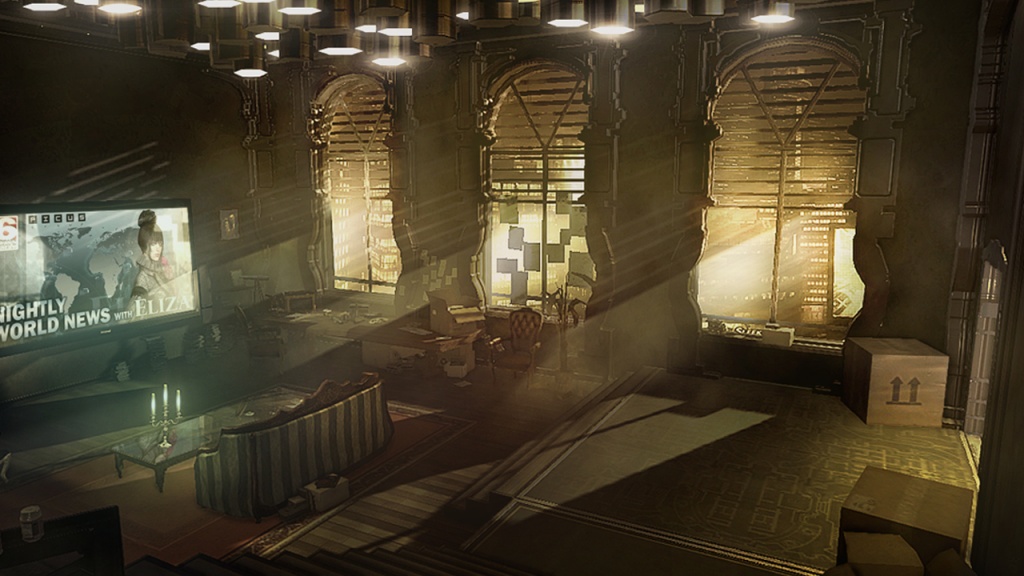
Every environment in Deus Ex: Human Revolution is fascinating and downright beautiful. I would trust its art director Jonathan Jacques-Belletête to design my house, my car, my furniture and my entire wardrobe. The polygonal pattern (or “triangular awesome sauce” as Jacques-Belletête always refers to it on his Tumblr) that lies at the core of the creative design is present in every facet of the game. The title screen shows polygons falling to create an image. In the game, desk cabinet drawers are slanted in convex/concave patterns, office building windows mimic the slanted polygons and, hell, even passers-by on the streets have hardened, polygonal patterns on their slacks. At this rate, I wouldn’t be surprised if the composer, Michael McCann, wrote the musical notes in little triangles on the sheet music. Human Revolution, hands down, has the most cohesive and well-realized game world I’ve ever stepped into. And I was never not glad to be in the universe Eidos Montréal had set up. I respect that it has its very own stylized thing going on among a plethora of games that strive for nothing more than brown, near-photorealistic graphics. In the art book that came with the Augmented Edition of the game, Jacques-Belletête wrote, “Art direction in videogame [sic] shouldn’t only be making things look pretty, it should also be about communicating ideas.” I couldn’t agree more.
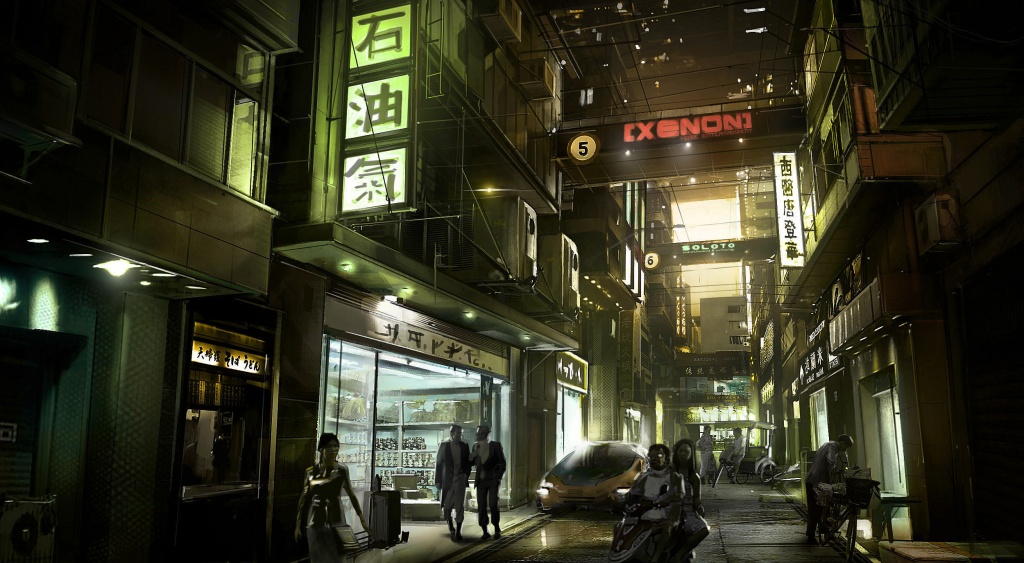
When the opening credits start up, one of the first names you see is Art Director Jacques-Belletête’s, and it’s easy to see why. If he dreamt up every scrap of what exists in Human Revolution‘s world, he deserves some kind of lifetime achievement award. You can tell that he pays attention to more than just video games. He’s cognizant of art, design and fashion, among other things. He’s just the kind of well-cultured-hipster powerhouse that can breathe such beautiful design into the visually stagnant video game industry. Not only is the universe beautifully realized and completely visually cohesive, it’s actually lived in. It’s hard to find environments in open-world sections of games that resound with people really living in them, beyond simply walking around.
If you take a look in anyone’s office or bedroom in a building, there’s stuff everywhere. Stuff. Their Stuff. There are paper stacks, sticky notes on desks and walls, coffee cups, pens, parcels from mail carriers and more. People live and work in the settings in Human Revolution, and it’s so filled out. If you hack someone’s computer you might find a hilarious email that contains more character than some game protagonists after you spend hours with them. Eidos Montréal have created a world here that oozes with life. And although it’s a world set in the future on a different timeline than the one we’re living in, it’s still tied to the past. Like I mentioned, there are sticky notes all over people’s desks and real books next to eBooks. It’s nice to see that Eidos Montréal crafted a universe that isn’t completely independent from where it evolved.
The relationships among characters is also key, even if they’re not always full and deep. I got great pleasure out of the squabbles between Jensen and his techie sidekick Frank Pritchard. Anytime Jensen got uptight with Pritchard and pronounced his full name “Fran-cis” like a mother warning a child, I giggled. The voice cast isn’t all spot-on, but the main characters, especially Stephen Shellen, who voices David Sarif, deserve recognition.
Another relationship that I constantly found interesting was the one between Jensen and Megan Reed, a prominent researcher at Sarif Industries, who Jensen is assigned to protect early in the game. It’s obvious they had a past, but everyone sort of dances around the issue when they discuss her with Jensen. Pritchard seems to be the only one ballsy enough to call her Jensen’s ex-girlfriend, but I can’t help but wonder if it were more than that. The fact that their previous relationship isn’t dragged out onto the table in its entirety might annoy (or relieve) some players, but I found it intriguing that most NPCs sort of gloss over the details. Not everyone knows what happened between Jensen and Reed in the past and not everyone wants to talk about it. They usually respect Jensen’s privacy (or are ignorant of his past) when she comes up in conversation. However, if she does, it’s easy for Jensen to get heated about it, which says something about the way he feels about her.

After I finished Human Revolution, I thought back to how many groundbreaking moments the game had. This was something I regularly anticipated while playing, because I felt like I was always waiting for them to happen. Human Revolution did have some moments that had me covering my mouth and saying, “Oh no, I cannot believe this is happening!” but it never had that explosive, balls-to-the-wall, action-packed instance I craved as a gamer.
Human Revolution succeeds at being the perfect slow-boil game. Certain moments get intense, but the climax isn’t necessarily about kicking ass and blowing shit up. It’s the kind of game that, like a great movie or book, makes you think about it long after you’re finished. Although the game is largely about the conflict between people who have chosen to augment their bodies with machinery and the human purists – it feels real. This is something I could see happening in the future.
And even though I was never blown away by a large-scale, climactic battle, I never felt inferior in the robotic legs of Adam Jensen. As Arthur Gies mentioned in his IGN review, no matter how I was playing the game, I always felt badass.
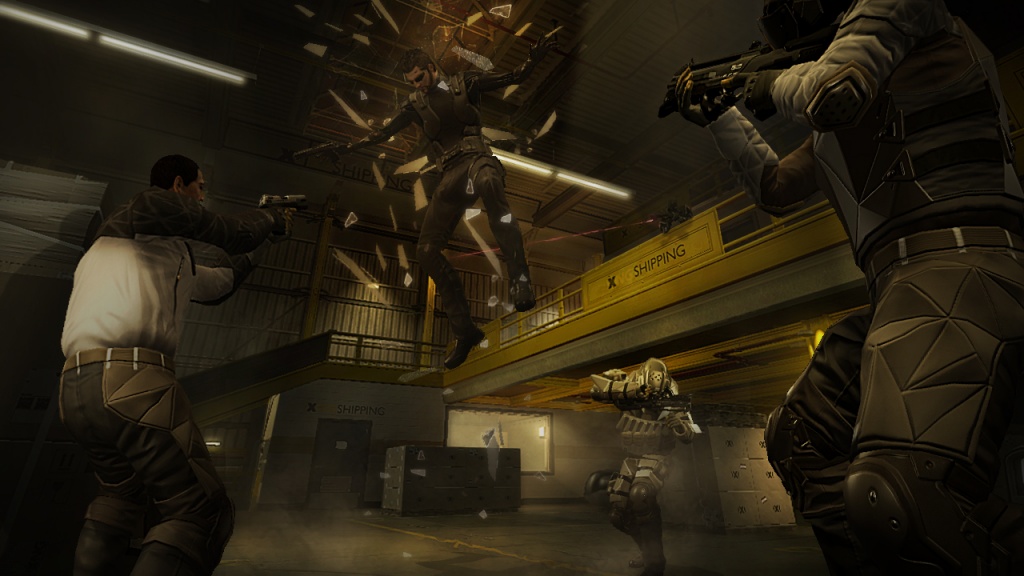
I found myself more satisfied by the design elements in the universe, rather than by action. I’d walk into an office lobby, see a walkway lined with beautiful, red polygonal sculptures and be in awe. Lighting fixtures and characters’ outfits would take my breath away. Human Revolution is far from the most technically beautiful game out there, but it’s art direction is the most visually inspiring of any game I’ve played. Walking into a room and being entranced by how a desk, lighting fixture or someone’s bulletproof vest is designed will take me a lot further than one climactic gun battle could ever dream to.
Photos from Deusex.com