Home
Home

Editor's note: Rob takes a look at how games' health systems have changed the last few years and whether or not this is making games too easy. It's a very interesting debate and Rob does a great job presenting both sides of the issue. - Aaron
 Made popular by Bungie in Halo: Combat Evolved, the health regeneration mechanic has forever changed first-person shooters. Think of other recent, popular FPS -- Call of Duty 4: Modern Warfare or Killzone 2 -- and one mechanic they all have in common is a health-regen system in place of the traditional health pack system.
Some argue that the health-regen system is liberating -- that it frees the player to take more tactical risks when engaging enemies. Health-regen does so by allowing players to easily recover from any mistakes.
Others argue that health-regen makes the game less challenging if the player knows that a full health bar is just a few seconds behind cover. They argue that with intelligent level-design and health pack placement, developers can craft a truly challenging experience that requires resource management as well as player skill.
Some players get bogged down in the debate over which mechanic is superior and I think that this creates a false dichotomy between the two health systems. Other developers have taken fresh approaches to both systems, which can make for more interesting player choices.
History
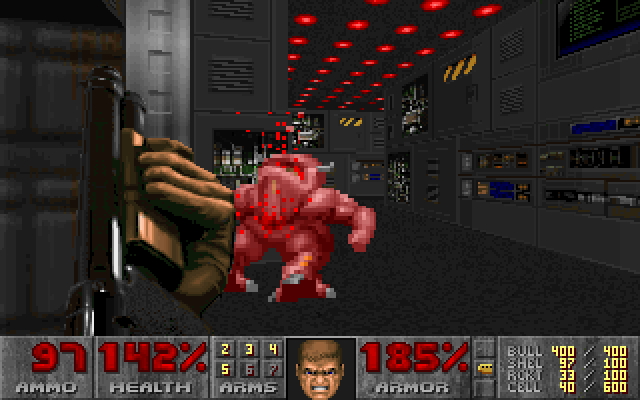
In id Software’s Wolfenstein 3D, and later in Doom, the health pack system was codified. First-person shooters were games which used a number health system that could be replenished by finding health packs scattered across the map. Pretty much every FPS of the time used this system.
Although it wasn't the first game to feature regenerating health, Halo is widely credited as the game that introduced the regenerating shield to the masses. In addition to a traditional health bar, the player also had an energy shield to absorb damage. If depleted, the player’s health bar would be negatively affected, but the energy shield would eventually regenerate if untouched for a period of time. Health was still restored using health packs.
By Halo 2, the system had changed to full health and shield-regen, though Halo: ODST reintroduced health packs for health bar restoration.
In PC FPS, health-regen hadn’t really caught on, but health packs evolved into health stations. Released around the same time, both Doom 3 and Half-life 2 made use of fixed health stations. Each station would hold 100 health points that could be distributed to the player on a point-by-point basis. This meant that if the player only needed 21 health points to get back to full health, the health station would retain the other 79 points for later use.
While these health systems are the two most easily categorized, there are other health systems which are rarely discussed in these debates.
Resistance presented a pure hybrid of health-regen and health packs. In the first section of the game the player uses the traditional health pack system; however, after certain narrative events unfold, the player is given access to health-regen.
This health-regen only works in quarters, though, which means that health-regen will only take the player to the nearest quarter of health. For example, if the player’s health is reduced to 51 percent, then health-regen will only take the total health to 75 percent.
In order to have full health again, the player must find a health pack for each quarter lost. This means that if the player’s health is down to 25 percent, the player needs to find three health packs to be back at full strength.
I feel that this system offers the best of both worlds. The challenge of a health pack system is retained by preserving, to a degree, the risk of permanent health loss; however, there’s enough leeway to give players the opportunity to recover from minor, but not grave, mistakes.
F.E.A.R. 2 also presents a sort of hybrid, but one that leans more towards the health pack system. Like Resistance, F.E.A.R. 2 has minor health-regen in place of full health-regen. But instead of giving players instant health restoration when picking up health packs, they're added to the inventory for player-controlled use.
The game makes use of medkits that fully restore the player’s health when used. Only three such medkits can be held at any time. This gives the player a strategic decision to make regarding the optimal time to use medkits and when to save them.
The developer justifies the health system as a means to preserve the tension between combat engagements. When the player is left with little health, part of the enjoyment comes from the nerve-wracking experience of not knowing if she’ll find a medkit or an enemy first.
Conclusion
I feel that the move towards health-regen -- in first-person shooters and some third-person shooters like Gears of War and Uncharted -- may be to the detriment of overall level challenge. I don’t mean to say that the Halo or Call of Duty games are cakewalks, but that the challenge is reduced to the specific battle a player is currently engaged in, instead of the level as a whole.
Health pack systems present a more challenging level experience because of the extra resource management required from players. But these systems can fall into their own trappings of telegraphing more challenging engagements by stockpiling health resources near an upcoming battle.
I also recognize the value in encouraging players to be more adventurous in their tactics by mitigating the risk of permanent health loss. Despite this, I believe that some games can be a little too forgiving.
Both Resistance and F.E.A.R.2 offer alternatives to these two health systems that retain the challenge and tension of health pack systems while also leaving enough room to forgive players for minor mistakes.
F.E.A.R. 2 takes things a step further by putting the strategic choice of health replenishment in players’ hands no matter where they are located. By allowing players to take health packs with them, players do not have to waste time backtracking.
I’d like to see more games take this approach of balancing strategic player choice while leaving some room to be tactically risky.