

Editor's note: I've been so obsessed with Borderlands lately that I haven't fired up Torchlight yet. That may have to change.... -Demian
The fun of collecting bigger and better items is self-evident to most gamers. Two recent releases, Torchlight and Borderlands, don't just tap into that primal lust for the next upgrade -- they turn it into a core part of the gameplay.
Finding new loot is like a mini-reward for adventuring. As players progress further into a game and as quests become often tedious or monotonous, the chance of obtaining better loot can sometimes be the only driving force behind player progression. Loot’s allure is that powerful.
While collecting and using loot is most of the fun, the cosmetic effects of new loot are also significant -- nothing brings a feeling of satisfaction like shedding that wimpy leather armor for a badass suit of plate mail.
With this in mind, how do Torchlight and Borderlands handle loot, and which will better satisfy the rabid loot-mongers among us? You know who I am...I mean, you know who you are.
Both games convey the fun and addiction of loot in their own ways. A sensation of fear and dread of the unknown drives the hunt for loot in Torchlight, as the player travels down further into the dungeons below town, he’s moving farther away from safety. The risk is greater, as are the rewards.
Borderlands takes a different approach, since the player is never too far from a safe area. The joy of loot hunting in this game comes from collecting new and powerful weapons, and the enticing on-screen mayhem that ensues with their use.
The amount of items a character can equip is another important aspect of the loot experience. The more stuff that a player can put on a character, the more enjoyable loot hunting can be, simply because there’s more cool stuff to find.
Torchlight really shines in this area, as it gives players six different armor slots, up to four different weapons at any given time, and three ring/necklace slots for bonus effects. Borderlands also gives players the ability to equip up to four guns at once, along with a shield, a grenade mod, and character class mods.
Both games share a number of other loot staples -- randomization, the color system popularized by Blizzard’s World of Warcraft, and a player inventory. While the games also share the joy of continuously finding new gear to better smash to bits one’s enemies, Torchlight developer Runic just makes it easier to manage the copious loot players will find.
I’m not at all surprised that Torchlight’s loot system is solid -- Runic Games is headed by three developers with more than a decade’s worth of action-RPG experience. Max and Erich Schaefer co-founded Blizzard North, the studio responsible for the Diablo series, and Travis Baldree designed the action-RPG Fate.
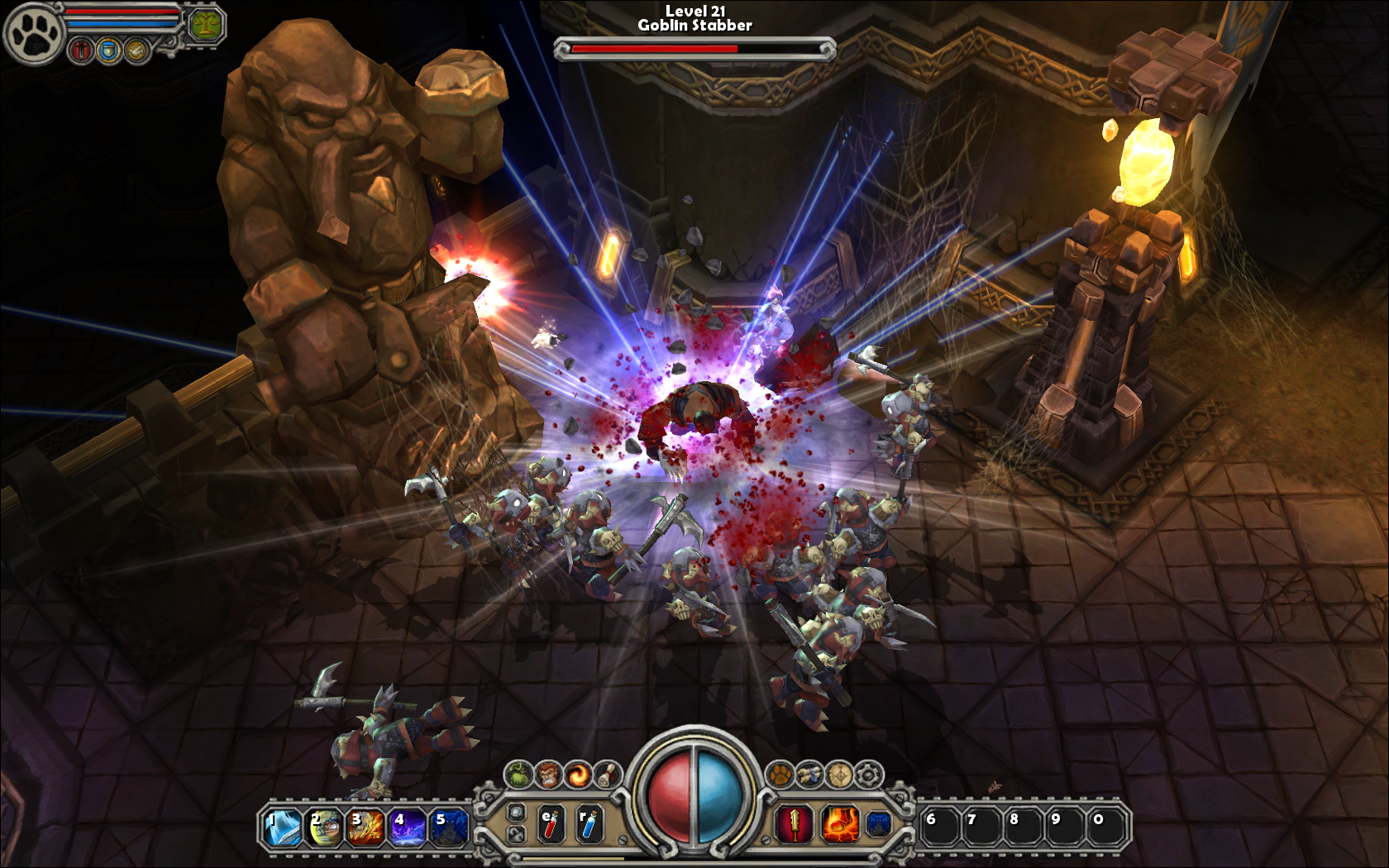
Many of the innovations from Diablo and Fate are evident in Torchlight. From Fate, Runic has incorporated the pet, which acts as a second inventory and means that players will be able to horde more loot. In addition, the pet can travel to town to sell unwanted loot as players continue deeper into the dungeons below Torchlight.
The streamlining nature of this mechanic cannot be overstated -- freeing the player from continuously returning to town to sell extraneous loot is a huge time saver.
From Diablo comes a number of core mechanics that make loot management easier. Torchlight provides the player with a stash, which is where players can hold loot that they may not be able to use yet or loot that they want to keep for strategic reasons.
Going one step further, Torchlight provides a shared stash. This allows players to share loot with new characters! That rare Crested Axe of the Savage found in the depths of the mines can be used in a new game by placing the weapon in the shared stash.
Torchlight also encourages players to equip sets -- two or more items of the same set yield extra bonuses. Needless to say, players are unlikely to find two or more parts of one set all at once. Having a stash to store parts to a set makes collecting them much easier.
Again from Diablo, Torchlight also has a greater element of discovery than Borderlands, since some items in the game are unidentified. Finding unidentified items (or gambling for items from the merchant who sells them unidentified) adds to their mystery.
Finally, Torchlight keeps loot competitive throughout the game by offering players a number of upgrade options. Some items allow for gem socketing for additional bonuses, and low-level gems can be combined to produce high-level item enhancements.
One thing I really enjoy about the socketing and gem system is that players have the option to either recover the gems from an item by destroying that item, or freeing the item’s sockets by destroying the installed gems.
Either option is a trade-off, but I like that gem placement is no longer a permanent decision. This allows players to upgrade placed gems with more powerful versions, or to recover powerful gems from items no longer deserving of their bonuses.
But sockets and gems aren’t the only way players can keep loot fresh -- Torchlight also allows players to enchant items as many times as they have the gold to cover the cost.
Adding enchantments (which includes adding sockets!) to a beloved weapon can keep it viable for much longer than usual, but at the risk of spending mountains of gold with no payoff. All enchantments are randomly applied and there’s a chance of rolling no enchantment at all!
Admittedly, Torchlight’s loot system is a tough act to follow, but Borderlands does add an interesting twist to looting -- the ability to grind for loot.
Areas in Borderlands will respawn; not just enemies but also lockers, gun chests, and safes (i.e., treasure chests). This game mechanic means that players can return to previously explored areas to roll for more, and hopefully better, loot. For many players, engaging in this activity can make Borderlands a continuously fun and rewarding loot experience.
While Borderlands does retain the joy of collecting loot, players will have difficulty holding onto all those amazingly destructive weapons.
Probably the biggest oversight in Borderlands is the lack of a stash -- all loot must be kept in the player’s inventory. Player inventory is incredibly small compared to the millions of guns in the game. And if you want to pass a great item down to one of your lower level characters, you'll have to find a friendly (and trustworthy) human intermediary to hold the item while you swap to your lowbie.
To be fair, players can increase their inventory limit by rescuing clap trap robots during missions. But with no way to know when a mission will throw one of these robots into the mix, players have to make a lot of tough decisions about which items to keep.
Players will drop a lot of guns, and that’s not the way of a true loot whore. We need to get the most of these unwanted items, which means that we’ll be making a lot of back-and-forth runs to a vending machine to sell them.
Gearbox could have taken a page from Metal Gear Solid 4, which allowed players to sell/purchase weapons from any location in the game via the Mk. II & III, mall robots which moved items for Solid Snake. Couldn’t Gearbox have used a similar solution for Borderlands? It's already got robots, after all, and running back-and-forth to sell unwanted loot is no fun.
Finally, consumable items like healing kits don't stack in the inventory. With such limited space in Borderlands, there’s really no reason to ever carry these items. No stacking means consumables are completely worthless, except in situations where they’re used immediately after they drop.
Overall, both games provide an addicting drip feed for the loot-obsessed, but Borderlands is hindered by some serious management issues. Torchlight makes storing and collecting loot so much easier that I’m rarely forced to dispose of any great items.
Borderlands regularly forced me to make tough calls -- do I want to keep the Burning Sniper Rifle with high chance to trigger fire effects, or should I keep that other sniper rifle which does more damage but doesn't light dudes on fire? These are the sorts of things gamers can lose sleep over.
If I had to recommend one game over the other for players with a nasty loot itch to scratch -- Torchlight, hands down.