Home
Home

Editor's note: Wondering why Rob hasn't written much in recent weeks? No, he hasn't become a professional Demon's Souls player. He and his wife welcomed the arrival of their first child (mazel tov, Rob!) -- and he also learned something important about game design. -Jason
They say that the birth of a child is a life-changing event, but they're only partially right. Many things have changed for me -- such as a new appreciation for the sleep deprived -- but at least one thing has stayed the same. I still try to sneak in a little time with video games most days.
My son is just over a week old now, and between changing poopy diapers (it's actually not as bad as you imagine) and feeling a warm jet of piss soak through my T-shirt as I change that poopy diaper, I’ve got my hands full. Video games offer one way for me to relieve some of the day-to-day stress of childcare.
In the past week, I’ve played a handful of games -- Demon’s Souls (are you surprised?), Borderlands, Torchlight, and a little Civilization 4: Beyond the Sword. Now with a child under my care, I’ve come to realize one aspect of game design that’s damn important.
My son needs my attention at the drop of a hat, so I’m basically on call all day, every day. This means that any game I play needs to allow me to pause and save at any time.
From what I’ve been playing recently, Civilization 4 is the clear model. Being able to save anywhere, any time -- in addition to Civ 4 being a turn-based game -- just makes this a really easy game to play while caring for a newborn.
Torchlight isn't much different; this Diablo clone uses a save-and-quit system, which allows players to stop playing at any time and save all progress. Additionally, players can pause the game at any time. I haven’t had any problems here.
Demon’s Souls, which also uses a save-and-quit system, has forced me to play handicapped. When connected online to other players, either through blue soul summons or red phantom invasions, the game doesn't allow you to save and quit.
I can easily choose not to play the game co-op with blue phantoms, but red phantom invasions are completely out of my control when in bodily form. This means that I’m forced to play the game in soul form with reduced total health. It's not too bad, though; I can still stop playing at a moment’s notice without losing any progress.
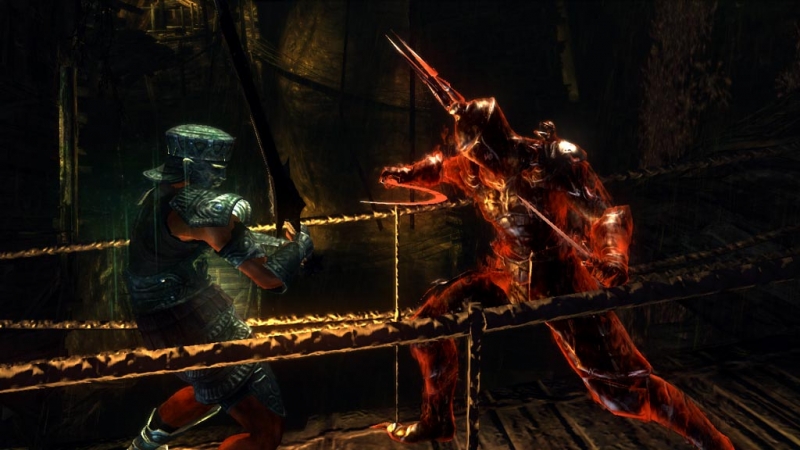
I'm sorry -- we just can't play together anymore.
Borderlands, on the other hand, makes use of a rather strange save system. Saves are completely out of the player’s hands; the game handles them. It’s a sort of checkpoint system based on what I’ll call “save nodes” scattered throughout the game.
You can save and quit at any time, but you’ll be sent back to the most recent save node. In practice, this means that you may have to redo an entire area.
At least Borderlands allows players to pause at any time, but I’d rather not leave the game paused for too long. For reasons unknown to me, Borderlands really taxes my dual 8800 GT video cards in SLI. I’ve already had the game overheat my cards and cause Windows to crash. No other game I own does this -- not even other graphically intense titles like Gears of War, BioShock, or Dawn of War 2.
While these games mesh pretty well with caring for a newborn, I’m a little worried about some future titles that I’ve been looking forward to playing.
Both God of War games use a location-based save system. Will God of War 3 also make use of such a system, or will Santa Monica Studios finally join us in the 21st century? I suppose I’ll be able to pause any time, though.
What about Final Fantasy 13? All 12 previous Final Fantasy games used the same location-based save system. I get the feeling that Final Fantasy 13 shall be parked in my backlog of unplayed games for quite a while.
Other games I’ll likely have to pass on for the time being are multiplayer-focused titles, like Zipper Interactive’s ambitious MAG and Valve’s Left 4 Dead 2.
But that’s OK by me. When not booting up a game to take the edge off, I’ve got the little man of the house putting a smile on my face.